
Gender and Inclusive Justice Case: Premilal Chaudhary vs. Office of Prime Minister, Council of Minister, NKP 2080 B.S, No. 7, DN: 11125
Case: Ceriorari
Plaintiff: Premilal Chaudhary
Defendant: Office of Prime Minister, Council of Minister
Decision Number: 11125
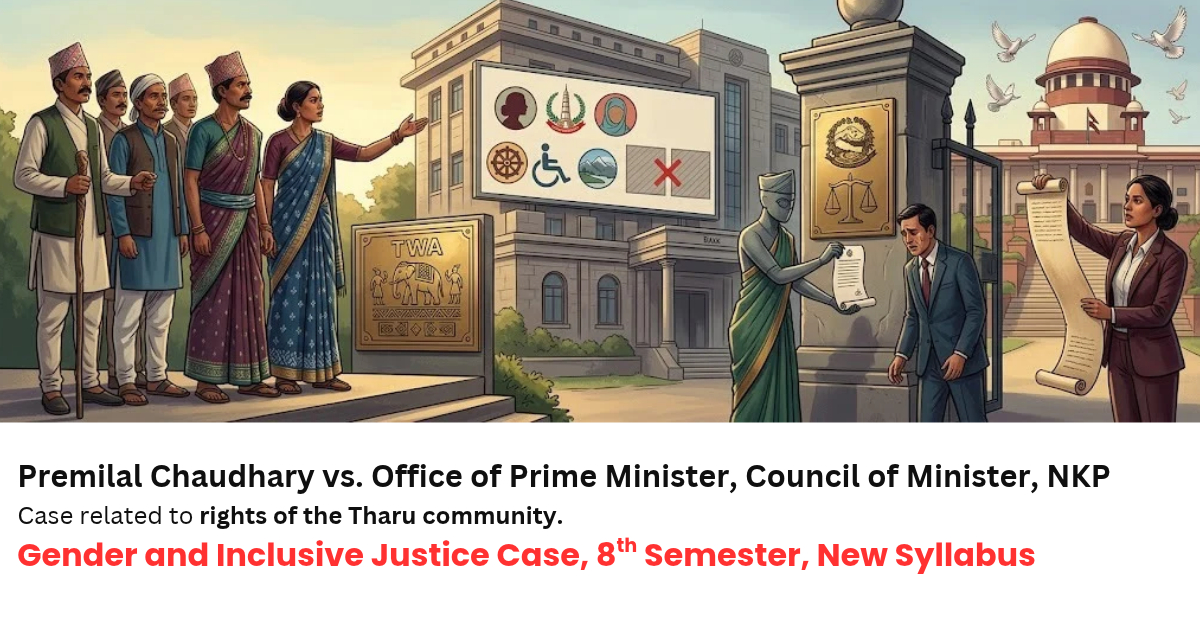
This case relates to reservation in employment, the rights of the Tharu community, and the State’s duty to implement proportional inclusion under the Constitution.
Facts of the Case:
The petitioners were members and representatives of the Tharu community. One of the petitioners was authorised by the Tharu Welfare Association, an organisation working for the rights and interests of the Tharu community.
The Constitution recognises the right of socially and economically backward groups, including the Tharu community, to participate in state bodies on the basis of proportional inclusion. The Constitution also requires laws to be made for the implementation of fundamental rights.
On 14 November 2021, Rastriya Banijya Bank published vacancy notices for several posts. The notices created inclusive categories for women, Indigenous Nationalities, Madhesi, Dalit, persons with disabilities and the backward region. They did not create a separate Tharu category.
The petitioners approached the Tharu Commission. The Commission decided that the concerned authorities should issue a new advertisement including a Tharu category. The vacancy process was not cancelled, and the petitioners then filed a writ petition before the Supreme Court.
Petitioners’ Claim:
The petitioners said that the bank’s vacancy notices ignored the Tharu community’s constitutional right to proportional inclusion and employment. They asked the Court to cancel the notices and order a fresh advertisement with a separate Tharu reservation category. They also asked the Court to ensure the implementation of an earlier Supreme Court order concerning Tharu reservation.
Government and Bank’s Argument:
The Government argued that Tharu people were already included under the Indigenous Nationalities category. It said that the exact percentage and method of reservation had to be fixed by legislation and could not be created only on the basis of population figures.
The bank argued that its employee regulations already provided inclusive categories. It said that Tharu applicants could compete under the Indigenous Nationalities category. It also argued that cancelling the advertisements would interfere with the bank’s recruitment process.
Legal Issues:
- Whether the Tharu community is entitled to a separate reservation category under the Constitution?
- Whether reservation can be fixed only on the basis of the population of a community?
- Whether the Government had failed to make laws necessary to implement the constitutional right to proportional inclusion?
- Whether the bank’s vacancy notices should be cancelled for not creating a separate Tharu category?
Decisions of the court:
Supreme Court:
The Supreme Court held that the Tharu community is recognised as a separate group under the Constitution. It also held that the State had delayed the implementation of the constitutional right to proportional inclusion for too long.
However, the Court did not order an immediate fixed percentage of reservation for the Tharu community. It held that the exact groups, percentages, eligibility requirements and method of measuring backwardness must be decided through legislation and service regulations.
The Court directed the Government to make the necessary laws and arrangements within nine months. The Court said that reservation must consider real social, cultural and economic backwardness, not population figures alone. The system should also include monitoring, review and safeguards to prevent benefits from being taken by people who no longer need them.
The Court refused to cancel the existing bank advertisements. It held that the petitioners had not personally applied for the advertised posts and that some recruitment processes had already been completed. Cancelling the advertisements would also affect the administration of the bank.
However, the Court ordered the Government and concerned institutions to compensate for the posts lost by eligible reserved groups because reservation had not been implemented. Once the new legal system was created, the missed opportunities, including those from the financial year 2079/80, had to be included in future recruitment.
The writ petition was therefore partly allowed. There was no criminal punishment because this was a constitutional and public interest case.
Principle Established:
- Reservation cannot be based only on the population of a caste or community.
- Real social, cultural and economic backwardness must also be considered.
- The exact percentage and eligibility rules for reservation must be fixed by law.
- The Tharu community is a constitutionally recognised group and cannot automatically be treated only as part of another category.
- Reservation laws should include clear goals, time limits, monitoring and periodic review.
- The State cannot indefinitely delay the implementation of a constitutional right.