

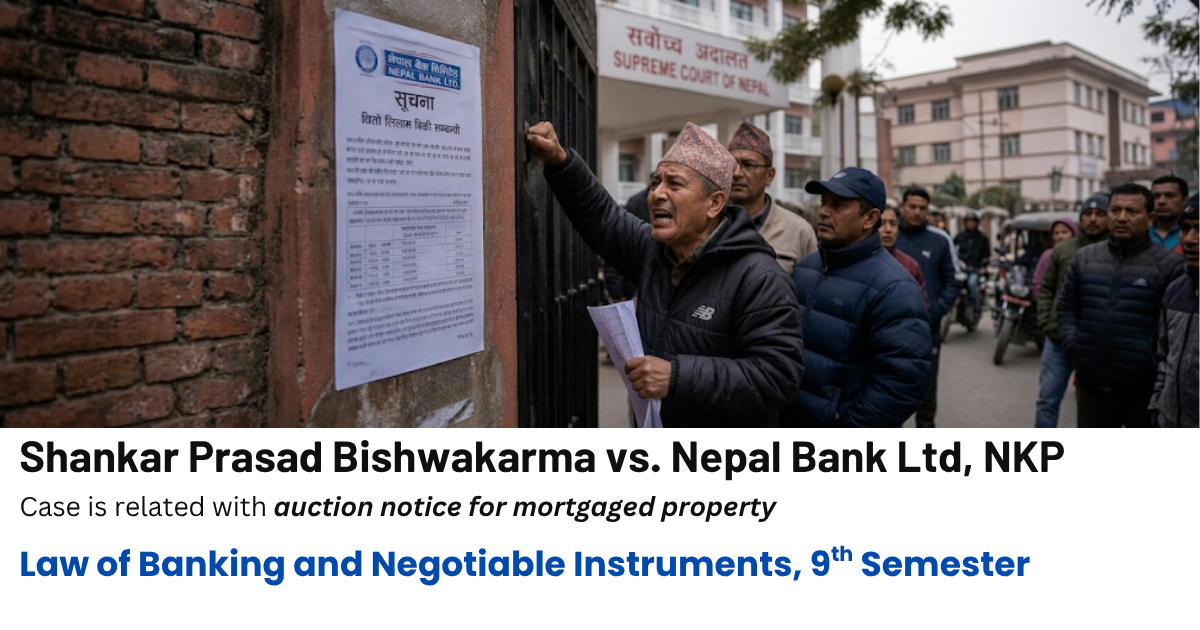
Banking Law Case: Shankar Prasad Bishwakarma vs. Nepal Bank Ltd., NKP (2060 ), No.1/2, P.118., DN: 7177
Case: Appeal against Denial of Injunction-cum-Mandamus (Banking/Loan Recovery Dispute)
Plaintiff/Applicant: Shankar Prasad Bishwakarma
Defendant/Respondent: Nepal Bank Limited, Siddharthanagar Branch, Bhairahawa, and others
Decision Number: 7177
This case concerns whether a bank could publish an auction notice for mortgaged property when the borrower had defaulted on repayment, and whether the borrower had a right to the same interest waiver given to other borrowers.
Facts of the Case:
Shankar Prasad Bishwakarma ran a small business called Shankar Kastha Udhyog (a wood/timber enterprise) in Ward No. 6, Siddharthanagar Municipality, Rupandehi. To run this business, he took a loan of NPR 50,000 from Nepal Bank Limited, Siddharthanagar Branch, on 2042/11/13. As security, he mortgaged his land (measuring 0-0-6 dhur, under Receipt No. 1365 of the Rupandehi Land Revenue Office) and the house built on it. Under the loan agreement, he was supposed to repay the full principal and interest by 2045/11/17, but he did not pay on time. His business later fell sick and shut down.
Over time, he managed to pay back only NPR 12,728 in small installments. When he could not pay the rest, the bank published a public notice in Gorkhapatra on 2056/10/9, announcing that his mortgaged house and land would be auctioned to recover the loan.
Bishwakarma objected to this notice on several grounds. He said his property was worth about NPR 700,000 (seven lakh), but the bank published the auction notice without even getting the property properly valued. He also said the notice did not mention exactly how much money he still owed. He pointed out that other borrowers in a similar situation had been given a 90% waiver on interest, and he asked for the same treatment, offering to pay the remaining principal and interest if the bank would waive 90% of the interest, just like it had done for others. When the bank refused, he filed a petition asking for an injunction (with an interim order) to stop the auction, and for mandamus directing the bank to accept his offered payment and release the mortgage.
The Appellate Court, Butwal, in its decision dated 2057/4/32, held that there was no dispute that Bishwakarma had taken the loan and still owed money on it, and that his claim to have the same interest waiver as another borrower was not supported by facts. It dismissed his petition. Bishwakarma then filed this appeal on 2058/6/10, arguing that the Appellate Court’s decision should be overturned.
Legal Issues:
- Where a bank issues an auction notice after the default period has expired, is that notice invalid because Section 47(a)(1) of the Commercial Bank Act, 2031 requires the borrower to be notified by public notice?
- Whether a borrower has an enforceable right to demand the same interest waiver granted to another borrower.
- Whether the Appellate Court, Butwal’s decision dismissing the petition should be upheld.
Different Courts’ Decision:
High Court or Appellate Court:
The Appellate Court, Butwal (2057/4/32) found no dispute that the petitioner had failed to repay the loan and no factual basis for the claimed interest waiver; the petition was dismissed.
Supreme Court:
Supreme Court (Joint Bench of Justice Bhairab Prasad Lamsal and Justice Chandra Prasad Parajuli) upheld the Appellate Court’s decision and dismissed the appeal. The Court noted there was no dispute that Bishwakarma had taken the NPR 50,000 loan on 2042/11/13, mortgaging his land and house, and that he was supposed to repay the principal and interest by 2045/11/17, but had not done so. The Court held that once a borrower fails to pay back the loan (principal and interest) within the agreed time, it is not unlawful for the bank to publish a public auction notice under Section 47(a)(1) of the Commercial Bank Act, 2031, to sell the mortgaged property and recover its money.
On the question of the interest waiver, the Court explained that a bank is a commercial (business) institution, and any waiver or reduction of interest can happen only through mutual agreement between the borrower and the bank, it is not something a borrower can claim as a matter of right. Since Bishwakarma could not show that he had any such right, his argument on this point failed.
The Court concluded that Bishwakarma could not be freed from his duty to repay the loan he had taken, and that any interest waiver could only come about through agreement between him and the bank. Since he had not paid back the principal and interest, the bank’s act of publishing the auction notice while following its normal loan-recovery process, did not violate his rights. The Appellate Court, Butwal’s decision was found to be correct and was upheld. The appeal did not succeed.
Principle Established:
- Under Section 47(a)(1) of the Commercial Bank Act, 2031, a bank’s public auction notice after default within the agreed period is a lawful exercise of its loan recovery process.
- A borrower does not have an automatic right to demand the same interest waiver granted to another borrower; such waivers arise only from mutual agreement, not as a legal entitlement.
- Where the borrower has not cleared the outstanding loan, the bank’s lawful auction notice does not infringe the borrower’s rights.
Relevancy of the Case:
This case reaffirms banks’ statutory authority to auction mortgaged property upon default and clarifies that interest waivers are discretionary commercial arrangements rather than enforceable rights.