

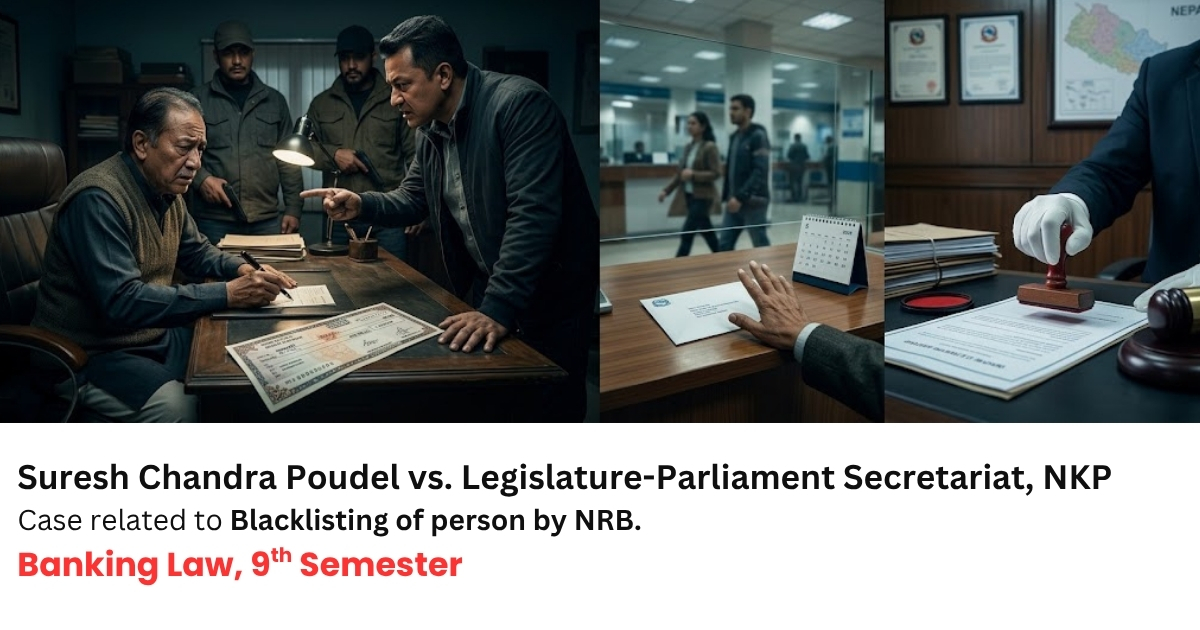
Banking Law Case: Suresh Chandra Poudel vs. Legislature-Parliament Secretariat, NKP (2068), No.6, P.893.
Case: Blacklisting for checque dishonour
Petitioner/Applicant: Suresh Chandra Malla
Defendant/Respondent: Legislature-Parliament Secretariat
Decision Number: 8627
This case concerns whether Nepal Rastra Bank can blacklist a person for issuing a bounced or stopped-payment cheque when other laws already provide remedies for the same conduct.
Facts of the Case:
Suresh Chandra Poudel issued a NPR 17,92,500 cheque to Ravin Shrestha for a share-purchase deal involving Udyam Bikas Bank Limited. Poudel later claimed that Shrestha and several armed men had forced him to issue the cheque.
Poudel then instructed Nepal Investment Bank to stop payment on the cheque. The bank stopped the payment before the cheque was presented.
Shrestha later asked the bank to blacklist Poudel. After consulting Nepal Rastra Bank, the bank proceeded with the blacklisting through the Credit Information Centre.
Poudel argued that blacklisting was unlawful. He claimed that Nepal Rastra Bank had no clear legal authority to blacklist someone merely because payment on a cheque had been stopped. He also argued that existing laws already provided penalties for cheque dishonour.
Most importantly, the cheque was not dishonoured due to insufficient funds. Its payment had been stopped on Poudel’s own instruction. He therefore claimed that blacklisting him violated his constitutional rights.
Legal Issues:
1. Did Nepal Rastra Bank have legal authority to blacklist people over bounced or stopped-payment cheques?
2. Was the blacklisting rule valid under Section 79 of the Nepal Rastra Bank Act, 2058?
3. Did blacklisting Poudel violate his constitutional rights?
4. Should the challenged blacklisting rule be cancelled?
Different Court’s Decision:
Supreme Court’s Decision:
The Supreme Court dismissed the writ petition and upheld Nepal Rastra Bank’s blacklisting directive.
The Court held that Nepal Rastra Bank has broad regulatory powers under Section 79 of the Nepal Rastra Bank Act, 2058. This includes issuing directives to maintain a safe, reliable, and trustworthy banking system. The blacklisting rule was therefore within its legal authority.
The Court emphasized that stopping payment on an issued cheque can undermine public trust in the banking system. Once a person issues a cheque, stopping its payment without proper justification can affect confidence in cheque-based transactions.
In Poudel’s case, the bank had given him additional time to settle the dispute before blacklisting him. The dispute remained unresolved, and Poudel did not deny issuing the cheque.
The Court therefore found that the blacklisting was lawful and did not violate Poudel’s constitutional rights. The writ petition was dismissed.
Principle Established:
1. Issuing a cheque creates an obligation to make payment. Unjustified stop-payment orders can undermine public trust in the banking system.
2. Nepal Rastra Bank may issue reasonable rules and directives to maintain a safe, reliable, and accountable banking system.
3. Under Section 79 of the Nepal Rastra Bank Act, 2058, Nepal Rastra Bank has authority to blacklist persons for bounced or stopped-payment cheques.
4. Such blacklisting is lawful even where other laws separately provide penalties for cheque dishonour.
5. Blacklisting is not unconstitutional if the person is given a fair opportunity to resolve the payment dispute before being blacklisted.