
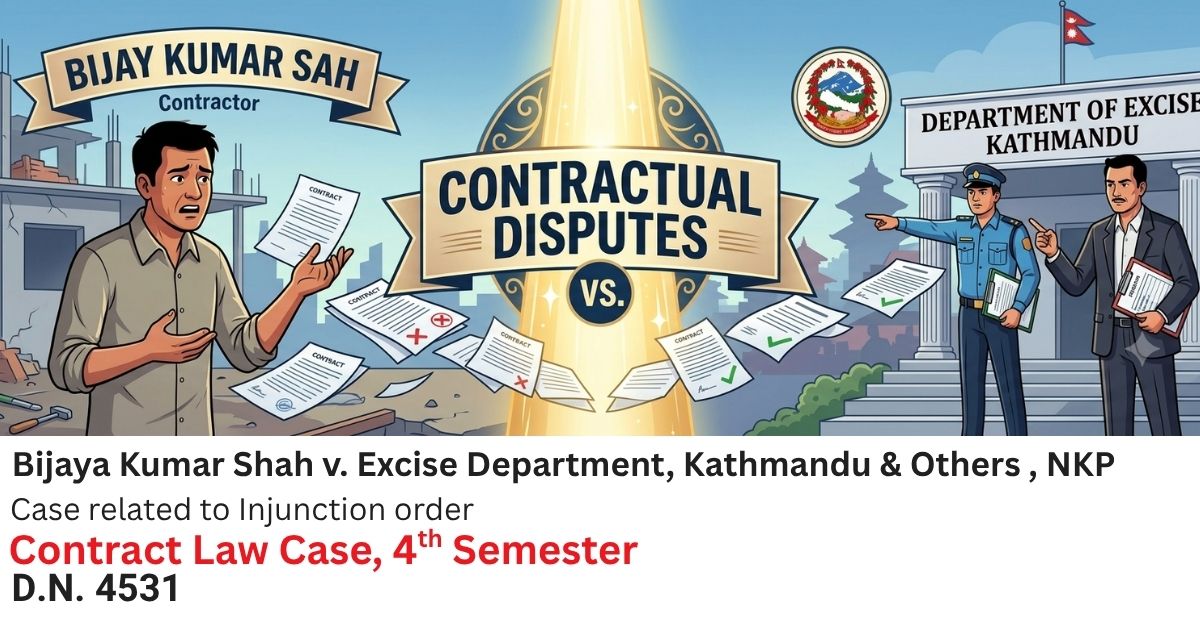
Contract law case: Bijaya Kumar Shah v. Excise Department, Kathmandu & Others, NKP 2049, Issue 5, D. No.: 4531.
Case: Injunction relating to enforcement of contractual obligations
Plaintiff: Bijaya Kumar Shah
Defendant: Excise Department (Kathmandu), Excise Office (Chitwan), Ministry of Finance.
Decision No: 4531
This case is related to Injunction relating to enforcement of contractual obligations and recovery of excise-related dues, performance of contract.
Facts of the Case:
The Excise Department invited applications to establish and operate a distillery. Bijaya Kumar Shah agreed to establish the distillery by depositing Rs. 5,56,750/- as security and accepting the condition that he would pay a minimum annual excise duty of Rs. 2,227,000/-. According to the agreement, he had to complete the distillery and begin production within the prescribed time. If he failed to do so, the security deposit would be forfeited. He was also allowed to operate temporarily while paying excise duty in installments. While constructing the distillery, heavy rainfall caused the reservoir to be washed away and the land to collapse. Before the original deadline expired he requested an extension. The Excise Department granted only a two-month extension, but he still could not complete the project. The government later cancelled his license, forfeited his security deposit, and demanded payment of the remaining excise amount. Fearing that his property would be seized to recover the amount, Bijaya Kumar Shah filed a petition seeking an injunction to stop the government from recovering the money.
Plaintiff’s Claim:
He could not complete the distillery because of natural disasters, which made performance impossible. Since no liquor was produced, excise duty should not be charged. The contract had become impossible to perform, so forfeiting his security deposit and recovering additional excise duty was unlawful. The government’s recovery process threatened his property rights protected under the Civil Rights Act, 2012 B.S. Therefore, court should issue an injunction preventing the government from recovering the claimed amount.
Defendant’s Arguments:
Plaintiff voluntarily entered into the contract and accepted all its terms. He failed to establish the distillery within the agreed time. Under the agreement, failure to complete the project resulted in automatic forfeiture of the security deposit. The government lawfully cancelled license and initiated recovery of the remaining excise amount according to contract and applicable laws. Since the authorities were only enforcing the contractual terms, there was no violation of any fundamental or civil right, and therefore an injunction could not be granted.
Legal Issues:
- Can a person avoid contractual obligations because the agreed project could not be completed?
- Can an injunction be issued to stop the government from recovering money that is due under a voluntarily signed contract?
- Does enforcement of contractual liabilities amount to a violation of rights protected under the Civil Rights Act, 2012?
Decisions of Courts:
Bagmati Zonal Court:
Zonal Court held that Excise Department had not properly followed the contractual provision regarding further extension of time and allowed petition and ordered the issuance of an injunction.
Madhyamanchal Regional Court:
Regional Court reversed Bagmati Zonal Court’s decision and held that the government was merely enforcing the contract voluntarily signed by petitioner. Since no protected civil right was threatened, the injunction was refused and the petition was dismissed.
Supreme Court:
Supreme Court dismissed appeal also held that Bijaya Kumar Shah voluntarily entered into the agreement and remained bound by its terms so, the forfeiture of security deposit and recovery of the remaining amount were actions taken under the contract. Such recovery did not violate any right protected by the Civil Rights Act. Therefore, no injunction could be granted and the decision of Madhyamanchal Regional Court was affirmed.
Established Principles:
- A person who voluntarily enters into a contract must perform the contractual obligations within the agreed time.
- A contracting party cannot escape liabilities arising from the agreement simply because performance was not completed.
- Recovery of money due under a valid contract does not violate civil rights protected under the Civil Rights Act.
- An injunction cannot be granted merely to prevent lawful enforcement of contractual obligations.
- Where there is no actual or threatened violation of a protected legal right, the remedy of injunction is not available.