
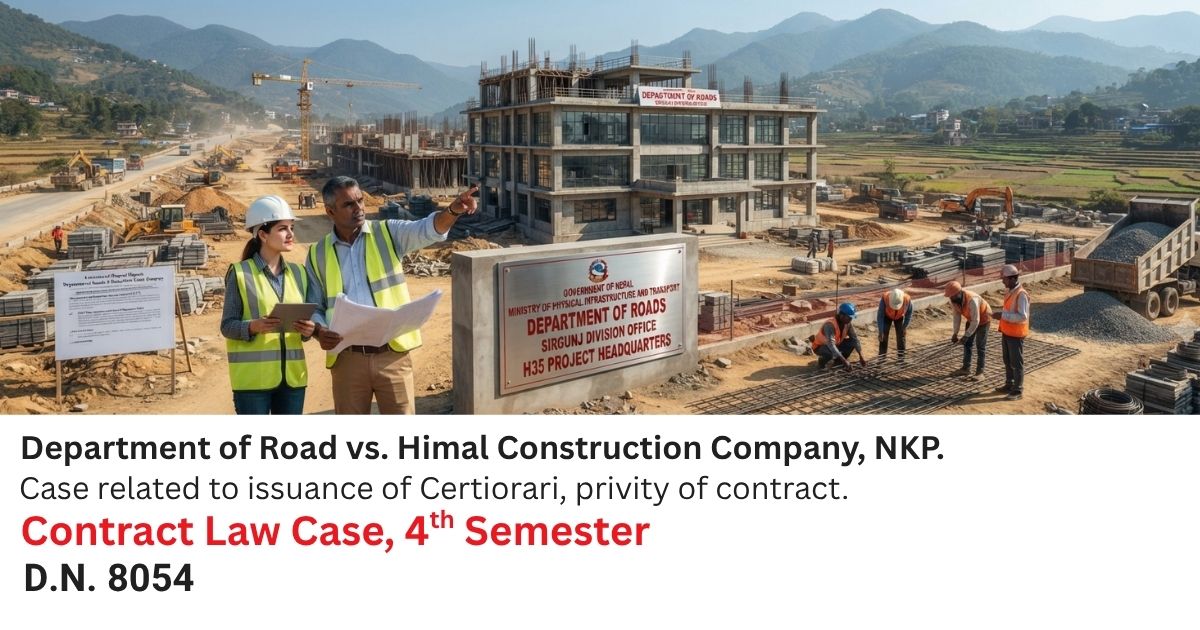
Contract Law Case: Department of Roads vs. Himal Construction Company, NKP 2066, No.1, P.49, NKP 2044, No.8, P.857.
Case: certiorari, privity of contract.
Plaintiff: Department of Roads, under the Ministry of Physical Planning and Works.
Defendant: Patan Appellate Court, Himal Construction Company
Decision Number: 8054
This case is related to writ of certiorari concerning the right of a subcontractor to demand arbitration against the Department of Roads when it was not a party to the original contract.
Facts of the Case:
The Department of Roads entered into separate contracts with Rara Construction Ltd. and Himal Construction company on 26 November 1995 for the Dumre – Besisahar Road Project. Rara Construction was responsible for road construction under contract section DBRP-4, while Himal Construction was responsible for constructing five bridges under section DBRP-5. Both companies engaged The Gorkha Engineers & Services International (P.) Ltd. to carry out construction work under subcontracting arrangements and granted it authority to perform certain contractual activities. Later, the Department of Roads terminated the main contracts after discovering that certain qualification documents submitted by the contractors were fraudulent. The Gorkha Engineers claimed that it had invested money and suffered losses because the construction work was terminated. It therefore sought arbitration to resolve the dispute. The Department of Roads objected, arguing that it had no direct contract with The Gorkha Engineers. The dispute eventually reached the Supreme Court through a writ petition challenging the order of the Patan Appellate Court.
Plaintiff’s Claim:
The Department of Roads argued that it had entered into contracts only with Rara Construction and Himal Construction. Since The Gorkha Engineers was not a party to those original contracts, it had no independent right to demand arbitration against the Department. Any contractual claim arising from the subcontracting arrangement should be addressed against the relevant main contractor.
Defendant’s Arguments:
The opposing parties argued that The Gorkha Engineers had been authorized by the main contractors to carry out construction work, enter into relevant arrangements, and receive payments. It had performed work and invested money under those arrangements. They contended that it should therefore be allowed to pursue arbitration concerning the losses arising from termination of the contracts.
Legal Issues:
- Whether a subcontractor that was not a party to the original contract could demand arbitration against the Department of Roads?
- Whether authorization granted by the main contractors gave the subcontractor an independent right to pursue arbitration against the Department?
- Whether the Patan Appellate Court’s order to restart the arbitrator-appointment process was lawful?
Decision of the Courts:
Arbitration Tribunal: The majority of the three-member arbitration tribunal decided on 2057/12/30 B.S. that The Gorkha Engineers could not pursue the claim because it was not a party to the original contracts.
Patan Appellate Court: On 2059/07/07 B.S, Patan Appellate Court ordered the parties to restart the process of appointing an arbitration tribunal and proceeding with the dispute.
Supreme Court: The Supreme Court quashed the order of Patan Appellate Court by issuing a writ of certiorari. It held that The Gorkha Engineers’ subcontracting relationship with the main contractors did not make it a party to the original contracts between the Department of Roads and those contractors. Consequently, The Gorkha Engineers could not demand arbitration against the Department concerning the original contracts merely on the basis of its subcontracting arrangements and authorization.
Established Principles:
- Doctrine of Privity of Contract: Contractual rights and obligations ordinarily arise between the parties to the contract.
- Separate contractual relationships: A subcontractor’s contractual relationship with a main contractor does not automatically create a direct contractual relationship with the employer.
- Right to arbitration: A person cannot ordinarily invoke an arbitration clause in a contract to which they are not a party merely because they performed work under a subcontract.
- Scope of authorization: Authority to perform contractual work does not, by itself, make the authorized person a party to the original contract.