

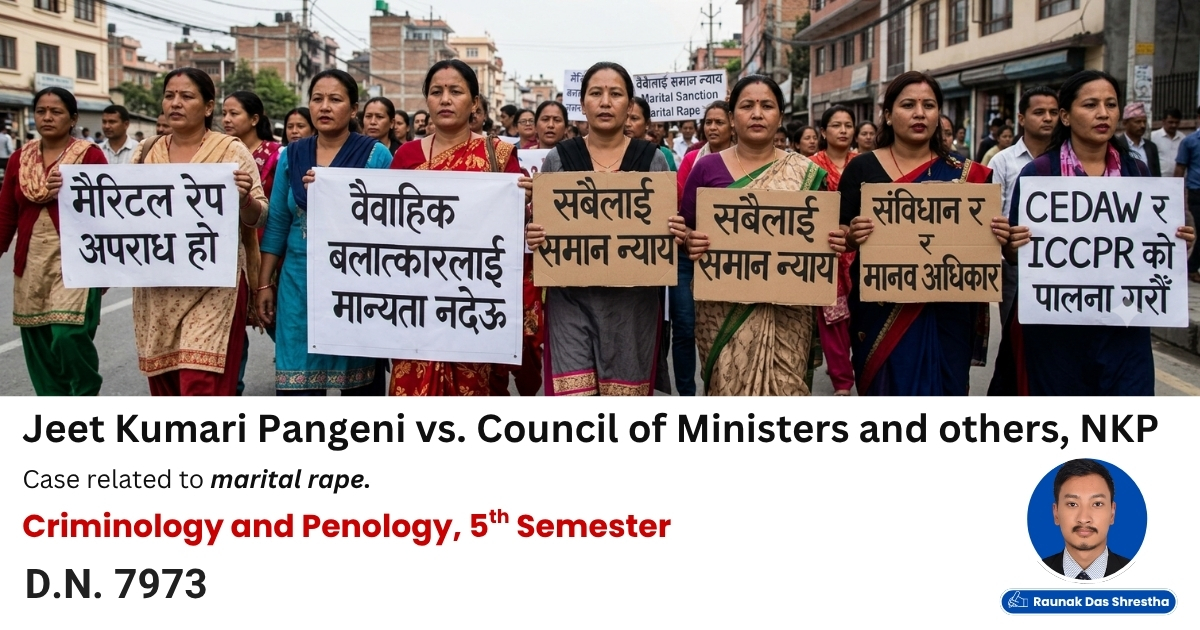
Criminology and Penology Case: Jeet Kumari Pangeni vs. Council of Ministers and others, Writ No. 0035/064, Date of Decision 2060/11/11 B.S, DN:7973
Case: Writ of mandamus
Plaintiff/Applicant: Jeet Kumari Pandeni and others
Defendant/Respondent: Council of ministers and others
Decision Number: 7973
This case is challenging the constitutionality of the Rape chapter of the Muluki Ain which prescribes only 3-6 months imprisonment in case of marital rape and 5-15 years imprisonment in case of non-marital rape, on the ground that the right to equality has been violated.
Facts of the Case:
Jit Kumari Pangeni was married in 2050 B. S to Bed Prasad Pangeni and had three children. Her husband physically beat her several times after their marriage and insisted on having sex with her without her consent. He allegedly raped and assaulted her even after she refused. She made a criminal complaint to the police and criminal proceedings started. As the case was heard, she found that the current law only gave three to six months imprisonment for marital rape, while rape by anyone else would be punished with five to fifteen years’ imprisonment based on the victim’s age. The petitioner contended that this distinction was against the married women and infringed their constitutional and human rights. She and women rights activists filed a writ petition in the Supreme Court, asking the court to review the discriminatory provision stating it violated the Interim Constitution’s equality provisions, and breached Nepal’s obligations under CEDAW, ICCPR, and ICESCR.
Legal issues:
- Whether prescribing a lower sentence for marital rape is discriminatory and unconstitutional.
- Whether the Supreme Court should declare the law void, or issue directive order to for harmonization
Different Courts Decisions:
Supreme Court:
Supreme Court held that there was no reasonable or constitutional basis for reducing punishment for the victim’s husband and that this does not adhere to the equality principle.
The Court, however, did not invalidate the provision, but instead issued a directive order to the Government and the Ministry of Law to amend the law and create a punishment in accordance with the constitutional principle of equality.
Principle Established:
- Marital rape is a serious criminal offence and should not be punished less harshly because of the marital relationship.
- The principle of equality before the law means that the punishment for a crime should be determined by the nature and gravity of the offense and not the relationship between the offender and the victim.
- While the determination of criminal penalties is the responsibility of the legislature, the Supreme Court can give directive orders when the legislation is not consistent with the constitutional principles.