

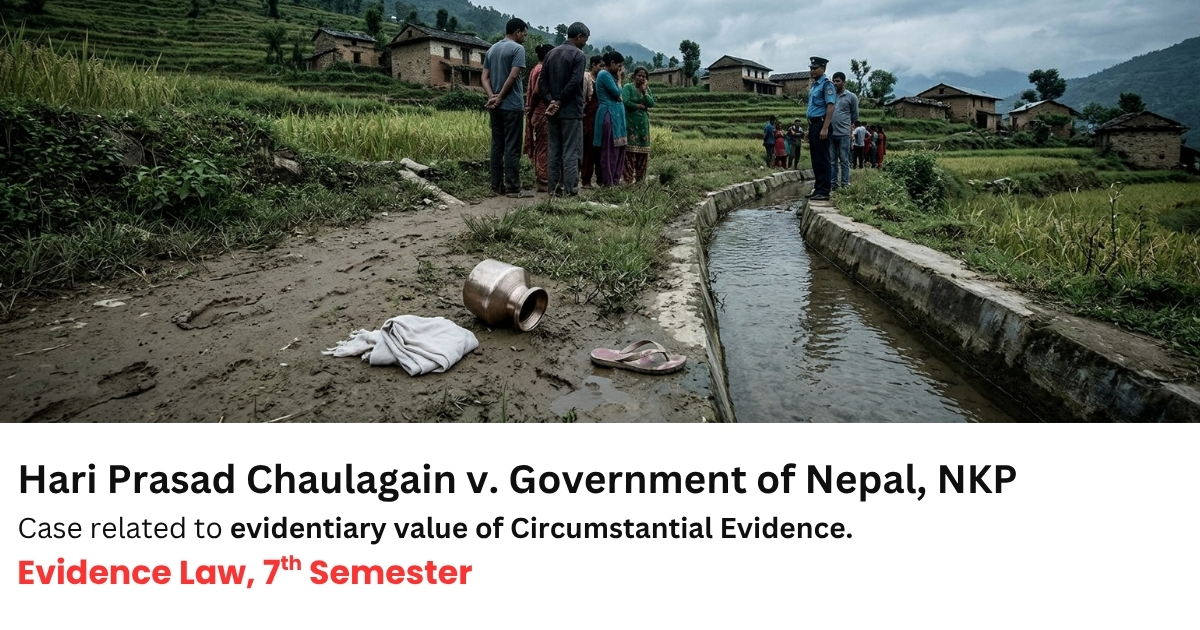
Evidence Law Case: Hari Prasad Chaulagain v. Government of Nepal, NKP 2079 B.S., Vol.2, DN: 10825
Case: Culpable Homicide
Plaintiff: Government of Nepal on the complaint of Kumar Prasad Pahadi
Defendant: Yagya Prasad Chaulagain, Hari Prasad Chaulagain and Sanjhana Adhikari (Chaulagain)
Decision Number: 10825
This case is related to the evidentiary value of circumstantial evidence in murder cases, the role of medical evidence, the assessment of alibi, and the principle that suspicion alone is insufficient to establish guilt beyond reasonable doubt.
Facts of the Case:
Tulsakumari Pahadi (Chaulagain) was found dead in a small irrigation canal near her home in Sindhuli. Her husband reported that she had accidentally fallen into the canal and died. However, her brother filed a complaint alleging that she had been subjected to long-term domestic abuse by her father-in-law Yagya Prasad Chaulagain, her brother-in-law Hari Prasad Chaulagain, and her sister-in-law Sanjhana Adhikari (Chaulagain). He stated that, shortly before her death, Tulsa had informed family members that she was being beaten and feared that her in-laws would kill her.
The post-mortem report stated that the cause of death was a fracture of the first and second cervical vertebrae, resulting in cardiac and respiratory arrest with internal bleeding. The body also had bruises and scratches. The doctor testified that the neck fracture could have been caused either by a fall or by someone twisting her neck and could not conclusively determine the cause.
Several relatives and neighbours claimed that the accused had regularly abused Tulsa and suspected that they had killed her and moved her body to the canal. However, none of them had witnessed the incident. The accused denied the allegations, stated that they were elsewhere at the time of the incident, and produced witnesses to support their alibis.
Legal Issues:
1. Was Tulsakumari’s death a murder or an accidental fall?
2. Was the circumstantial evidence sufficient to prove guilt beyond reasonable doubt?
3. Can suspicion and allegations of family disputes be treated as proof of murder?
4. Did the accused establish a reasonable doubt through their alibis?
Decisions of the Courts:
Sindhuli District Court:
The District Court acquitted all three accused, holding that the prosecution had failed to prove murder beyond reasonable doubt.
Patan High Court:
The Appeal Court convicted Yagya Prasad Chaulagain, Hari Prasad Chaulagain, and Sanjhana Adhikari of murder and sentenced each to life imprisonment.
Supreme Court Decision:
The Supreme Court reversed the Appeal Court’s judgment and acquitted all three accused. It held that the prosecution failed to establish a complete chain of circumstantial evidence, the medical evidence did not conclusively prove murder, and suspicion alone could not justify a conviction.
Principle Established:
• Circumstantial evidence can sustain a conviction only if it forms a complete and unbroken chain pointing solely to the guilt of the accused.
• Suspicion, however strong, cannot replace proof beyond reasonable doubt.
• Where medical evidence supports more than one possible cause of death, the benefit of doubt must go to the accused.
• A criminal conviction cannot be based solely on family disputes or unverified allegations.