
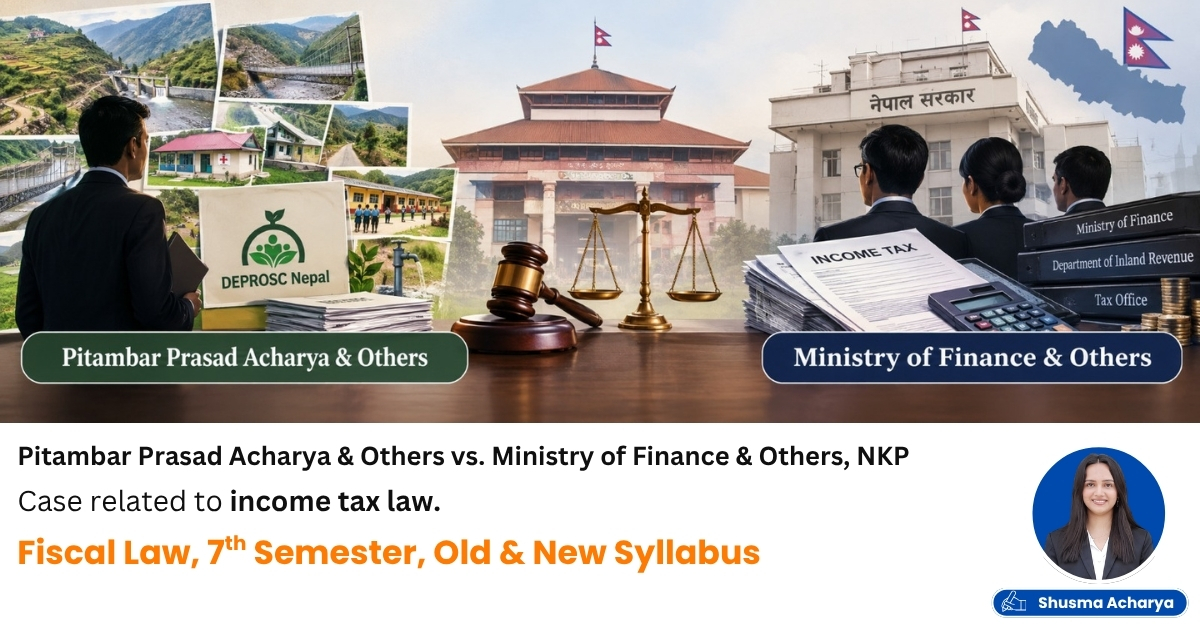
Fiscal Law Case: Pitambar Prasad Acharya & Others vs. Ministry of Finance & Others, Nepal Kanoon Patrika (NKP), DN: 9143, No. 4, P. 422.
Case: Certiorari/Mandamus
Plaintiff/Applicant: Pitambar Prasad Acharya on behalf of Development Project Service Centre (DEPROSC Nepal)
Defendant/Respondent: Government of Nepal, Ministry of Finance, Department of Inland Revenue and others
Decision Number: 9143
This case is related to income tax law.
Facts of the Case:
DEPROSC Nepal was registered on 2050/06/10 BS under the Associations Registration Act, 2034 and it works on poverty alleviation in line with government policy. It has worked in 54 of Nepal’s 75 districts and has built irrigation, drinking water, health post, school, rural road, suspension bridge, community building and micro-hydro projects 7,647 in total. The Inland Revenue Office gave it a tax exemption certificate on 2061/05/01 BS and it filed annual financial statements every year. With Nepal Rastra Bank’s permission it ran a microfinance programme for poor rural women. On 2069/03/24 BS the tax office asked for documents and by letters of 2069/10/11 and 2069/10/14 it treated the following as taxable net income:
- Rs 28,38,816.65 for FY 2056/57
- Rs 29,59,924.45 for FY 2057/58
- Rs 21,66,09,029.43 in total for FY 2058/59 to 2067/68
The office relied on the organization’s income from bank loan investments, microfinance interest, consultancy, bank deposit interest and others. It also cited grants taken without government approval and profits from competitively bid projects. The organization went straight to the Supreme Court instead of using the review and appeal route in the tax law.
Plaintiff’s Claim:
The tax exempt status was recognized by the tax office itself and the certificate was never cancelled nor declared inactive. Section 42(1)(Cha) of the then Income Tax Act 2031 and Section 2(Dha)(1)(Ka) of the existing Income Tax Act 2058 exempt non profit public benefit organizations. It had not breached the conditions of its certificate nor acted outside its objectives.
Defendant’s arguments:
Under Section 115 of the Income Tax Act 2058 the organization could seek administrative review before the Department of Inland Revenue and then appeal to the Revenue Tribunal but skipped this so the writ should be dismissed.
Legal Issues:
- Can writ jurisdiction be invoked against a tax office’s decision when alternative remedies exist?
- Is the petitioner a service-oriented, tax-exempt organization under Section 42(1)(Cha) of the Income Tax Act 2031 and Section 2(Dha)(1)(Ka) of the Income Tax Act 2058?
- Can a service oriented non-profit organization carry out financial transactions and is income from them taxable?
- Should the writ order requested be issued?
Different Courts Decision:
Supreme Court:
The Court held that a disputed legal question in a tax authority’s decision cannot be said to be beyond writ jurisdiction. The authority is competent to decide which income is taxable but if that is contrary to law a writ can address that. It accepted that DEPROSC Nepal is a genuine service oriented non profit organization. The Court held that being non profit does not exempt all income. Financial transactions are not purely service as they are also profit-oriented business and net profit from such business cannot be tax free.
The Court further held that tax exemption has its own limits and a certificate does not make all income tax free and it is wrong to argue that business income cannot be taxed. The tax office ignored Sections 24 and 31 of the Financial Intermediary Institutions Act 2055 under which the government may grant full or partial income tax exemption on microfinance income. No such exemption decision had been made. The tax office did not analyse which income was taxable and which was exempt as it taxed the entire amount including amounts that should not have been taxed.
The Court issued certiorari quashing the decision of 2069/10/08 and the assessment orders and letters of 2069/10/11 and 2069/10/11 and 2069/10/14 and also issued mandamus directing the respondents to evaluate the evidence and decide the organization’s tax liability afresh within 3 months. The judgment quashed the orders on the ground of failure to separate taxable and exempt income.
Principle Established:
- An assessment that lumps all income of a non profit organization without following the legal steps to separate taxable and exempt income is not lawful and can be quashed.
- Tax authorities are competent to decide what is taxable and what is not but if they act contrary to law or a legal question is in dispute that question can be resolved through writ jurisdiction.
- Being non-profit does not exempt all income and a non profit organization that carries on commercial or financial business cannot claim exemption on all of that income.
- Tax exemption has its own limits. A tax exemption certificate does not make an organization tax free on pure business income.
Relevancy of the Case:
This case is a leading authority on the tax treatment of NGOs, cooperatives and microfinance institutions in Nepal. It balances two things: exemption for genuine non-profit work and taxation of business and financial income.