

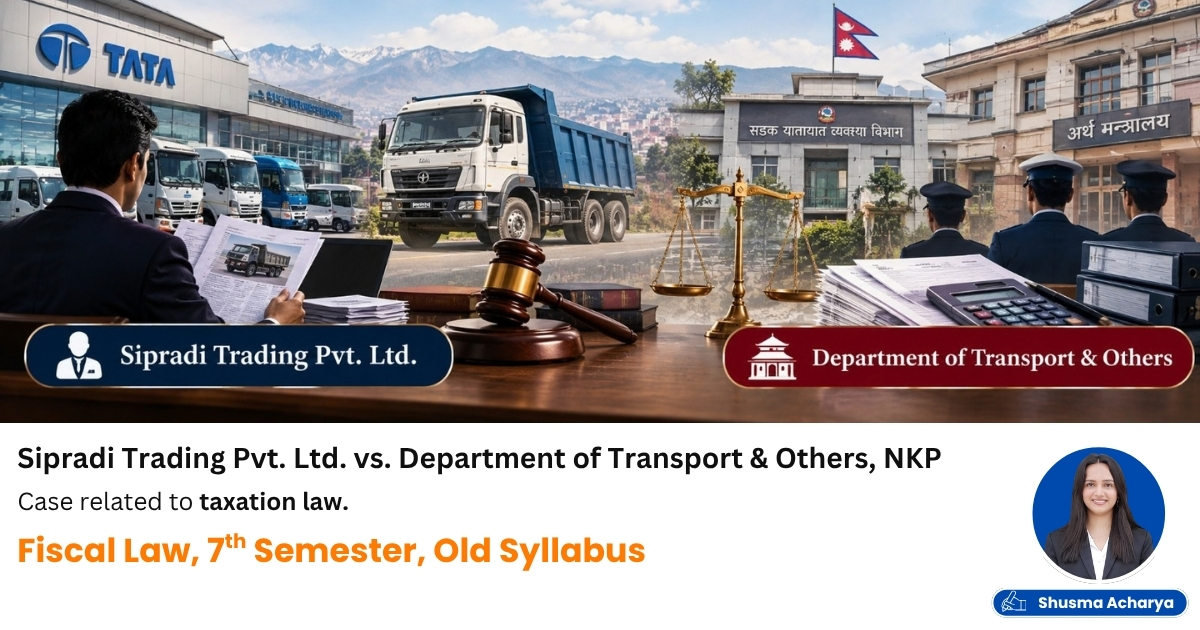
Fiscal Law Case: Sipradi Trading Pvt. Ltd. vs. Department of Transport & Others, NKP (2068), DN: 8610, No. 6, P. 766.
Case: Writ of Certiorari with Mandamus
Plaintiff/Applicant: Sipradi Trading Pvt. Ltd through its CEO Shambhu Prasad Dahal
Defendant/Respondent: Department of Transport Management and others
Decision Number: 8610
This case is related to taxation law.
Facts of the Case:
The petitioner is a company and the authorised Nepali dealer of India’s Tata. It imports cars, jeeps, buses, trucks and tippers and sells them in Nepal. On 2066/04/08 the petitioner took an imported tipper to the Transport Management Office in Lalitpur for registration. At that time the budget for FY 2066/67 had not been passed and the Finance Bill 2066 was only proposed. The Finance Ordinance/Act 2066 under Section 9, Schedule 3, Part A imposes a 3% Road Construction and Maintenance Fee on car, jeep, van, microbus, bus and truck but tippers are not named/included. In Part B (Vehicle Tax) tippers are grouped with dozers, excavators, loaders, rollers and cranes.
The Transport Management Office was unsure on whether the fee applied to tippers and asked the Department of Transport Management for directions. The Department decided that tippers are covered and sent the decision to the Finance Ministry for endorsement. The Finance Ministry backed the decision and tippers were charged 3% of their value. The Court later issued an interim on 2066/05/10 not to implement the Department’s decision against the petitioner.
Plaintiff’s Claim:
Neither the Finance Act 2066 nor the interim tax order names tippers as subject to the fee and the Finance Bill’s Part B groups tippers with excavators and dozers. The Department and the Ministry cannot impose tax by a decision or circular because only the people’s representative body can levy tax. Article 89(1) of the Interim Constitution 2063 guarantees that no tax shall be levied or collected except in accordance with law. The tipper fee and any registration was therefore illegal. The petitioner requested the Court to quash the Department’s decision.
Defendant’s arguments:
The Department of Transport Management responded that a tipper carries goods and puts heavy load on roads and falls within “truck”. The fee is a charge for using roads so all road users should pay it, even motorcycles as well. Diplomatic vehicles, ambulances and hearses are the only listed exemptions. The Ministry of Labour and Transport responded that the 3% collected was placed in a deposit account and not in revenue pending the Finance Ministry’s decision. The Ministry of Finance responded that the Gazette notice of 2066/03/29 lists car, jeep, van, microbus, bus, truck and tippers fall within the definition of truck so the decision was lawful.
Legal Issues:
- Was there any law on levying and collecting tax when the petitioner went to register the tipper? Was there a legal vacuum?
- Where the tax is not explicit, can the Department of Transport Management and the Finance Ministry interpret a term or item as falling in a taxable class?
- Under the existing law does the road fee on car, jeep, van, microbus, bus, truck apply to tippers?
Different Courts Decision:
Supreme Court:
The Joint Bench of the Supreme Court dismissed the writ petition. The Court ruled that there was no legal vacuum as the Gazette notice of 2066/03/29 under the Temporary Tax Collection Act 2012 kept taxation in force until the Finance Act was passed and the petitioner’s claim was not supported by law of fact. Only the people’s representative body can levy tax and the law must state the tax clearly as no taxation without representation. But no legislature can list every item and new goods or similar goods may appear. Executive bodies must therefore be able to classify items that are not named. The Finance Ministry did this under Section 19 of the Finance Act 2066.
Under ejusdem generis, tippers carry goods like buses and trucks and they do not dig, push or compact as excavators, dozers and rollers do. So they belong in the truck class. The 3% fee collected from the petitioner was lawful.
Principle Established:
- Where the new budget or Finance Bill has not yet been passed the government may keep taxes in force through a notice under the Temporary Tax Collection Act 2012 so no tax law vacuum arises.
- Only the legislature can levy tax and set rates and a taxing law must state the tax clearly as no taxation without representation.
- If some goods are not named or classified then the executive body or officer concerned must have the power to decide which class they belong to.
- Under ejusdem generis items of a similar kind or class to the listed items fall within the same group and dissimilar items do not.
Relevancy of the Case:
It is a key precedent on the limits of executive power in tax matters and it confirms that only Parliament may levy tax but that the executive may classify unlisted items into existing categories.