
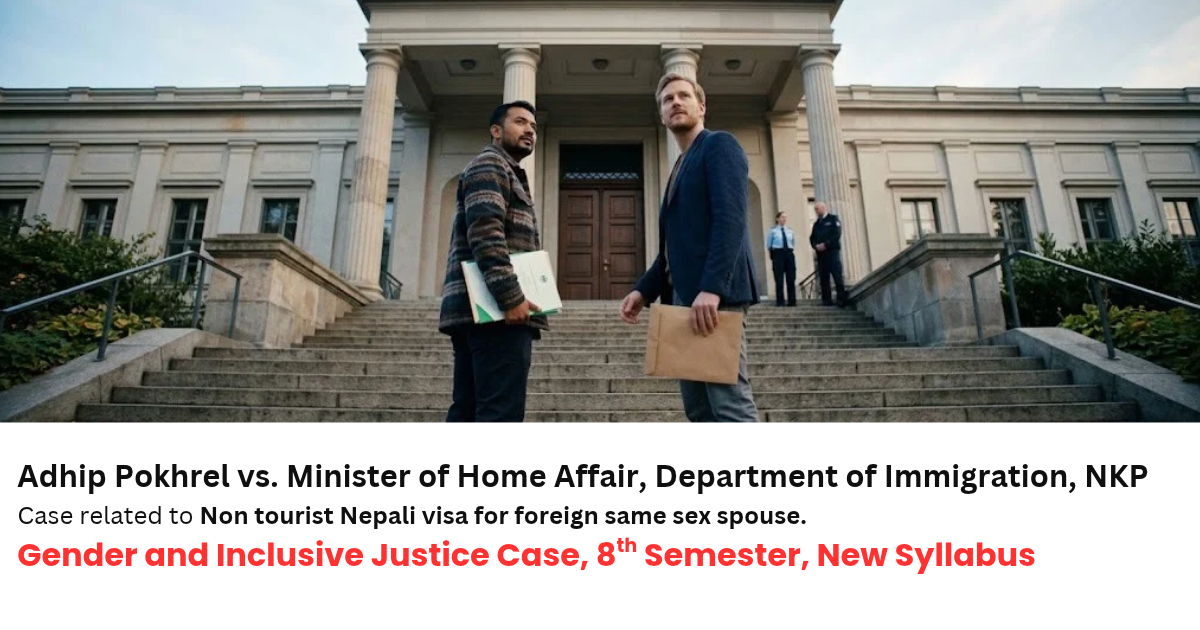
Gender and Inclusive Justice Case: Adhip Pokhrel vs. Minister of Home Affair, Department of Immigration, NKP 2080 B.S, No. 5, DN: 11097
Case: Certiorari and mandamus
Plaintiff: Adhip Pokhrel
Defendant: Minister of Home Affair, Department of Immigration et.al
Decision Number: 11097
This case relates to the right of a foreign same sex spouse of a Nepali citizen to obtain a non-tourist spouse visa and the protection of the rights of sexual and gender minorities.
Facts of the Case:
Adhip Pokharel is a Nepali citizen. Tobias Volz is a German citizen. Both are gay men and belong to the sexual and gender minority community.
They met in Nepal and later married under German law on 19 October 2018. Their marriage was registered at the marriage registration office in Malsch, Germany. They received an official marriage certificate, which was later certified by the German Embassy.
After the marriage, Tobias had been living in Nepal on a tourist visa. He applied to the Department of Immigration for a non-tourist spouse visa. The Department did not proceed with the first application and later asked for a marriage certificate registered in Nepal.
Adhip went to the local ward office to register the marriage in Nepal. He was informed that Nepal had no procedure for registering a same-sex marriage, so the marriage was not registered there. Tobias made another visa application with the German marriage certificate and a copy of an earlier Supreme Court order concerning spouse visas for same-sex couples. He was again verbally informed that the visa would not be issued.
The couple then filed a constitutional writ petition before the Supreme Court. They asked for a non-tourist spouse visa for Tobias and for directions to remove legal obstacles affecting same-sex couples and other sexual and gender minorities.
Petitioners’ Claim:
The petitioners said that they were legally married under German law and had submitted an official marriage certificate. They argued that a foreign same-sex spouse of a Nepali citizen should receive the same non-tourist spouse visa as other spouses. They also asked the Court to protect their rights to equality, identity, dignity and family life.
Government’s Argument:
The Department of Immigration said that Tobias had not properly applied through the online system or had not submitted all required documents. It stated that an applicant must provide the documents required by immigration law, including proof of marriage. It argued that the visa application could be considered after the required documents were submitted and verified.
Legal Issues:
- Whether Tobias was entitled to a non-tourist spouse visa as the foreign spouse of a Nepali citizen?
- Whether a marriage legally registered in a foreign country could be considered for the visa application?
- Whether refusing or delaying the visa because the same-sex marriage was not registered in Nepal amounted to discrimination?
- Whether the words “husband” and “wife” in immigration forms and laws excluded same-sex couples?
Decision of the different courts:
Supreme Court:
The Supreme Court held that the marriage registered under German law could not be rejected merely because it was not registered in Nepal. The official marriage certificate and its authentication were sufficient documents to consider the marriage.
The Court held that a foreign same-sex spouse of a Nepali citizen cannot be denied a non-tourist spouse visa because of sexual orientation or gender identity. Such denial would be discriminatory and contrary to the Constitution, immigration law and the right to equality and dignity.
The Court stated that if the Nepali spouse’s citizenship certificate, an official marriage certificate and identification of both spouses were submitted, the Immigration Department could not refuse the visa only because the couple was of the same sex.
The Court also directed the Government to amend the immigration form and procedure. The words “husband” and “wife” should not create an obstacle for same-sex couples. The procedure should allow foreign spouses of Nepali sexual and gender minority citizens to obtain non-tourist visas easily.
The writ petition was allowed to this extent. There was no criminal punishment because this was a constitutional rights case.
Principle Established:
- A foreign same sex spouse of a Nepali citizen is entitled to equal treatment in visa matters.
- A foreign marriage certificate cannot be rejected only because the marriage is not registered in Nepal.
- Immigration authorities cannot discriminate on the basis of sexual orientation or gender identity.
- Legal words such as “husband” and “wife” should be interpreted in an inclusive manner where necessary.
- The State must protect the identity, dignity, family life and equal rights of sexual and gender minorities.
- Administrative forms and procedures must not create unnecessary barriers for same-sex couples.