
Gender and Inclusive Justice Case: Dil Bahadur Bishwakarma & Others vs. Cabinet Secretariat & Others, NKP (2062), No. 4, P. 498, DN: 7531
Case: Mandamus
Plaintiff: Dil Bahadur Bishwakarma et.al
Defendant: Cabinet Secretariat & Others
Decision Number: 7531
The case is relating to the Chhaupadi practice and the protection of women’s constitutional rights during menstruation.
Facts of the Case:
The Dalit NGO Federation (DNF), through its President Dil Bahadur Bishwakarma, filed a public-interest writ petition against the Government of Nepal. The case concerned the Chhaupadi practice followed in parts of Nepal, especially in the far-western districts.
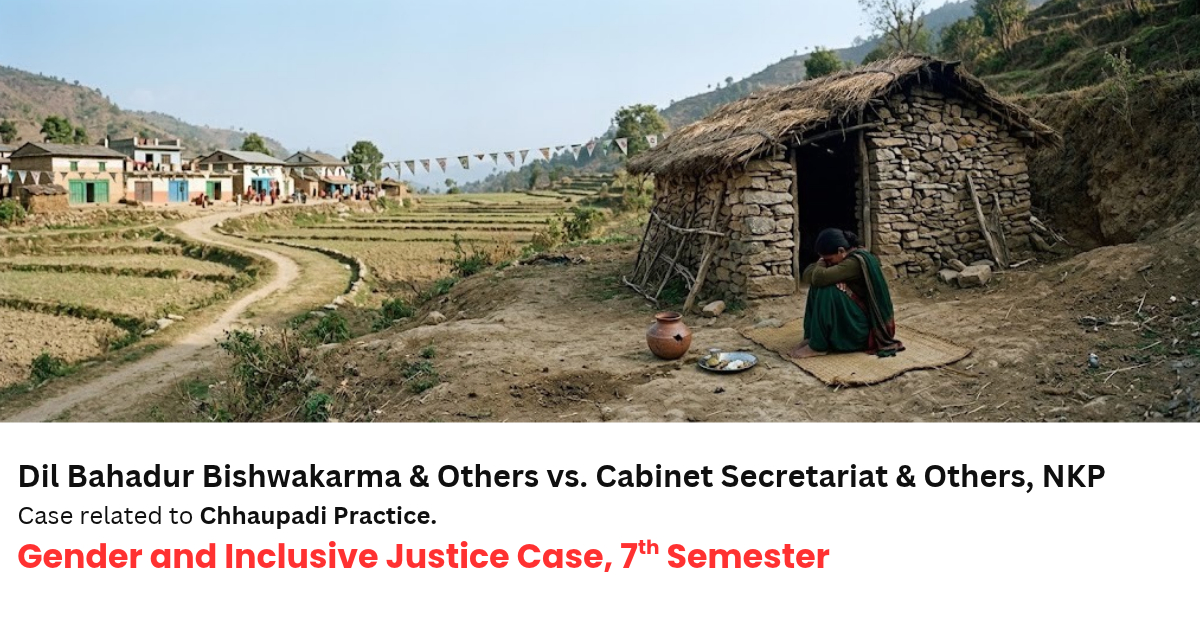
Under this practice, women and girls were sent out of their homes during menstruation. They were made to stay in a separate hut or in a cattle shed called a Chhaupadi hut. They were treated as impure and kept away from family members.
The women were often not allowed to enter the house, kitchen, temple, or water sources. They could not use ordinary household items. They were sometimes given only stale bread with salt and chilli. They were denied nutritious food such as milk, curd, and ghee.
The huts were usually dirty, unsafe, and poorly ventilated. Women had to sleep on straw, sacks, or rough mats. They faced cold, illness, malnutrition, physical weakness, social humiliation, and mental suffering. Some women also faced sexual violence, snake bites, animal attacks, and even death while staying in the huts.
The petitioners argued that the practice was based on superstition and discrimination. It violated women’s right to equality, personal liberty, dignity, health, and life. They said that the Government had failed to take effective steps to stop the practice.
Plaintiff’s Claims:
The petitioners claimed that sending menstruating women to Chhaupadi huts was an inhuman and discriminatory practice. They argued that it treated women as inferior because of a natural biological process.
They asked the Court to order the Government to immediately stop the practice and to declare it a social evil. They also requested a law against discrimination during menstruation.
They asked for a study of the health effects of Chhaupadi on women and children. They also requested public-awareness programmes, local-level action, and guidelines to protect women until detailed legislation was made.
Defendants’ Arguments:
The Government authorities argued that Chhaupadi was a social and cultural problem that could be gradually removed through awareness, education, and empowerment. They stated that government agencies were already conducting programmes to reduce harmful social practices and discrimination.
Legal Questions:
- Whether Chhaupadi violated women’s constitutional rights?
- Whether forcing menstruating women to live in separate huts was discriminatory and inhuman?
- Whether the Government had taken sufficient measures to end Chhaupadi?
- Whether the Supreme Court could issue directions to the Government to protect women from the practice?
Different Court Decisions:
Supreme Court Decision:
The Supreme Court accepted that Chhaupadi was still being practised in the far-western districts. It relied on the information and reports showing that menstruating women were forced to stay in unsafe huts, denied nutritious food, and prevented from using water sources and household facilities.
The Court held that the Government had not shown that it had taken effective measures to end the practice. General statements about awareness programmes were not enough. The State had a duty to protect women’s life, health, dignity, equality, and personal liberty.
The Court therefore issued directive orders to the Government. It ordered the Prime Minister’s Office to declare within one month that sending menstruating women to Chhaupadi huts was a social evil. It directed the Health Ministry to form a committee, including doctors, to study the effects of Chhaupadi on women and children and to submit a report.
The Court directed the Local Development Ministry to mobilise local bodies and conduct public-awareness programmes. It also ordered the Ministry of Women, Children and Social Welfare to prepare and implement guidelines within three months to prevent discrimination against women during menstruation.
The Court further stated that the Government should study the need for legislation and prepare laws if necessary. The petitioners were also encouraged to take appropriate steps to spread awareness against the practice.
Principles Established:
- Chhaupadi is a discriminatory and harmful practice against women.
- Menstruation cannot be used to treat women as impure or inferior.
- Chhaupadi can violate the rights to life, health, dignity, equality, and personal liberty.
- The State has a positive duty to protect women from harmful social practices.
- General awareness programmes are not enough without effective action.
- Social and cultural traditions cannot justify violations of constitutional rights.
- Public-interest litigation can protect the rights of vulnerable groups.
- Courts can issue appropriate directions when fundamental rights are threatened by harmful social practices and government inaction.