
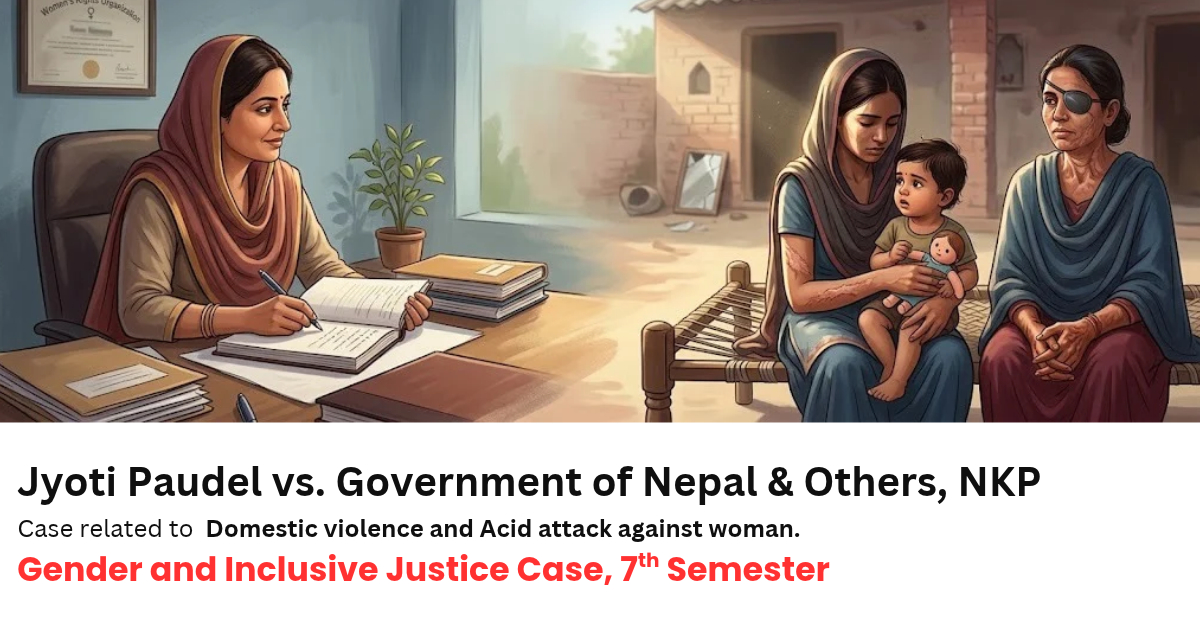
Gender and Inclusive Justice Case: Jyoti Paudel vs. Government of Nepal & Others, NKP (2065), No. 4, P. 485, DN: 8282.
Case: Mandamus
Plaintiff: Jyoti Paudel
Defendant: Government of Nepal & Others
Decision Number: 8282
This case is relating to domestic violence, acid attacks against women, protection of women’s rights, and the State’s obligations under CEDAW.
Facts of the Case:
The Women Rehabilitation Centre and Advocate Jyoti Paudel filed the petition concerning violence against women, including acid attacks suffered by Sadina Khatun and Rita Devi Mahato.
Sadina Khatun was beaten by her husband while breastfeeding her three-year-old daughter. He then threw acid at her, which also affected the child. Sadina suffered severe burns and permanent disfigurement to her face and hands. She approached the police, but no effective action was taken.
Rita Devi Mahato was also attacked with acid. She suffered severe burns to her face, neck, and arms. She lost the sight of one eye and was left with permanent injuries and disfigurement. The attack also caused social humiliation and difficulties in her daily life.
The petitioners argued that such violence was linked to social attitudes that treated wives and daughters-in-law as inferior to men. The existing law did not adequately address serious domestic violence such as acid attacks or provide proper investigation, prosecution, punishment, treatment, compensation, and rehabilitation.
Plaintiff’s Claims:
The petitioners claimed that the State had failed to adequately protect women from domestic violence and discrimination. They argued that Nepal had also failed to properly fulfil its obligations under CEDAW. They asked the Court to order effective laws and systems for investigation, prosecution, punishment, treatment, compensation, rehabilitation, legal assistance, and protection of women victims.
Defendants’ Arguments:
The Home Ministry argued that existing laws applied equally to everyone and that no specific violation of rights had been shown. The Prime Minister’s Office said that the Government was already working to control violence against women and that law-making was mainly the legislature’s responsibility. The Ministry of Law argued that acid attacks were already punishable under existing laws. The Ministry of Women, Children and Social Welfare stated that a draft domestic-violence law was being considered.
Legal Questions:
- Whether the existing law adequately protected women from domestic violence and acid attacks?
- Whether Nepal had fulfilled its obligations under CEDAW?
- Whether the existing punishment and legal procedures were sufficient for serious domestic violence?
- Whether the State should provide victims with effective remedies, including treatment, compensation, legal assistance, rehabilitation, and speedy justice?
Different Court Decisions:
Supreme Court:
The Supreme Court held that the case involved both public interest and the personal rights of the two injured women. It found that the existing legal system did not adequately protect women from serious domestic violence and acid attacks.
The Court noted that the Domestic Violence Act did not clearly cover acid attacks within its definition of domestic violence. It also lacked clear procedures for investigation, prosecution, and evidence collection. The punishment was inadequate for serious forms of violence and did not provide an effective deterrent or sufficient justice to victims.
The Court held that Nepal could not ignore its obligations under CEDAW after ratifying the Convention. Under the Nepal Treaty Act, international treaty obligations could prevail where applicable domestic law conflicted with them. Therefore, the State had a duty to establish effective laws and mechanisms to protect women.
The Court issued directive orders to the Government to broaden the definition of domestic violence, provide effective punishment, and establish clear procedures for investigation and prosecution. It also directed the State to provide free legal assistance to women victims and recommended the use of trained women police officers in investigating such cases.
The Court further directed the Government to consider a separate fast-track court for cases involving violence against women. A four-member committee was formed to study the necessary laws, staff, budget, and infrastructure and submit its recommendations.
The Court did not determine the criminal guilt of the persons responsible for the acid attacks or impose criminal punishment on them.
Principles Established:
- Domestic violence is a human-rights violation, not merely a private family matter.
- Nepal must implement its international treaty obligations, including CEDAW, in good faith.
- Women must not be treated as inferior because they are wives or daughters-in-law.
- Acid attacks are serious forms of violence requiring effective legal protection.
- Laws must provide effective investigation, prosecution, punishment, and remedies.
- Punishment for serious violence should have a real deterrent effect.
- Victims of violence should have access to treatment, compensation, legal assistance, protection, and rehabilitation.
- The State must take steps to address social practices that discriminate against women.
- Special procedures, including fast-track courts, may be used to provide speedy and dignified justice to women victims.
- Courts may issue directive orders where existing laws and mechanisms fail to adequately protect fundamental rights and treaty obligations.