
Gender and Inclusive Justice Case: Munish Acharya vs. Shruti Gautam, Supreme Court Writ No. 073-CI1672, Decision date: 2080-09-23
Case: Relating to divorce
Plaintiff: Munish Acharya
Defendant: Shruti Gautam
Writ No: 073-CI1672
This case relates to divorce on the grounds of living separately for three years and causing serious physical or mental harm to the husband.
Facts of the Case:
Munish Acharya and Shruti Gautam had an arranged marriage on 15 June 2009. They had no children.
After the marriage, Shruti stayed at Munish’s family home for some time. She later began staying at her parental home. The parties gave different explanations for this. Munish said that she left the home without his consent. Shruti said that she was not allowed to return because of problems with her mother-in-law and other family members.
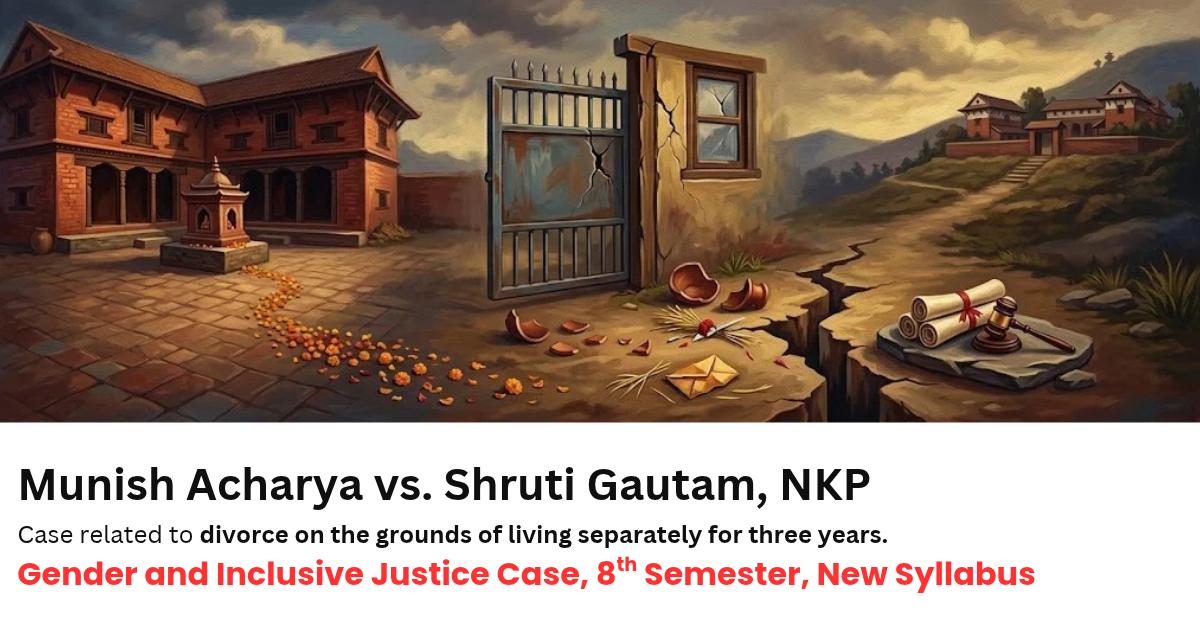
During the Dashain festival in 2010, Shruti went to Munish’s home with her sister and other family members. A conflict took place between the two families. The gate and a window were damaged, and some family members suffered injuries. The parties gave different accounts of how the incident started and who was responsible.
Shruti continued to live at her parental home. Munish later filed for divorce before Kathmandu Metropolitan City. Attempts at reconciliation were unsuccessful. The matter was then sent to the Kathmandu District Court.
Plaintiff’s Claim:
Munish claimed that Shruti had lived separately from him for more than three years without his consent. He also claimed that she and her family members had damaged his house and caused physical and mental suffering to him and his family. He asked for divorce under the then applicable Muluki Ain, Husband and Wife Chapter.
Defendant’s Argument:
Shruti denied leaving the home voluntarily. She said that Munish’s family had refused to let her live there. She claimed that she was ready to live with her husband. She said that the Dashain incident involved a family conflict and only caused ordinary injuries. She argued that there was no legal ground for divorce.
Legal Issues:
- Whether Shruti had voluntarily lived separately from Munish for at least three years without his consent?
- Whether the period of separation had reached the required three years when the divorce case was filed?
- Whether the Dashain incident caused the serious physical or mental harm required for divorce?
- Whether a bad or unhappy marital relationship alone was enough to grant divorce?
Decisions of the Courts:
Kathmandu District Court:
The District Court held that Munish had not proved that Shruti had voluntarily lived separately for three years or that she had caused serious physical or mental harm. The divorce claim was dismissed.
Patan Appellate Court:
The Appellate Court upheld the District Court’s decision. It found that the evidence did not prove the required legal grounds for divorce.
Supreme Court:
The Supreme Court upheld both lower-court decisions and dismissed Munish’s claim for divorce.
The Court held that a husband relying on the ground of separation had to prove that the wife had voluntarily left him and had remained separate for at least three years. In this case, the evidence showed that Shruti was still visiting or going to the matrimonial home until around January 2010. Therefore, the required three-year period had not been completed when Munish filed his application in November 2012.
The Court further held that merely living at the parental home for three years was not enough. The Court had to examine why the wife was living separately. If she had been prevented from living in the matrimonial home or had been forced to leave because of family circumstances, her separation could not automatically be treated as voluntary abandonment.
The Court also considered the Dashain incident. It accepted that injuries had occurred, but found that they were ordinary injuries caused during a family quarrel. They were not fatal, disabling or sufficiently serious to amount to the major physical suffering required by law. Munish had also not clearly proved that Shruti herself had inflicted the injuries.
The Court explained that ordinary disagreement, lack of affection, family conflict or an unhappy relationship is not by itself a legal ground for divorce under the relevant provision. Serious physical or mental harm must be proved. Such harm normally requires repeated intentional conduct or a situation in which the spouses cannot safely live together.
The Supreme Court therefore held that the Appellate Court’s decision was lawful. The divorce was refused. There was no criminal punishment because this was a civil matrimonial case.
Principle Established:
-
- Separation for three years is a ground for divorce only when the spouse has voluntarily abandoned the other spouse.
- The three-year period must be proved with reliable evidence and must have been completed when the case was filed.
- A wife who leaves because she is not allowed to live in the matrimonial home cannot automatically be treated as having voluntarily abandoned her husband.
- The Court must examine the social and family circumstances behind the separation.
- Ordinary quarrels and minor injuries are not enough to prove serious physical or mental suffering.
Case Link:
https://supremecourt.gov.np/court/public/media/2024_09/75f18353cba937dc6218540c237be75c.pdf)