

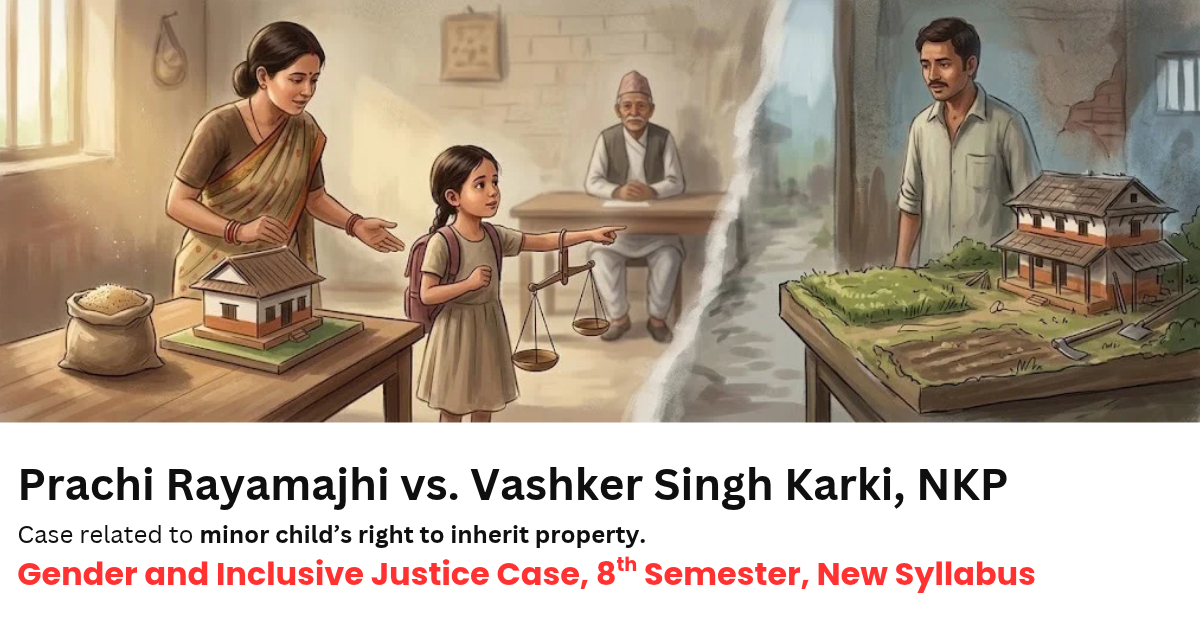
Gender and Inclusive Justice Case: Prachi Rayamajhi vs. Vashker Singh Karki, NKP 2079 B.S No. 9, DN: 10936
Case: Partition of Property
Plaintiff: Prachi Rayamajhi
Defendant: Vashker Singh Karki
Decision Number: 10936
This case relates to a minor child’s right to inherit property and the mother’s right to manage that property after the parents’ divorce.
Facts of the Case:
Sarahana Karki was the minor daughter of Bhaskar Singh Karki and Prachi Rayamajhi. Her parents had divorced, and she was living with her mother. Sarahana was nine years old when the case was filed.
In an earlier divorce and partition case, Prachi Rayamajhi had received her own share of the family property. Bhaskar Singh Karki still held property that had not been divided. Sarahana’s mother filed a new partition case on her behalf to claim Sarahana’s share in that property.
The case concerned both Sarahana’s share in her father’s property and the question of who should manage that share while she remained a minor.
Plaintiff’s Claim:
Sarahana, through her mother, claimed her legal share in her father’s property. Her mother said that she was Sarahana’s guardian and that the property should remain under her care because Sarahana was living with her. She asked the Court to protect and use the property for Sarahana’s best interests.
Defendant’s Argument:
The father argued that the mother should not control Sarahana’s property. He claimed that the property might be misused if the mother remarried or stopped caring for Sarahana. He also argued that the law placed a child of Sarahana’s age under the father’s responsibility. He asked that the property be placed under his control or under the joint control of both parents.
Legal Issues:
- Whether a minor child has the right to claim a share of the father’s property?
- Whether the mother could file the case on behalf of her minor daughter?
- Whether the mother alone or both parents should be guardians of the minor’s property?
- Whether the mother’s possible remarriage was enough to remove her as guardian?
Decision of the Different courts:
Kathmandu District Court:
The District Court held that Sarahana was entitled to her share of the property. It placed the property under her mother’s guardianship. The mother could use the property for Sarahana’s best interests. However, she had to inform the father before transferring or mortgaging it.
Patan High Court:
The High Court partly changed the District Court’s decision. It held that both parents should jointly act as guardians of Sarahana’s property. The property could not be transferred or mortgaged without the consent of both parents.
Supreme Court:
The Supreme Court reversed the High Court’s decision and restored the District Court’s main order.
The Court held that the mother had the legal right to file the case on behalf of Sarahana. The law allowed either the father or the mother to bring a case for a minor child.
The Court noted that Sarahana was living with her mother and that the parents’ marriage had ended. There was no dispute that the mother was caring for her. Therefore, the mother could also act as the guardian of Sarahana’s property.
The Court held that the mother’s possible future remarriage was only an assumption. It could not be used to presume that she would misuse her daughter’s property. Treating the mother as fit to care for the child but unfit to protect the child’s property would be unfair and discriminatory.
The Court also clarified that the legal provision placing a child of a certain age under the father’s responsibility mainly concerns care, education and medical treatment. It did not require Sarahana’s property to be placed under the father’s control.
The Supreme Court held that the property should remain under the mother’s guardianship and be used for Sarahana’s best interests. If it became necessary to transfer or mortgage the property, the father had to be informed. His consent was not required in every situation.
The Supreme Court therefore partly reversed the High Court’s decision and restored the District Court’s decision. There was no criminal punishment because this was a civil inheritance and guardianship case.
Principle Established:
- A minor child has the right to claim and receive a share of a parent’s property.
- Either parent may file a case on behalf of a minor child.
- A mother may act as the guardian of her minor child’s property when the child is living under her care.
- A mother’s possible remarriage cannot, by itself, remove her guardianship.
- The child’s best interests must guide the protection and use of the child’s property.
- The mother’s guardianship should not be denied on the basis of a mere suspicion that she may misuse the property.