
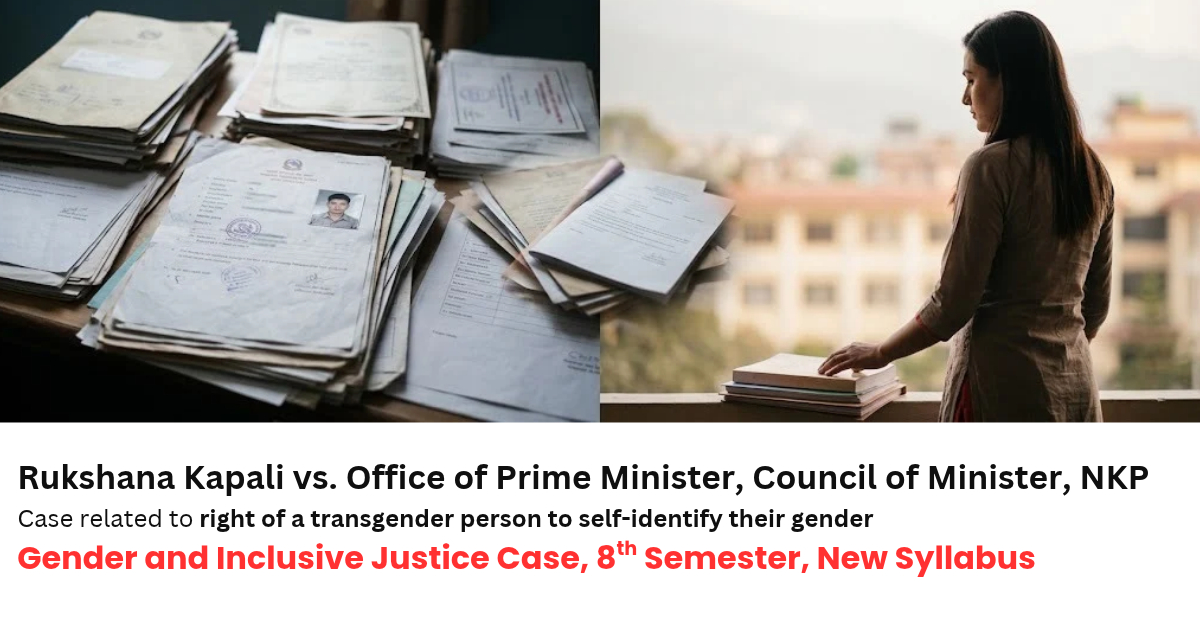
Gender and Inclusive Justice Case: Rukshana Kapali vs. Office of Prime Minister, Council of Minister, Supreme Court Writ No.077-WO-0973, Decision date: 2080- 07-20, DN: 11406
Case: Certiorari
Plaintiff: Rukshana Kapali
Defendant: Office of Prime Minister, Council of Minister
Decision Number: 11406
This case relates to the right of a transgender person to self-identify their gender and to update official documents according to that identity.
Facts of the Case:
Rukshana Kapali is a Nepali citizen and a transgender woman. She was assigned male at birth. Her family gave her a name and the details in her birth registration, school records and other documents were prepared on that basis.
From a young age, she understood and identified herself as a girl. After completing Grade 10, she decided to live according to her gender identity. She chose the name “Rukshana Kapali” and began identifying herself as a woman.
She received Nepali citizenship in 2015. Her citizenship certificate carried the name “Rukshana Kapali”, but the gender section stated “other”. Her birth registration and some other official documents also contained different names or different gender descriptions. Some later documents identified her as a woman, while others stated “other” or “third gender”.
Rukshana repeatedly tried to have her documents updated to show her name and gender consistently. She also tried to register at Tribhuvan University. The University did not register her form because her educational records and citizenship documents did not show consistent personal details.
She also experienced problems when dealing with government offices and service providers. Her earlier name and gender details were disclosed or used, which caused embarrassment and affected her dignity and privacy.
She then filed a writ petition before the Supreme Court. She asked the Court to direct the authorities to record her gender as “female” in her citizenship, educational certificates and other identity documents, and to keep her previous name and gender details confidential.
Petitioner’s Claim:
The petitioner argued that gender identity is based on a person’s own inner experience and self-determination. She said that refusing to recognise her as a woman violated her rights to dignity, equality, privacy, education and employment. She also asked for protection of her previous name and gender details.
Government and Institutional Arguments:
The Government argued that corrections to citizenship and other official documents had to follow the procedure under the existing laws. It said that the law allowed correction of minor mistakes and certain details, but did not clearly provide for changing the gender entry in the manner requested.
Tribhuvan University argued that it normally admits students and issues certificates according to the name shown in their existing educational and citizenship documents. Other authorities said that they had not intentionally violated the petitioner’s rights and that the relevant documents could be corrected only according to law.
Legal Issues:
- Whether the Supreme Court could hear the petition under its extraordinary writ jurisdiction?
- Whether a transgender person has the right to determine their gender identity through self-identification?
- Whether official documents can be changed to reflect the person’s self-identified gender?
- Whether the petitioner’s previous name and gender details must be kept confidential?
Decisions of the Different courts:
Supreme Court:
The Supreme Court held that a person’s gender identity is not decided only by the sex assigned at birth. If a person later understands and identifies themselves as belonging to another gender, their self-identified gender must be respected.
The Court held that Rukshana had the right to identify herself as a woman. A transgender woman who was assigned male at birth can determine her gender identity through self-determination.
The Court also held that the Constitution protects dignity, equality, privacy and the right to education. Refusing to recognise the petitioner’s gender identity made it difficult for her to use public services and continue her education. It also exposed her to humiliation and discrimination.
The Court directed the concerned authorities to update the petitioner’s citizenship, educational certificates and other identity documents so that her gender was recorded as “female”. The authorities were also directed to keep her former name and former gender details confidential, unless disclosure was authorised by the Court or by the petitioner in writing.
The writ petition was allowed and a mandamus order was issued. There was no criminal punishment because this was a constitutional rights case.
Principle Established:
- Every person has the right to determine their own gender identity.
- Gender identity is not determined only by the sex assigned at birth.
- A transgender person’s self-identified gender must be respected by the State.
- Official documents may be updated to reflect the person’s real gender identity.
- Refusal to recognise gender identity can violate dignity, equality, privacy and education rights.
- A person’s former name and gender details are private information.
- The State must protect such information and must not disclose it without the person’s consent or a lawful court order.