
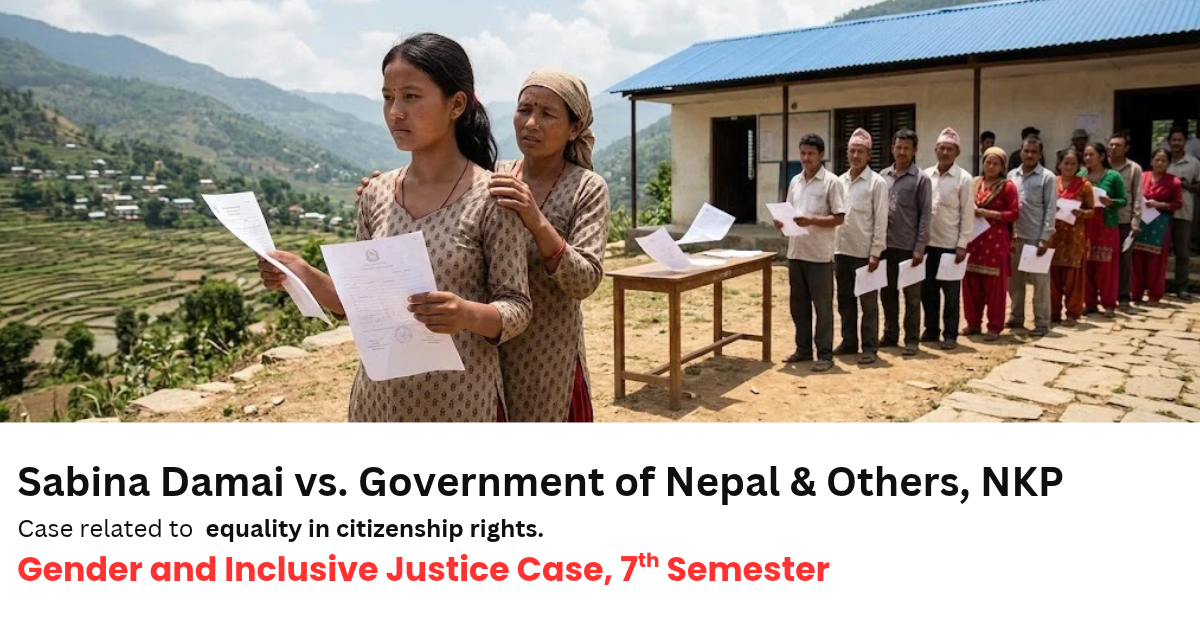
Gender and Inclusive Justice Case: Sabina Damai vs. Government of Nepal & Others, NKP (2068), Р. 247, DN: 8557
Case: Mandamus
Plaintiff: Sabina Damai et.al.
Defendant: Government of Nepal, Office of the PM and Council of Ministers
Decision Number: 8557
The case is relating to citizenship through a Nepali mother, equality in citizenship rights, and whether an unknown father can prevent a person from obtaining citizenship.
Facts:
Sabina Damai was an 18 year old woman from Dolakha. Her mother, Gangamaya Damai, was a Nepali citizen by descent. Sabina’s father was unknown, and neither Sabina nor her mother knew his identity or address.
Sabina sought Nepali citizenship through her mother. She completed the required procedure, submitted the necessary documents to the concerned local authority, and appeared for verification. She then applied to the District Administration Office, Dolakha, for a citizenship certificate based on her mother’s Nepali citizenship.
The Chief District Officer refused to issue her the citizenship certificate. The officer stated that Sabina’s father had not been identified and that his address was unknown. Her application was returned orally on that ground.
The absence of a citizenship certificate created difficulties for Sabina in proving her legal identity and accessing rights and services connected with citizenship, including employment, property and political rights.
The case was also brought as a public-interest petition because similar difficulties were reportedly faced by other children of Nepali mothers. The dispute therefore concerned not only Sabina’s individual application but also the practice of requiring information about a father when a person sought citizenship through a Nepali mother.
The petitioners relied on the constitutional provisions on citizenship and equality, the Nepal Citizenship Act, 2006, the Citizenship Rules, 2006, and relevant international human-rights instruments.
Plaintiff’s Claims:
The petitioners claimed that Sabina was entitled to citizenship through her Nepali mother and that the identity or address of her father was not a legal requirement. They argued that refusing her citizenship violated her rights to citizenship, identity and equality and discriminated against children seeking citizenship through their mothers.
Defendants’ Arguments:
The respondents argued that citizenship could be issued only after the required legal procedure and verification had been completed. The District Administration Office maintained that Sabina’s father’s details had not been established and that she had not accepted a certificate describing her parental information in the manner permitted by law. They also argued that other legal remedies were available and sought dismissal of the petition.
Legal Issues:
- Whether a person born in Nepal to a Nepali mother could obtain citizenship through the mother’s name?
- Whether the identity or address of the father was necessary for issuing citizenship through the mother?
- Whether refusing citizenship because the father was unknown violated the right to equality and identity?
- Whether the Court could issue directions to prevent similar denial of citizenship to others?
Different Court Decisions:
Administrative Decision:
The Chief District Officer of Dolakha refused to issue Sabina’s citizenship certificate because her father’s identity and address were unknown.
Supreme Court:
The Supreme Court allowed the petition and held that the constitutional expression “father or mother” could not be interpreted as requiring information about both parents. Where the Constitution recognised either parent, the citizenship process could not make the father’s identity an additional requirement when the claim was based on a Nepali mother.
The Court held that the authorities had wrongly refused Sabina’s application merely because her father was unknown. The absence of information about her father could not, by itself, deprive her of the right to obtain citizenship through her Nepali mother.
The Court also considered the discriminatory effect of a practice that effectively gave greater importance to the father than the mother in citizenship matters. It emphasised that constitutional rights could not be restricted by patriarchal social practices or administrative assumptions.
The Court ordered the District Administration Office to issue Sabina’s citizenship certificate through her mother’s name. It also directed the Home Ministry to circulate appropriate instructions to Chief District Officers so that children born in Nepal to Nepali mothers would not face the same difficulty merely because their fathers were unknown.
The Court further directed the Government to take measures to address discriminatory practices and raise public awareness regarding women’s equal citizenship rights.
Principles Established:
- Citizenship may be obtained through a Nepali father or mother where the law provides for either parent.
- “Father or mother” cannot be interpreted as requiring proof of both parents.
- An unknown father cannot, by itself, be a reason to deny citizenship through a Nepali mother.
- Citizenship is closely connected with legal identity and the exercise of other rights.
- Citizenship authorities must apply the law without gender discrimination.
- Patriarchal practices cannot override constitutional rights.