
Government of Nepal v. Lakpa Sherpa, NKP 2073, Vol 9, DN: 9684
Case: Human trafficking and Rape
Plaintiff: Government of Nepal on behalf of changed name Yamuna Rai
Defendant: Lakpa Sherpa et.al.
Decision Number: 9684
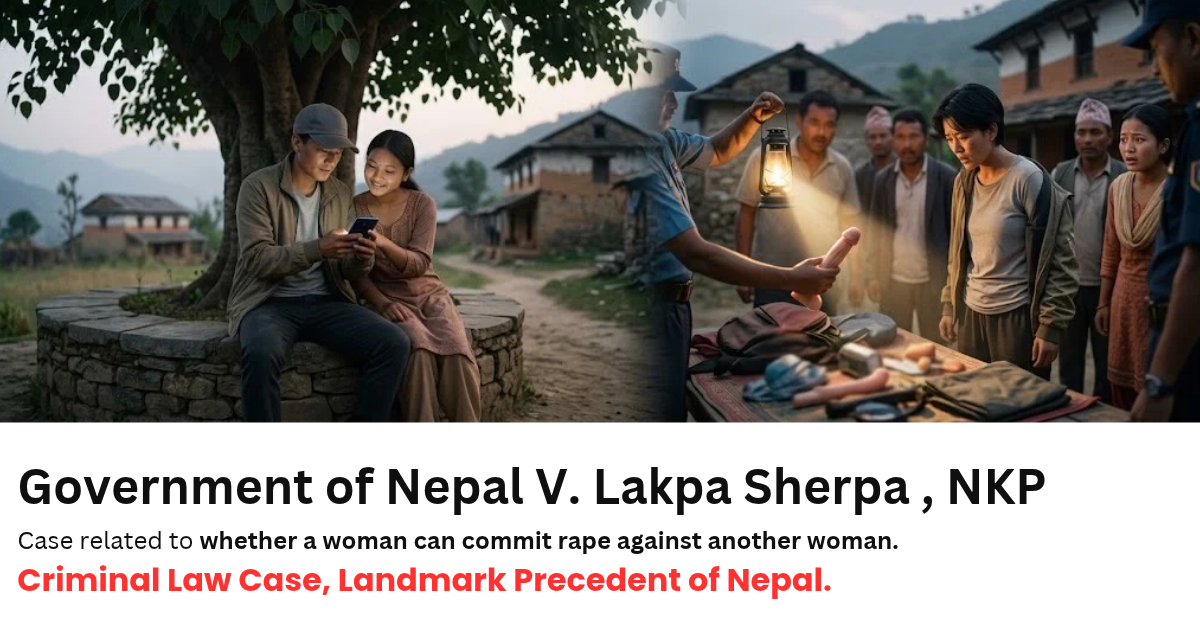
This case relates to whether a woman can commit rape against another woman by hiding her identity and using an artificial sexual organ.
Facts of the Case:
The victim, whose name was kept confidential as Yamuna Rai, was a minor. She was 14 years and 7 months old at the time of the incident.
She became acquainted with Lakpa Sherpa through mobile phone calls. Lakpa told her that Lakpa was a man named “Ajay Jimi”, worked as a driver and lived in Urlabari. Their conversations developed into a romantic relationship. Lakpa also spoke about marriage and said that Lakpa would come to take her away.
On 22 February 2011, Lakpa came to Seduwa with Sagar Sherpa. The victim met them there and took them to her maternal uncle’s house for the night. Lakpa and Sagar stayed in separate beds in one room. During the night, the victim went to Lakpa’s room after receiving a message.
The next morning, local people became suspicious about Lakpa’s identity. When Lakpa was searched, an artificial sexual organ was found hidden inside Lakpa’s underwear. The victim then learned that Lakpa was a woman and not the man Lakpa had claimed to be.
A complaint was filed. The artificial organ was seized and the police investigated the incident. The prosecution charged Lakpa and Sagar with rape and human trafficking and transportation.
Prosecution’s Claim:
The prosecution claimed that Lakpa had falsely presented herself as a man, used a false name and identity, and lured the minor through a romantic relationship and a promise of marriage. It alleged that Lakpa used an artificial sexual organ to rape the victim. It also claimed that Lakpa and Sagar had taken the victim for the purpose of trafficking and sexual exploitation.
The victim stated that Lakpa had sexual intercourse with her using the artificial organ. She also later stated that Sagar had sexually assaulted her. She said that the accused had told her not to raise an alarm and had promised to help her get a job.
Defendants’ Argument:
Lakpa denied raping the victim. Lakpa admitted hiding the truth about the name, identity and gender but claimed that no rape had taken place. Lakpa said that the artificial organ was carried for personal use. Lakpa also argued that the relationship and sexual activity were consensual.
Sagar denied having any sexual contact with the victim. He said that he had not spoken to her properly and had not participated in trafficking or rape. Both accused argued that the evidence was insufficient for conviction.
Legal Issues:
- Whether a woman can commit rape against another woman by using an artificial sexual organ.
- Whether the victim’s apparent consent was legally valid when it was obtained through deception about the accused’s identity and gender.
- Whether Lakpa committed rape against the minor victim.
- Whether the accused committed human trafficking or transportation for sexual exploitation.
Decisions of the Courts:
Sankhuwasabha District Court:
The District Court convicted both Lakpa and Sagar of rape. Each was sentenced to 6 years’ imprisonment, with an additional 5 years for group rape. Each was also ordered to pay Rs. 50,000 as compensation to the victim.
The Court did not find the charge of human trafficking and transportation proved.
Dhankuta Appellate Court:
The Appellate Court acquitted Sagar because the allegation against Sagar was not sufficiently supported by the initial complaint and other evidence.
It convicted Lakpa for committing unnatural sexual intercourse with a minor and imposed 7 years’ imprisonment. Lakpa was also ordered to pay Rs. 50,000 as compensation to the victim.
The human trafficking charge was not proved, so both accused were acquitted of that charge.
Decision of the Supreme Court:
The Supreme Court upheld the Appellate Court’s decision.
The Court held that rape is not limited to penetration by a natural male organ. Sexual penetration may also be carried out with an artificial organ or another object. The important questions are whether there was sexual penetration and whether it was without legally valid consent.
The Court found that Lakpa had deceived the victim by pretending to be a man and by using a false identity. The victim’s apparent consent was therefore not legally valid. Consent obtained through deception, fear, pressure or an improper influence cannot be treated as free consent.
The Court also held that a woman cannot receive immunity merely because she is a woman. If a woman deceives another woman, uses an artificial sexual organ and causes sexual penetration without valid consent, the conduct falls within the law against rape.
The Court explained that the understanding of rape must develop with changes in society, science and technology. Modern sexual offences may involve artificial sexual objects and may occur between people of the same sex. The law must protect victims from these forms of sexual violence as well.
The Court did not convict Sagar. The victim’s initial complaint and police statement did not clearly accuse Sagar of rape. The later statement made in court was not supported by sufficient independent or objective evidence. Since guilt in a criminal case must be proved beyond reasonable doubt, Sagar was entitled to acquittal.
The Supreme Court therefore confirmed Lakpa’s 7-year imprisonment and Rs. 50,000 compensation. It also confirmed Sagar’s acquittal and the acquittal of both accused from the human trafficking charge.
Principle Established:
- Rape is not limited to penetration by a natural male sexual organ.
- Penetration with an artificial organ or another object can amount to rape.
- A woman can commit rape against another woman.
- A person cannot escape liability merely because the person is a woman.
- Consent obtained by hiding one’s identity or gender is not legally valid consent.
- The law must respond to new forms of sexual violence created by technology and changing social relationships.