
Juvenile Delinquency Case: Advocate Aashish Adhikari on behalf of Keshav Khadka v. His Majesty’s Government, Ministry of Home Affairs et al, Writ no 70 of the year 2058 BS, Date of Decision: 2058/12/13 BS
Case: Writ of habeas corpus and mandamus
Plaintiff: Advocate Aashish Adhikari on behalf of Keshav Khadka
Respondent: HMG et al
Writ no: 70 of the year 2058
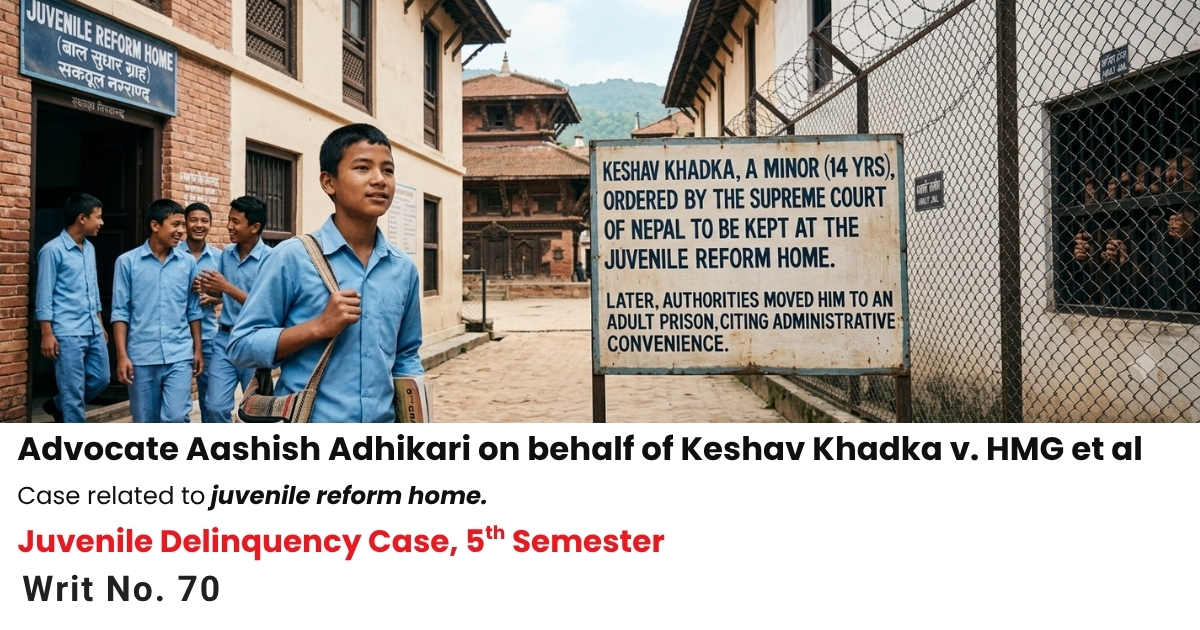
This case is related to juvenile reform home.
Facts of the Case:
The petitioner, Keshav Khadka, was a minor (14 years old) who had previously been ordered by the Supreme Court of Nepal to be kept at the Juvenile Reform Home (Bal Sudhar Griha) in Sanothimi, Bhaktapur rather than a regular adult prison cell. While residing at the reform home, he was enrolled in a nearby school in the 8th Grade and preparing for his annual examinations.
In total disregard of the Supreme Court’s prior ruling and his ongoing education, authorities later extracted him from the reform home and placed him back with adults in the jail. The authorities justified this through bureaucratic oversights, claiming a lack of space, administrative convenience. After which, the writ petition was filed by Adv. Aashish Adhikari (working under the Free Legal Aid project of CeLRRd) challenging the legality of removing a minor from a rehabilitation center and placing them back with adults.
Legal issues:
- Whether the state can legally house or transfer a minor child into an adult prison facility after a court has mandated placement in a child reform center?
- Whether interrupting a juvenile’s education and rehabilitation by placing them in an adult prison violates their fundamental rights under the Children Act, 2048 (1992) and the UN Convention on the Rights of the Child (CRC)?
Decision of the courts:
Supreme Court:
The Supreme Court reinforced its stance on juvenile protection, ruling against the detention of the minor in an adult prison facility.
The court ordered the relevant authorities to ensure the petitioner remained or was returned to a juvenile appropriate environment (the child reform home) to ensure his physical protection, mental well-being, and the continuation of his schooling and upcoming examinations.
Principles Established:
This case established the principle that all administrative and judicial actions concerning minors must prioritize their rehabilitation, education, and welfare over punitive incarceration.
Relevance of the Case:
This case serves as a key piece of evidence demonstrating that even when the Supreme Court issues orders, justice sector actors and prison administrations frequently relapse into traditional punitive behaviors (e.g., shifting children back to adult facilities due to administrative convenience or lack of institutional capacity).
Source: Baseline Survey on Juvenile Justice System in Nepal, 2010 {KSL JOURNAL}