
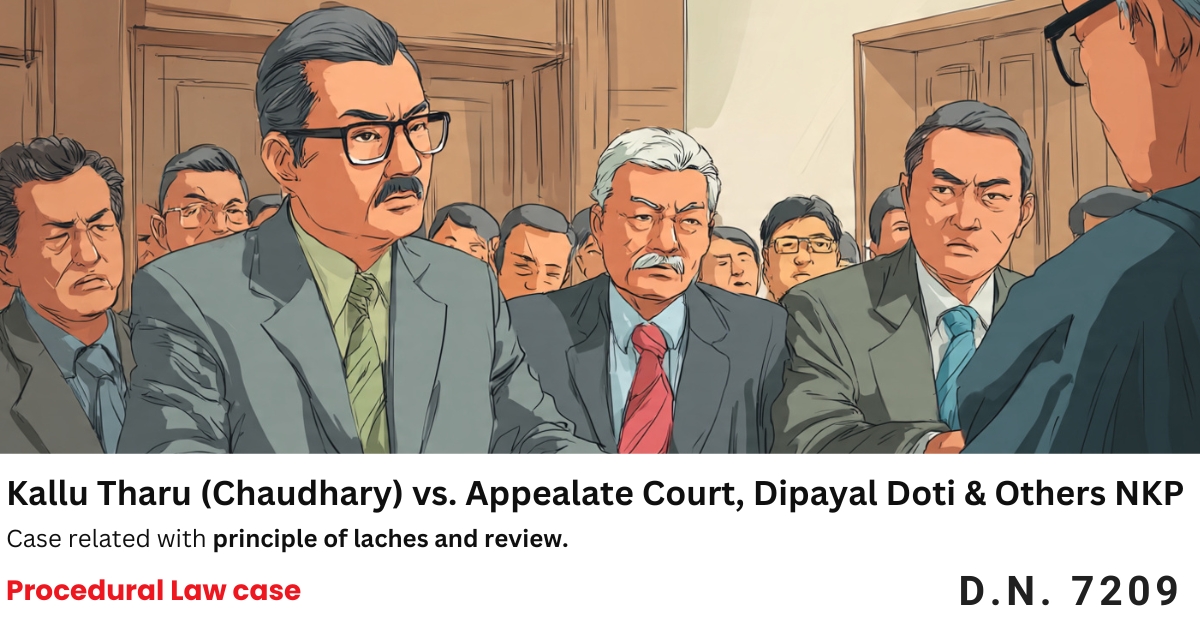
Procedural Law Case: Kallu Tharu (Chaudhary) vs. Appealate Court, Dipayal Doti & Others NKP(2060), NO.3/4, DN: 7209
Case: Mandamus and Certiorari
Plaintiff: Kallu Tharu
Respondent: Appealate Court, Dipayal Doti and Others
Decision No: 7209
This case is related with principle of laches and review.
Facts of the Case:
Petitioner Kallu Tharu had been cultivating land owned by the respondent, Sabitri Devi Bhandari, as a tenant. He initially filed an application at the Land Administration Office in Kailali, Dhangadhi, seeking formal recognition and maintenance of his tenancy rights. While the matter was pending, both parties reached a mutual agreement and submitted a joint petition to the Dang, Banke, Kailali Tribunal on 2031/1/21, whereby Kallu Tharu agreed to provide 55 manas of paddy annually. Based on this agreement, he received a tenancy rights certificate from the Land Administration Office, Kailali. Since then, he has regularly delivered the agreed amount of paddy each year and continued cultivating the land.
Later, the petitioner submitted a separate petition to the Land Reform Office, requesting the allotment of land in accordance with his tenancy rights. However, the office questioned the legality of his tenancy status and refused to allocate the land. Kallu Tharu then appealed the decision, but the Dipayal Appellate Court dismissed his appeal, leaving the matter unresolved.
Claim of the Plaintiff:
The plaintiff argues that the decision not to allot the land was made without properly examining the evidence and without considering the documents that clearly prove his tenancy rights. Such a decision, according to him, is arbitrary and unjust. He further claims that the rulings of both the Land Reform Office and the Dipayal Appellate Court violate Articles 11 and 17 of the Constitution, making them illegal and beyond their lawful jurisdiction. Therefore, the plaintiff asserts that these decisions cannot be upheld.
Arguments of the Defendant:
Appellate Court:
The appellate court argues that the petition was rightly dismissed because the Land Act 2021 contains a provision that bars appeals in such matters. Since the decision did not infringe upon any of the petitioner’s civil or constitutional rights, the court maintains that its dismissal was lawful.
Land Reform Office:
The Land Reform Office states that its decision was based on the fact that the submitted documents were insufficient to establish that the petitioner was a legally recognized tenant. Therefore, the refusal to allot land was justified.
Sabitri Devi Bhandari (Respondent):
She contends that the petitioner is seeking to overturn the decisions of both the appellate court and the Land Reform Office. However, to challenge the appellate court’s decision, the petitioner must rely on the provisions of the Justice Administration Act 2048. Even though a petition was filed, there was no legal basis for an appeal in the first place. Only after failing to obtain relief did the petitioner file a writ petition, which has resulted in a significant delay.
Thus, the respondent argues that the writ petition is time-barred and should be quashed.
Decision of the Supreme Court:
The Supreme Court quashed the petitioner’s writ petition on several grounds:
- The proper way to challenge the decision of the appellate court is as provided under the Justice Administration Act 2048. There is no alternative provision for reversing such a decision through a writ petition.
- Since the writ jurisdiction could not be invoked in this matter, there was no issue for the Court to examine under the writ process. As such, the petition against the appellate court’s decision was effectively without basis from the start.
- It is neither the judicial tradition nor the principle of this Court to repeatedly review the same decision.
- The principle of judicial certainty prevents a party from pursuing a new judicial route after failing to obtain relief through the proper legal path.
- The fact that the writ petition was filed after a long period and after spending time in the wrong forum does not exempt it from the application of the principle of Laches. Even when earlier proceedings were pursued incorrectly, the time elapsed still attracts the legal consequences of laches.
Principle Established:
Our judicial tradition and principles do not allow repeated judicial review of the same decision on the grounds of whether it is correct or incorrect. After failing through one judicial process, seeking another route is also not permissible, as it goes against the principle of judicial certainty.
The fact that the writ petition was filed after a long period and after spending time in the wrong forum does not exempt it from the application of the principle of Laches.