PNC Through My Eyes
Where Silence Becomes Survival
The first thing PNC (law faculty) taught me was fear not of failure, not of academics, but of being seen.
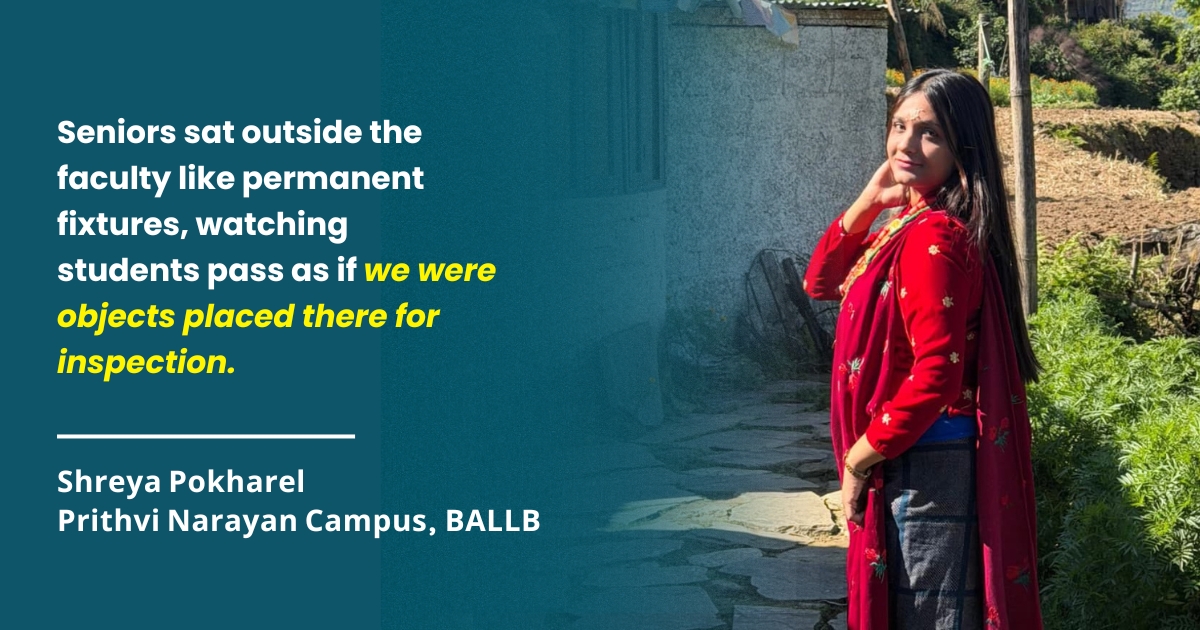
On Magh 15, 2080, before I attended a single class, before I opened a single book, I learned what it feels like to be reduced to a body. Seniors sat outside the faculty like permanent fixtures, watching students pass as if we were objects placed there for inspection. Their eyes were not curious. They were consuming. It didn’t matter how you dressed, how confident you looked, or how invisible you tried to be the stare followed, heavy and violating. It felt less like entering a university and more like stepping into a space where boundaries had already been decided and none of them were yours.
That discomfort didn’t fade. It settled. It became background noise, the kind you’re told to ignore if you want to survive.
People like to talk about “adjustment” as if it’s maturity.
What they really mean is endurance. Endure the staring. Endure the entitlement. Endure the quiet understanding that your safety, your dignity, your voice are secondary to someone else’s comfort. Endure the quiet realization that your dignity is negotiable, and that negotiation has already been completed without you.
This was not an accident. This was culture. And culture, once normalized, stops shocking you and it just starts shaping you.
From there, everything else followed. It educates.
PNC did not slowly disappoint me it revealed itself the moment I entered… The first lesson was fear.
The second was realization: diversity is not always virtue. PNC presents itself as a melting pot, a place to grow, to meet different minds, to challenge yourself.
PNC prides itself on diversity a beautiful word, almost sacred in how easily it is used. But no one speaks of the other side of diversity: the coexistence of unevolved minds. Adults, by age, yet children in instinct. Emotionally unregulated, intellectually lazy, morally convenient.
Then you notice it’s not a joke, it’s your life now. Five years, stuck in proximity with the immature, the petty, the loud, the arrogant, and the unrelentingly stupid. And the worst part? They are the ones defining norms, defining morality, defining who survives socially and academically.
The senior culture is no less devastating.
You do not think here. You agree.
Right and wrong are irrelevant. Consensus is everything. If many dislike one, you must too.If you refuse, you become the next object of correction. Neutrality is treated as betrayal. Questioning is treated as sin. Voice is punished.
Everyone claims innocence. Especially the guilty. Speak up for something or someone and watch carefully: they will ensure you are never allowed to speak of it again.
Because morality here is decided not by truth or ethics but by numbers, by majority, and by performance of loyalty.
There is a peculiar skill one develops here the ability to silence others without appearing oppressive. To isolate without direct confrontation. To rewrite narratives until truth itself becomes socially inconvenient.
Victimhood is an art form. Narcissism is celebrated. Both are worn openly, proudly, and with zero shame. PNC should host award shows for mastery in both. Friendship? Only if you thrive on toxicity. Otherwise, prepare to be isolated, mocked, or erased quietly.
And academics… the academics are the cruelest joke of all.
You are handed a syllabus. A schedule. A promise of meritocracy.
Then you discover the unwritten curriculum.
It teaches who to flatter, when to appear, who to avoid, and how proximity merely can start masquerading as competence.
No textbook covers this. Yet, graduates emerge in honors, their knowledge optional, their cunning mandatory.
How else do you explain to a student with no conceptual clarity, no subject knowledge, no intellectual discipline becoming a topper? How do you explain another student who wrote a strong exam failing because they had personal conflict with someone in power?
Merit is not measured. Merit is negotiated. Talent is irrelevant. Allegiance matters. Everyone sees it. But no one speaks.
Not because they are ignorant but because they understand the cost of honesty. Silence at PNC is not confusion. Silence is survival. Neutrality is not ethics; it is self-preservation.
What disgusts me most is selective morality. People who post endlessly about justice, rights, and oppression on social media suddenly lose their voice when injustice is inconvenient. They speak loudly but only when they are the victim. Another person’s suffering does not register. Empathy here is conditional.
Nice activism. Very aesthetic.
And some people master the dangerous duality PNC encourages; they are powerful and helpless at the same time. Victims when questioned. Confident when rewarded. Fragile when accountable. Dominant when protected. It is a performance worthy of study.
If you are studying law here, ask yourself: What is the point of studying justice if courage is punished? If the people reward manipulation over intellect? If survival requires silence and proximity?
This is the curriculum they never teach. This is the lesson you cannot unlearn. This is the education PNC offers:
- Survival at the cost of truth.
- Success at the cost of morality. Respect at the cost of intellect.
And when you finally step out, years later, you realize the institution didn’t just fail to educate you. It trained you to accept cruelty. It normalized manipulation. It made injustice routine. And it made people like this seem… ordinary.
If you leave this place thinking you’ve learned law, think again. You’ve learned something far more devastating: how far humans are willing to betray decency when power is on the line.
This is what PNC perfects.
The confidence to be wrong loudly.
Competence is quiet. Proximity makes noise.