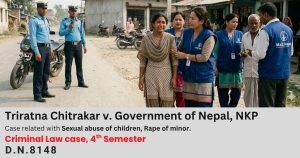

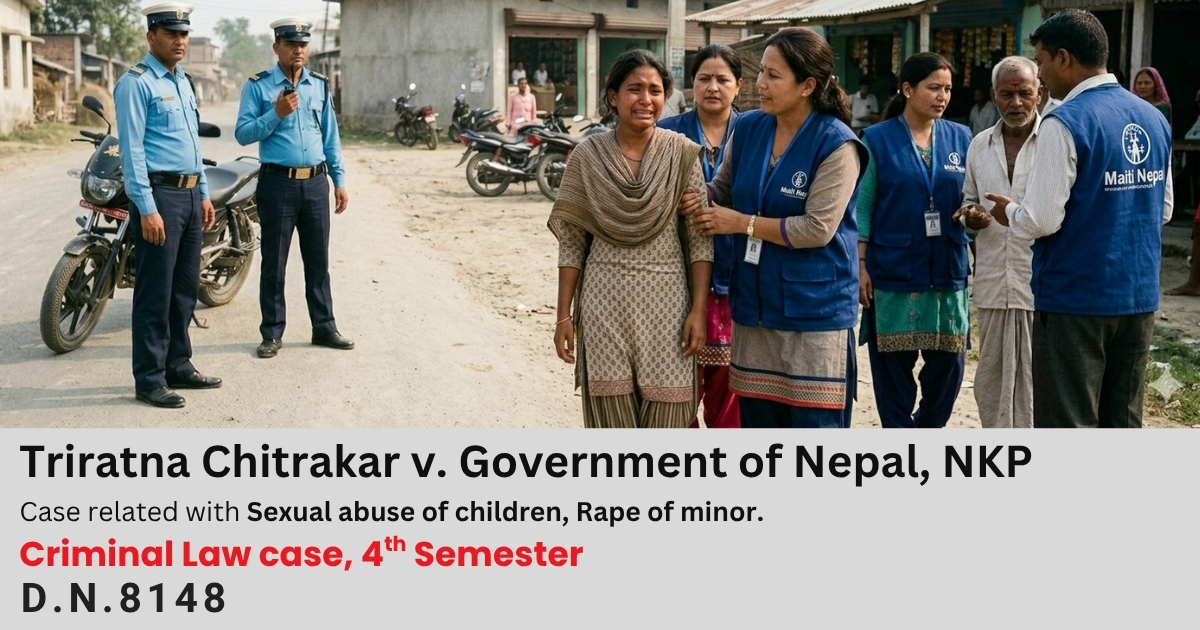
Criminal Law Case: Triratna Chitrakar v. Government of Nepal, NKP 2066, No. 5, DN: 8148
Case: Rape of Child
Plaintiff: Government of Nepal on behalf of Maiti Nepal Branch office, Hetauda
Defendant: Triratna Chitrakar
Decision Number: 8148
Note: This was the first case in Nepal from which the practice of in camera hearing(closed hearing) in rape cases began.
This case is related with Sexual abuse of children, Rape of minor.
Facts of the case:
An 11 years old girl from Bara was found crying and rescued by police. Police informed Maiti Nepal(a NGO) Hetauda Branch, upon inquiry by Maiti Nepal, girl stated that Triratna Chitrakar, a 59 year old man in whose house she worked as a domestic servant, had been repeatedly raping her for the past three years.
According to statement of victim’s father Lal Bahadur Lama Jimba, accused Triratna Chitrakar had lured them and taken the girl to his house three years prior under the pretext of providing her with an education, companionship for his wife, and support for her future marriage. Due to extreme poverty and a lack of awareness, the family had sent young girl to work as a domestic helper.
Victim provided consistent statements during police investigation and in court. She testified that, accused did following things repeatedly over three years: inserting his finger into her vagina, sucking her breasts, forcing her to perform oral sex, showing her pornographic material, and raping her. She stated that the first time he raped her, she bled from her vagina and cried because of the pain, and accused also beat her.
Medical examination report showed bruises on her left breast, nipple raised half an inch, her hymen torn, and the lower part of her vulva slightly torn.
However, defendant denied the allegations, claiming: injuries on victim were self-inflicted or caused by an accidental fall, he suffered from physical impotence and was unable to have sexual relations for 7-8 years, the girl have habit of cracking jokes with him, she used to touch his penis, while washing utensils she used to expose her breast, she had habit of pulling & pressing her own breast so the victim was falsely accusing him out of greed for property (inheritance).
Maiti Nepal file FIR against the defendant and requested necessary legal action be initiated against him.
Legal Issues:
Whether the consent of a minor is relevant or constitutes a defense in a rape case.
Whether the sole testimony of a minor victim is sufficient to establish guilt in a rape case.
Decision of the Courts:
Makwanpur District Court:
Makwanpur District Court, after examining victim’s testimony, medical report, and defendant’s own voluntary statement to police, found defendant guilty of offense of rape. District Court sentenced him to 10 years imprisonment under Section 3(2) of Chapter on Rape of Muluki Ain, and also ordered that half of the defendant’s share of property be paid to victim as compensation under Section 10 of same Ain.
Hetauda Appellate Court:
Appellate Court upheld District Court’s finding that defendant was guilty. However, Appellate Court reduced sentence from 10 years to 7 years imprisonment without providing any reasoning, justification, or legal basis for the reduction.
Supreme Court:
Supreme Court of Nepal, in its joint bench review, strongly criticized Appellate Court’s decision. Supreme Court held that this offense was not ordinary rape but a classic case of Custodial Rape (sexual assault of a minor under one’s control) and Pedophilia (adult sexual attraction to children). Court stated that Appellate Court acted arbitrarily and exercised its discretionary power improperly by reducing sentence without any valid justification. Ultimately, because Nepal Government did not challenge reduction of sentence from ten to seven years, Supreme Court was forced to let the seven-year sentence stand. Court directed all district courts and appellate courts, from now on take into account the gravity of offence, harm caused to victim, and all relevant sentencing factors when determining punishment in rape cases.
The court affirmed that this was in all likelihood the first case in Nepal where the repeated sexual exploitation of a minor by a pedophile who held child under his control had come to the attention of the judiciary, and formally classified it as a case of Custodial Rape. The court further directed the Registrar to write to all district courts instructing them to conduct proceedings in rape cases in closed court(in camera hearing) sessions.
Regarding compensation, Supreme Court directed District Court of Makwanpur to actively enforce earlier order regarding transfer of half of accused’s property share to victim, without waiting for victim to file a fresh application. Court also took strong note of the failure of public prosecutor to charge accused under multiple crimes, namely intentional assault, unnatural sexual intercourse, and rape.
Principle Established:
- Consent of a minor is irrelevant: consent of a minor has no legal value and is not a defence under the law.
- Victim’s sole testimony is sufficient evidence: In sexual assault cases, credible and reliable testimony of victim alone is sufficient to establish the guilt of accused, even without supporting evidence.
- Proceedings in rape cases must be held in closed court(in camera hearing): All proceedings in rape and sexual assault cases must be conducted in closed court(in camera hearing) sessions, limiting presence to the parties, their legal representatives, witnesses, victim’s close relatives, public prosecutor, and relevant court staff to protect the dignity, privacy, and wellbeing of victim.
- Custodial Rape recognized as an aggravated offence(serious offence): Sexual assault committed by a person having control over victim, such as an employer over a domestic worker, constitutes Custodial Rape and is to be treated as a particularly grave form of offence.
- Sentencing must be proportionate and reasoned: Courts must consider gravity of offence, harm suffered by victim, number of times offence was committed, manner of commission, and vulnerability of victim when imposing sentence.
- Appellate courts cannot reduce sentences without reason: An appellate court does not have authority to arbitrarily reduce a sentence imposed by a district court in a serious criminal case without providing clear legal grounds and justification for doing so.
- Multiple offences must be charged separately: Where the evidence discloses distinct criminal acts such as intentional sexual assault, rape, and unnatural sexual intercourse, prosecution is obligated to frame separate charges for each offence.
Note: This was the first case in Nepal from which the practice of in camera hearing(closed hearing) in rape cases began.