

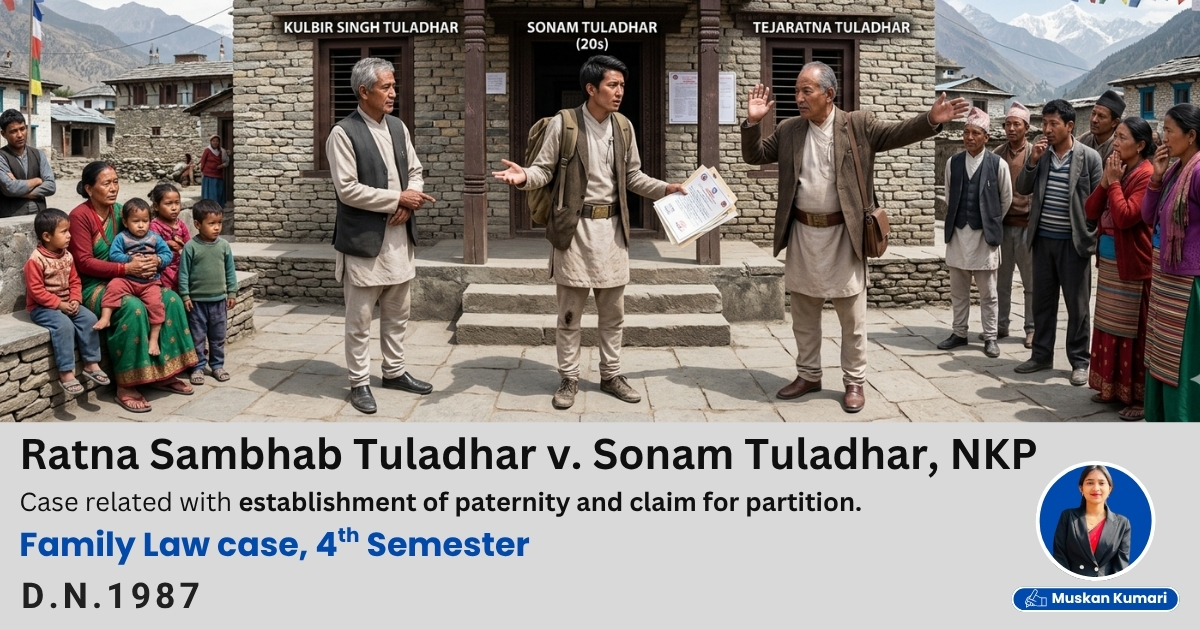
Family Law Case: Ratna Sambhab Tuladhar v. Sonam Tuladhar, NKP 2041, No.5, P.424, D.N:1987
Case: Paternity and Partition
Plaintiff: Sonam Tuladhar
Defendant: Tejaratna Tuladhar et.al.
Decision Number: 1987
This case is related with establishment of paternity and claim for partition/inheritance share.
Fact of the case:
Sonam Tuladhar filed a suit seeking determination of his legal father and claiming partition or inheritance rights. Sonam had been raised as the son of Kulbir Singh Tuladhar and had also identified Kulbir Singh as his father in his citizenship documents as well as in earlier legal proceedings. However, during a citizenship related case, both his mother and father, Nima Tuladhar, and Kulbir Singh stated that Sonam was actually the son of Tejaratna Tuladhar. These contradictory statements created confusion regarding Sonam’s biological father. When Sonam approached Tejaratna Tuladhar regarding the matter, Tejaratna also denied paternity.
Nima Tuladhar stated that she had lived with Tejaratna Tuladhar in Lhasa in the year 2003 B.S. and that Sonam was born in Lhasa in 2005 B.S. from their relationship. She further explained that only later, she begin living with Kulbir Singh Tuladhar, from whom she had other children. Kulbir Singh argued that Sonam had already been born before his relationship with Nima began. Similarly, Tejaratna Tuladhar denied being Sonam’s father and claimed that he had already returned to Kathmandu before Sonam’s birth. Since both men denied paternity, Sonam ultimately filed the present case before the Court seeking determination of his real father and claiming inheritance rights accordingly.
Legal Issues:
- Whether a paternity suit is maintainable when the plaintiff himself is uncertain about his father.
- Whether the mother’s statement (petboli) can be used as strong evidence to determine paternity.
- Whether Sonam is the son of Kulbir Singh or Tejaratna Tuladhar.
Decision of the Courts:
Kathmandu District Court:
Kathmandu District Court held that Sonam Tuladhar was the son of Tejaratna Tuladhar. However, Court stated that the issue relating to partition or inheritance rights could not be decided through this suit. Dissatisfied with the decision, the matter was taken before the Madhyamanchal Regional Court.
Madhyamanchal Regional Court:
On 2037/10/14, Regional Court upheld the decision of District Court and confirmed that Sonam Tuladhar was the son of Tejaratna Tuladhar. It also maintained the dismissal regarding the partition claim in the same proceeding.
Supreme Court (Division Bench):
Thereafter, matter reached Supreme Court before a Division Bench, where conflicting opinions arose between the judges. Justice Dhanendra Bahadur Singh held that the claim was maintainable, that paternity could legally be determined through the suit, and that the evidence sufficiently proved Tejaratna Tuladhar to be Sonam’s father.
On the other hand, Justice Gajendra Keshari Bastola took the view that the suit contained an uncertain claim because the plaintiff himself appeared uncertain regarding his father’s identity, and therefore the claim should fail. Due to these conflicting opinions, case was referred to Full Bench of Supreme Court.
Supreme Court (Full Bench):
On 2041/05/15, Full Bench of Supreme Court upheld the opinion of Justice Dhanendra Bahadur Singh and confirmed lower courts decision that Sonam Tuladhar was the son of Tejaratna Tuladhar. Court emphasized that, in case of paternity establishment mother’s statement is regarded as major evidence, mother’s statement is carried significant importance in determining paternity. Court said that, since the child was born from mother’s womb, paternity cannot be determined on the basis of real fact. It is always based on the affirmation of the mother. It further observed that the testimony of close relatives strongly supported the claim that Tejaratna was Sonam’s father. Consequently, the appeal filed by Tejaratna Tuladhar was dismissed, and the judgments of Kathmandu District Court and Madhyamanchal Regional Court were affirmed.
Principle Established:
Maternity is a definite biological fact because a child is born from the mother’s womb, but paternity cannot be determined with the same certainty and is often based on presumption and surrounding evidence.
-
- A mother’s statement is important evidence in paternity disputes.
- Paternity may be proved through surrounding circumstances and witness testimony.
- A suit does not fail merely because the child is uncertain about his biological father if such uncertainty was caused by others.