

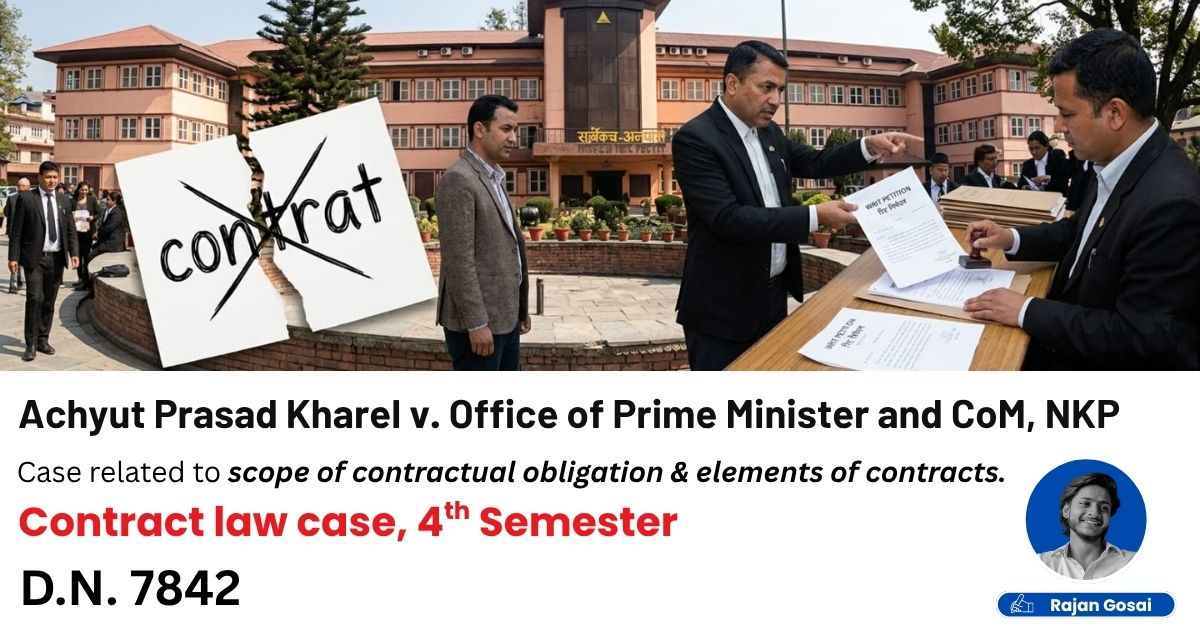
Contract Law Case : Achyut Prasad Kharel v. Office of the Prime Minister and Council of Ministers, Writ no. 2063-WS-0027, NKP 2064, No.5, DN: 7842
Case: Mandamus, Certiorari
Plaintiff: Advocate Achyut Prasad Kharel
Defendant: Office of the Prime Minister and Council of Ministers, among others
Decision no: 7842
This Writ Petition is Regarding with the Validity of Civil Imprisonment and the Scope of Contractual Obligations.
Facts of the Case:
Muluki Ain, 2020 no. 42(2) provision regarding punishment provides that , while recovering capital through confiscation, if the total capital cannot be collected through confiscation then remaining capital can be recovered by making application for imprisonment according to Number (19) provision regarding transaction, Number (10) provision regarding bankrupt, Number (10) provision regarding non-payment, Number (10) provision regarding theft Number (9) provision regarding arson within 7 days from the date confiscation.
Apart from the no. 10 of provision regarding theft and no. 9 of provision regarding arson of Muluki Ain 2020, remaining mentioned provisions are inconsistent with article (11) of ICCPR which provide that “No one shall be imprisoned merely on the ground of inability to fulfill a contractual obligation” approved by the Parliament of Nepal. Thus, according to article 88(1) of constitution of kingdom of Nepal, plea to the honorable court is to declare above inconsistent provisions of Muluki Ain, 2020 void.
As per 42 No. 2 of Muluki Ain, 2020 When a person responsible is made to pay the amount and if such amount is less or not enough even including his all property, then instead of the amount left unpaid, the person is to be imprisoned as per the provisions in
i) Lenden Byabaharko 19 No. (25 Rs. Per day not exceeding 1 year)
ii) Damasahiko10 No. (25 Rs. Per day not exceeding 6 months)
iii) BaakiNatirneko 10 No. (25 Rs. Per day not exceeding 1 year)
iv) Choriko 10 No. (25 Rs. Per day not exceeding 2 years)
v) Aago lagauneko 9 No. (25 Rs. Per day not exceeding 2 years)
Plaintiff’s Argument: Under Section 9(1) of the Nepal Treaty Act, 2047, any domestic law that contradicts an international treaty to which Nepal is a party becomes invalid to the extent of that contradiction. Therefore, the Muluki Ain provisions allowing imprisonment for civil matters conflict with the ICCPR and must be declared null and void.
Defendant’s Argument: Representing the government, the defense argued that failing to pay regular transaction debts, insolvency claims, or outstanding government dues does not stem from a “contractual obligation.” Instead, these are general civil and statutory liabilities. Because not all civil liabilities constitute contracts, these provisions do not conflict with the international covenant.
Legal Issues:
- Do the provisions of the Muluki Ain (concerning transactional matters, insolvency, outstanding government dues, etc.) fall within the definition of a “contractual obligation”?
- Can these provisions be declared unconstitutional or invalid as demanded by the petitioner?
Court’s Decision:
Special Bench of Supreme Court dismissed the writ petition. The court refused to invalidate the contested provisions of the Muluki Ain, ruling that the existing national laws were constitutionally valid and would remain fully operational.
Established Principles:
- Distinction Between Contractual and Civil Liability: Civil law is a distinct legal area, and liabilities within it can also be created by other legal provisions or transactions outside of a contract. All subject matters or transaction behaviors covered under general civil law cannot be included together and classified as contractual obligations.
- Essential Elements of a Contract : For a legally valid contract to exist under contract law essential elements must be present. These include competent parties, mutual understanding a lawful object, a certain consideration, and compliance with the procedure prescribed by law.
- Boundaries of Contractual Obligations: A liability is considered a “contractual obligation” only when it arises from a contract that fulfills all these essential elements of the Contract Act.
Relevancy of the Case:
This judgment holds an important place in Nepali jurisprudence due to its significance in the following areas:
Jurisprudential Clarity: The decision created a boundary line between a “contractual obligation” and a “general civil or statutory liability,” preventing any legal overlap between the two.
Interpretation of International Treaties: It established that the protections under Article 11 of the ICCPR cannot be generalized to evade individuals from accountability under domestic civil laws, such as standard personal debts or state dues.