
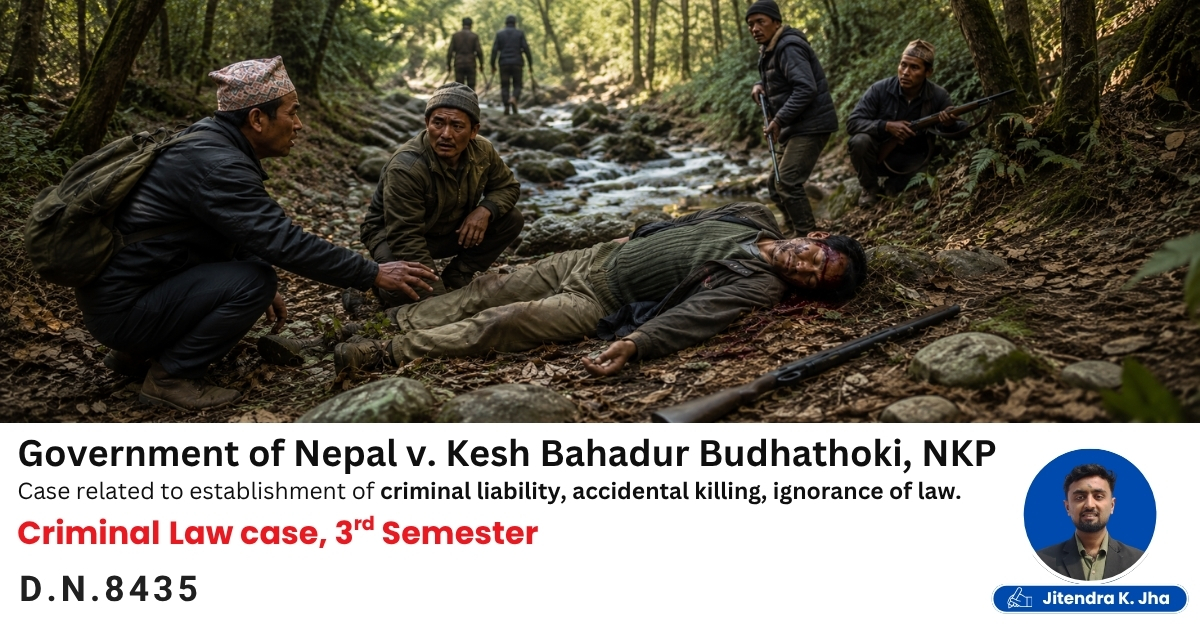
Criminal Law Case: Government of Nepal v. Kesh Bahadur Budhathoki, NKP 2062, D.N. 8435, (Mistake of fact)
Case: Culpable Homicide
Plaintiff: Government of Nepal on the complaint of Resham Bahadur Khatri
Defendant: Kesh Bahadur Budhathoki
Decision Number: 8435
This case is related with establishment of criminal liability in an accidental killing during hunting and ignorance of law.
Facts of the Case:
On Magh 11, 2063 B.S., Gir Bahadur Khatri, Kesh Bahadur Budhathoki, and some other friends (total of five persons) went to Durdra Khola forest in Dang for hunting. Members of the group(Gir Bahadur Khatri, Gun Bahadur & Baliram Pun) went to drive birds and animals toward the hunters, while Kesh Bahadur, Giriraj, and Hom Bahadur waited with holding guns. While waiting, Kesh Bahadur heard movement and rustling sounds in the bushes. Believing that a wild animal was coming, he fired his gun. However, the bullet hit his friend Gir Bahadur Khatri instead of an animal, and Gir Bahadur died at the spot due to the gunshot injury.
After the incident, Kesh Bahadur informed the other members about what had happened. The postmortem report confirmed that the death was caused by a gunshot injury. Father of the deceased filed a complaint demanding legal action against Kesh Bahadur. During investigation and trial, it was proved that the bullet fired by Kesh Bahadur caused the death. However, the defendant consistently stated that he did not intentionally kill Gir Bahadur and that he mistakenly fired at him thinking he was an animal. Even the deceased’s father stated before the court that the shooting happened accidentally.
Legal Issue:
- Whether the death of Gir Bahadur Khatri was an intentional homicide or an accidental death.
- Whether the defendant fired the gun with intention to kill the deceased.
- Whether the case falls under “mistake of fact” in criminal law.
- Whether the defendant should be punished under Section 13(1) or Section 6(2) of the Chapter on Homicide.
- Whether absence of motive, enmity, and prior planning affects criminal liability.
Decision of the Courts:
Dang District Court:
Dang Deukhuri District Court held that the defendant was responsible for the death because he admitted firing the gun that caused the victim’s death. The court treated the act as intentional homicide under Chapter on Homicide, Section 13(1), and sentenced the defendant to life imprisonment with confiscation of property.
The court’s decision was mainly based on the fact that the defendant admitted firing the shot and that the death directly resulted from his action.
Tulsipur Appellate Court:
The defendant appealed against the District Court’s judgment. The Appellate Court of Tulsipur carefully examined the circumstances of the incident, witness statements, and other evidence. The court found that there was no prior enmity, intention, or plan to kill the deceased. The court concluded that the defendant mistakenly believed that he was shooting at a wild animal while hunting and accidentally shot his friend. Therefore, the death was considered accidental due to a mistake of fact rather than intentional homicide. Accordingly, the Appellate Court reversed part of the District Court’s decision and sentenced the defendant to one year imprisonment under Section 6(2) of the Chapter on Homicide.
Supreme Court Decision:
Government of Nepal appealed to the Supreme Court, arguing that the Appellate Court had made an error by treating the case as accidental death instead of intentional homicide. After reviewing all evidence, witness statements, and the surrounding circumstances, the Supreme Court upheld the Appellate Court’s decision. The Court explained that in criminal law, a genuine “mistake of fact” may excuse criminal liability in certain situations. Court found that the defendant reasonably believed that an animal was approaching and fired the gun without knowing that the deceased was there. The Court also noted that there was no evidence of prior enmity, intention, or planning to kill the deceased.
Therefore, the Supreme Court confirmed the Appellate Court’s judgment and held that the defendant should be punished under Section 6(2) with one year imprisonment.
Principle Established:
- Ignorance of law is not an excuse in criminal law.
- A genuine and reasonable mistake of fact may excuse criminal liability.
- Intentional homicide requires clear intention, motive, or prior planning to kill.
- If death occurs accidentally without criminal intention, lesser punishment may apply.
- Criminal liability depends on both the act committed and the intention behind the act.