
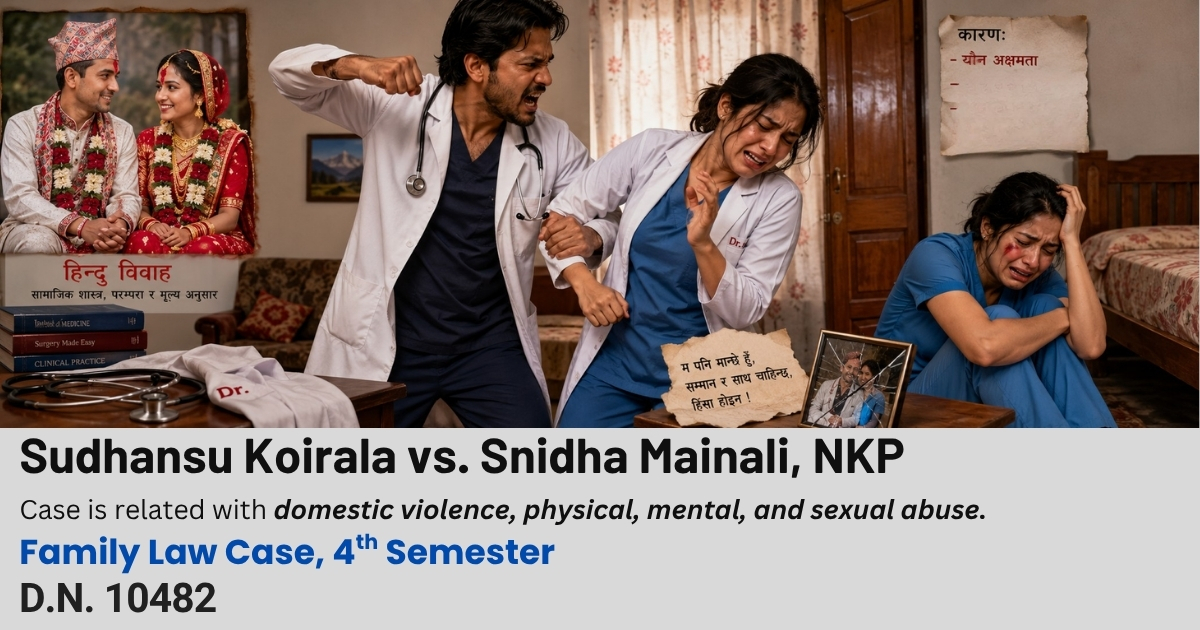
Family Law Case: Sudhansu Koirala vs. Snidha Mainali, NKP 2077 B.S., Vol. 62, D.N: 10482
Case: Domestic Violence
Appellant/Defendant: Sudhansu Koirala
Respondent/Plaintiff: Snidha Mainali
Decision Number: 10482
This case is related to domestic violence within marriage, including physical, mental, and sexual abuse, the doctrine of continuing offence, and the victim’s right to treatment expenses and compensation under the Domestic Violence (Crime and Punishment) Act, 2066.
Facts of the Case:
Dr. Snidha Mainali and Dr. Sudhansu Koirala, both medical doctors, were married on 2069/08/14 in accordance with social customs and traditions. Shortly after their marriage, disputes arose between them. The plaintiff alleged that the defendant had concealed his sexual incapacity before the marriage and, thereafter, whenever this issue was raised, he became angry and started physically assaulting, threatening, and mentally harassing her.She further alleged that one of the assaults resulted in a fracture of her tailbone and that the defendant also created disturbances at her workplace and clinic, causing her humiliation and emotional distress.
Claiming that she had been subjected to continuous physical, mental, and sexual abuse amounting to domestic violence under the Domestic Violence (Crime and Punishment) Act, 2066, she filed a complaint against her husband and also implicated her father-in-law and mother-in-law for their alleged involvement. She sought punishment of the defendants, along with treatment expenses and compensation as provided under the Act.
Legal Issues:
- Whether the defendant committed domestic violence under the Domestic Violence (Crime and Punishment) Act, 2066.
- Whether the plaintiff’s complaint was filed within the statutory limitation period.
- Whether the plaintiff was entitled to both treatment expenses and compensation under the Act.
Decision of the Courts:
Kathmandu District Court:
District Court held that Dr. Sudhansu Koirala had committed domestic violence to his wife, Dr. Snidha Mainali by physically assaulting and mentally abusing her after marriage. The Court held that such acts amounted to domestic violence under Section 3 of the Domestic Violence (Crime and Punishment) Act, 2066, which defines physical, mental, emotional, sexual, and economic abuse committed by one family member against another. Accordingly, the Court convicted Dr. Sudhansu under Section 13, which provides punishment for committing domestic violence. It also ordered him to pay all medical treatment expenses under Section 9 and provide compensation under Section 10 for the physical and mental suffering caused to his wife. However, the allegations against his father and mother were not proved, so they were acquitted.
Patan Appellate Court:
Appellate Court upheld the District Court’s judgment, affirming the defendant’s conviction, punishment, treatment expenses, and compensation.
Supreme Court:
Supreme Court dismissed the defendant’s appeal and affirmed the lower courts’ judgments. It held that domestic violence includes physical, mental, sexual, and emotional abuse, recognized continuous domestic violence as a continuing offence, and ruled that treatment expenses and compensation are distinct remedies that may be awarded simultaneously. It also emphasized a gender-sensitive, human rights-based interpretation of domestic violence laws.
Principle Established:
Supreme Court held that domestic violence is not limited to physical assault but also includes mental, emotional and sexual abuse within marriage. It recognized continuous domestic violence as a continuing offence and emphasized that marriage must be based on equality, dignity, and informed consent, and held that treatment expenses and compensation are separate remedies that may be awarded simultaneously.
Relevancy of the Case:
This is a landmark decision on the interpretation of the Domestic Violence (Crime and Punishment) Act, 2066. It broadened the scope of domestic violence by recognizing physical, mental, sexual, and emotional abuse within marriage, treated continuous domestic violence as a continuing offence for limitation purposes, affirmed that treatment expenses and compensation are independent remedies, and emphasized a gender-sensitive, human rights-based approach to the protection of victims.