

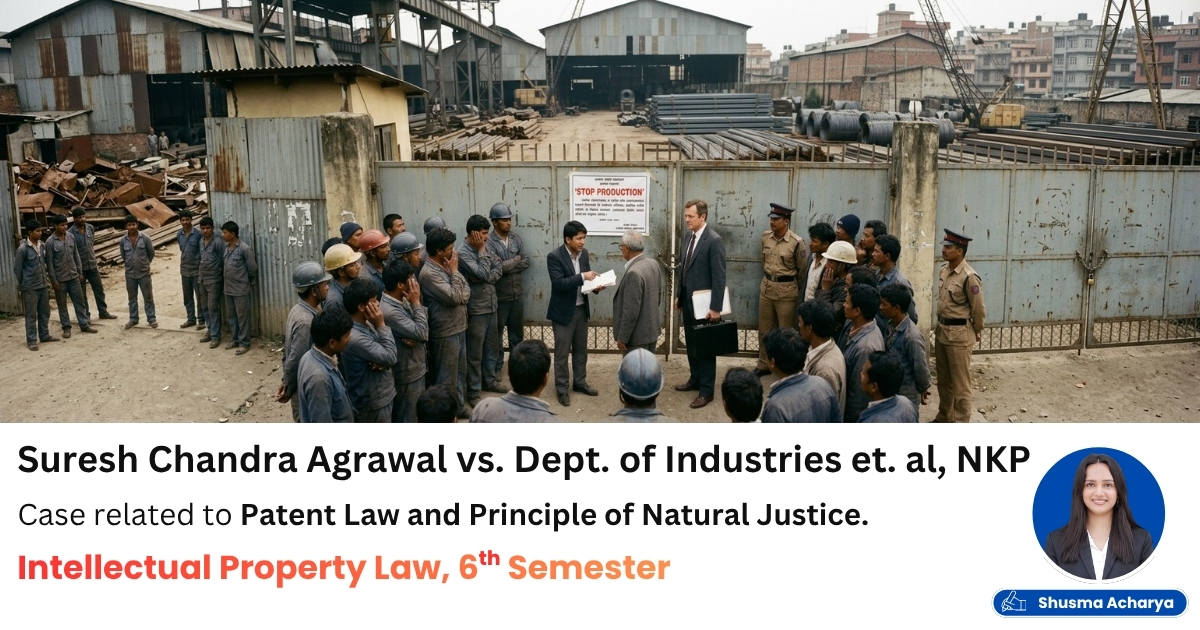
Intellectual Property Case: Suresh Chandra Agrawal vs. Dept. of Industries et. al, NKP 2049 B.S, Issue 8, DN 4605-1, p.791
Case: Writ of Certiorari
Plaintiff/Applicant: Suresh Chandra Agrawal on behalf of Ashok Steel Industries Pvt.Ltd.
Defendant/Respondent: Department of Industries, Tursteg Steel Corporation and others
Decision Number: 4605-1
This case is related to Patent Law, the right to obtain copies of official records, and Principle of Natural Justice.
Facts of the Case:
Ashok Steel Industries had been operating under a license granted by the Department of Industries since 2040/01/12, manufacturing and distributing goods that met prescribed quality standards. Luxembourg-based Tursteg Steel Corporation had filed a complaint against petitioner in the Department of Industry alleging that the company was illegally using a patented technology (“Reinforcing Concrete”) registered by Trustag Steel Corporation of Luxembourg.
The company responded that it had not produced anything under the specific patented names cited, and requested a copy of the complaint against it along with the standard applicable fee. The Department repeatedly declined to provide the copies of the complaint, the patent registration, or its own decision, even after the applicant paid the prescribed duplication fee of Rs 800. The Department later ordered the industry to stop production and communicated this to the District Administration Office, which then pressured the company to shut down. The applicant argued that the illegal and faulty unilateral decision of the Department violated the applicant’s right to equality under Article 10(1), right to property under Article 11(2) (e) and Article 15 and Section 7(a) (2) (3) (4) of the Patent, Design and Trademark Act, 2022 as well as No. 211 of the Court Procedure.
The Department of Industry argued that the copy of the patent was not provided to the petitioner since the patent had not been published in Nepal Gazette. Furthermore, the industry was notified to stop production based on the interlocutory order of the Bagmati Zonal Court.
Legal Issue:
- Whether the Department of Industries’ refusal to provide the applicant with the copies of the complaint paper, the patent registration, and its own decision – and its subsequent order halting production without allowing a chance to respond violated the principles of natural justice and the applicant’s legal and constitutional rights?
Different Courts Decisions:
Supreme Court:
The Patent, Design and Trademark Act, 2022; Section 7 (a) (1) requires patents to be published in Nepal Gazette except for the national interest. The Department of Industry’s written response did not show that the patents in question were kept confidential for reasons of national interest; where the law mandates publication of patents in the Nepal Gazette. According to Section 7 (a) (2) if anybody desires to see or copy the particulars, maps or drawings of a patent published under sub-section (1), one may be allowed to do so after paying the fees prescribed by the Department. Pursuant to Section 7 (a) (3) of the same Act, it is mentioned that if anyone has any objection against the patent one may file objection within 35 days of taking such copy and further it is provided that the department should investigate and take necessary actions after receiving such complaint as per sub-section (4).
In addition to this, the Principle of Natural Justice requires that the petitioner should be given an opportunity to refute the complaint against them by looking at the appropriate conduct and the copy of the evidence. If a copy of the complaint and copy of the decision to stop the production of the petitioner is not provided, it is not certain on what basis the petitioner will refute the allegation against them. The Court therefore held that the Department’s letter and the entire course of action relating to its refusal to provide copies disregarded the principle of natural justice, and that this conduct including the letter and the decision not to provide copies was erroneous and void, to be quashed by an order of certiorari, with mandamus additionally issued directing the Department to provide the copies in accordance with law.
Principle Established:
- A government body exercising quasi-judicial or administrative authority cannot deny a party access to the complaint, evidence, and its own decision affecting the party’s rights, especially where that party stands to suffer an adverse consequence such as halting the production. Denial of such access breaches the procedural requirement of natural justice.