
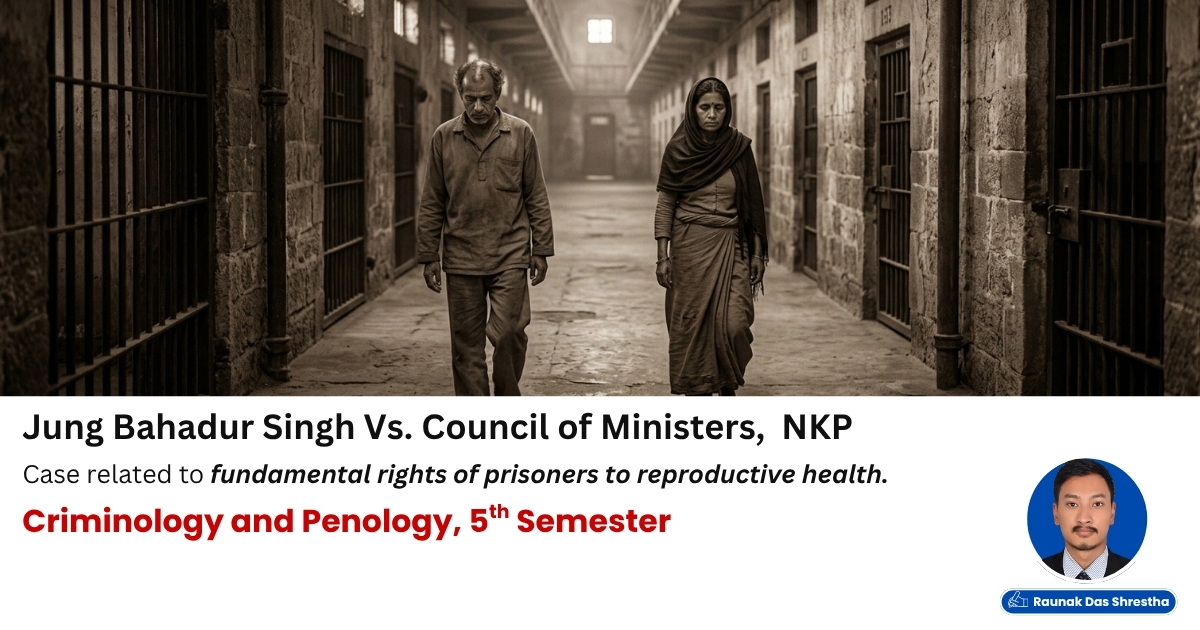
Criminology and Penology Case: Jung Bahadur Singh vs. Office of PM and Council of Ministers and others, Writ No. 2066/1222, NKP 2068 B.S, Vol. 6, p. 986, D.N. 8631
Case: writ of certiorari and mandamus
Plaintiff/Applicant: Jung Bahadur Singh and others
Defendant/Respondent: Council of ministers and others
Decision Number: 8631
This case is related to the fundamental rights of prisoners to reproductive health and reproductive rights as per Interim Constitution of Nepal, 2063. The Supreme Court considered whether the prisoners who are legally married have constitutional rights to family life.
Facts of the Case:
Married couple Surja Marik Dom and Chhotani Devi Marik Dom, who were serving life imprisonment for homicide. The husband and wife were both imprisoned in the same district prison, but were not put in the same prison cell in accordance with prison rules. The couple did not have children before they were imprisoned. They claimed that they would no longer be able to have children as they would lose their natural reproductive capacity before the end of their sentences, thus they would not be able to be a parent again. The petitioners said that Article 20 (2) of the Interim Constitution of Nepal, 2063 gives every woman the right to reproductive health and reproductive rights. They also used constitutional provisions on fundamental rights and Nepal’s commitments to international human rights treaties, such as ICCPR and ICESCR. They said that the only right that is suspended by imprisonment is the freedom of movement. Thus, the refusal of married prisoners to have the opportunity to live in a family and exercise reproductive rights infringed their fundamental rights.
The Government disagreed, stating that all constitutional rights could not be exercised in the same way by prisoners as free citizens who had been convicted of serious offences. It also argued that the current prison legislation did not include provisions for conjugal visits, and that the decision making process was the sole prerogative of the executive. In the light of the provisions of the Constitution, prison law, international human rights law and comparative international law, the Supreme Court decided that reproductive rights are fundamental rights even while the person is imprisoned and that the State has a duty to protect those rights subject to reasonable security measures.
Legal issues:
- The issue of prisoner’s constitutional right to reproductive health and reproductive rights while in custody.
- Does it infringe the fundamental rights of the prisoners, guaranteed under Interim Constitution of Nepal, 2063, to keep them in different cells of the prison without allowing any family visit?
- Whether the imprisonment suspends all the constitutional rights of a prisoner or only the right to personal liberty and movement.
Different Courts Decisions:
Supreme Court: The Court ruled that all fundamental rights are not suspended by the imposition of a sentence of imprisonment. It concluded that the prisoners, who are legally married, have the right to reproduction as guaranteed by the Constitution and ordered the Government to set up a committee, draw up suitable legislation and policy, and gradually implement a system of family (conjugal) visits for prisoners who are legally married, with due consideration to the security and discipline of prisons.
Principle Established:
- Imprisonment does not suspend all fundamental rights.
- Reproductive rights are fundamental rights and apply even to convicted prisoners.
- Prisoners should be treated with dignity and given opportunities for rehabilitation and social reintegration
- International human rights instruments can be used as a guide for constitutional interpretation.