

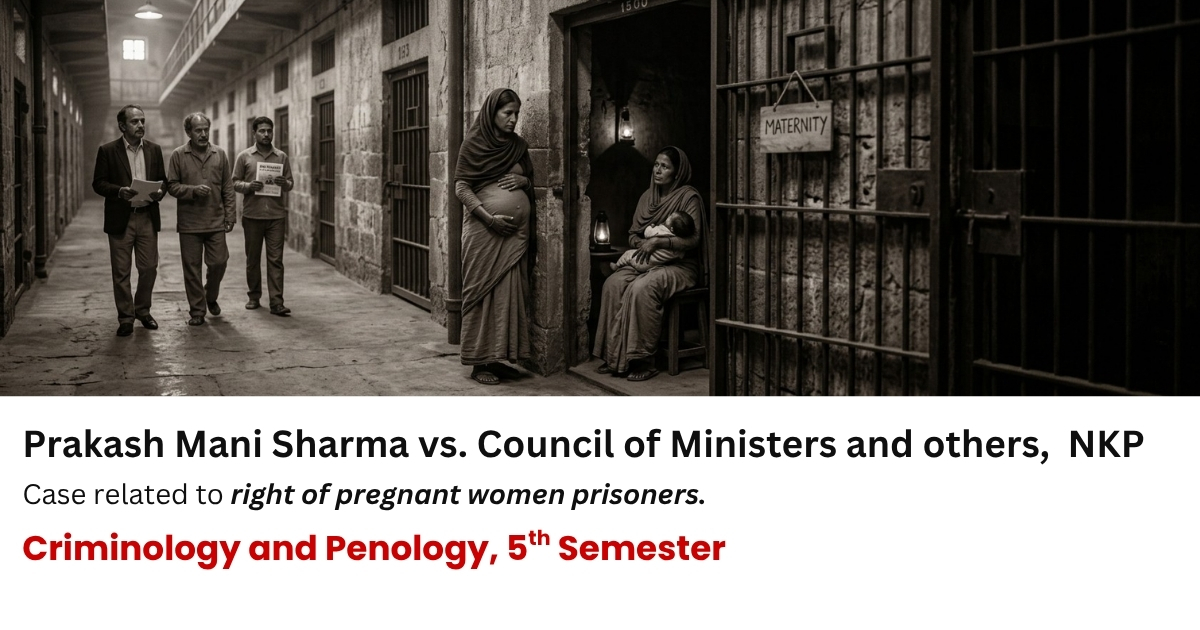
Criminology and Penology Case: Prakash Mani Sharma vs. Council of Ministers and others, NKP 2065 B.S, Vol 4. D.N. 7952
Case: Sexual Rights of Pregnant Women Prisoners
Plaintiff/Applicant: Advocate Prakash Mani Sharma & Others
Defendant/Respondent: Council of Ministers & Others
Decision Number:7952
The case is about the constitutional challenges to the provisions of the Prison Act, 2019 which barred certain categories of pregnant women prisoners from being released on bail on the basis of the gravity of their offence.
Facts of the Case:
Section 12(1) of the Prison Act, 2019 was challenged in a PIL by Janahit Sanrakshan Manch (Pro Public) and Advocate Prakash Mani Sharma. The provision was that a pregnant woman prisoner could be released on bail after six months of pregnancy, but not those convicted or charged with offences like murder, life imprisonment, offences against the State or offences involving the royal family. The petitioners argued that such a distinction is unfair to pregnant women prisoners and infringes upon the constitutional right to equality. They also argued that the State had failed to provide adequate health care, nutrition, and facilities for pregnant prisoners and their dependent children, and requested the Court to formulate national standards and direct the government to improve prison conditions.
Legal Issues:
- Whether Section 12(1) of Prison Act, 2019 infringed the constitutional right to equality by discriminating against the pregnant prisoners on the basis of the nature of their offences.
- Whether it was unconstitutional for the government to exclude prisoners convicted of serious offences from temporary release.
- Whether the Government should be directed to frame proper policies and minimum standards for the protection, health, nutrition and welfare of pregnant women prisoners and their children.
Different Courts Decisions:
Supreme Court:
The Supreme Court rejected the challenge to the constitutionality of Section 12(1) and held that classification of prisoners based on the seriousness of the offences was a reasonable and permissible classification and did not violate the constitutional right to equality. The Court has held that equality involves treating like cases alike and that unlike cases can be treated differently if there is a rational basis. The Court, however, noted that the Government has failed to address the plight of pregnant prisoners and issued a directive order to the Government to formulate and implement policies and programmes to provide proper health care, nutrition, protection and other necessary facilities to pregnant prisoners, breastfeeding mothers and their children.
Principle Established:
- Under the Constitution, reasonable classification is allowed if it is rationally related to a legitimate purpose.
- The classification of criminal offences, according to the seriousness of the offence, is constitutionally valid and not discriminatory provided it meets the test of reasonableness.
- Pregnant women convicted of serious offences are not in the same category as pregnant women convicted of ordinary offences for the purposes of temporary release.
- Even if the restriction on release is constitutionally valid, the State has an ongoing responsibility to provide adequate health care, nutrition and protection for pregnant women prisoners and their dependent children.