

I was eleven when the law learned my name for the second time and decided not to remember it again. I realized that the law, in the presence of power, could choose not to see.
Power had already taught me its grammar. I had grown up watching adults bend truth with the ease of opening a door. Our family’s name carried weight; it protected us as surely as walls and locks. I had learned early that consequence is selective that some wrongs are quietly excused while others are shouted into oblivion. Some people are born closer to forgiveness than others.
The first violation happened when I was five. I don’t describe it for spectacle. Children don’t experience violence as scenes; we experience it as weather. Pressure. Confusion. A ceiling that won’t look back. After that, my body learned to flinch before my mind learned to speak. Touch became a language I refused to read.
By seven, we moved to the capital. Every Dashain, we returned home, to rituals that pretended nothing had changed. There was a man-call him Mr. X-who belonged everywhere he shouldn’t have. He smiled like ownership. He touched like entitlement. I didn’t have words for rape then, but my body did what bodies do when they recognize danger: it memorized. He smiled with ownership. He touched as though entitlement had weight. I did not know then the word for what he was taking, but my body did.
The year I turned eleven, he came again. The house emptied in the afternoon. Quiet fell thick enough to choke on. He lied easily said everyone was out in the fields. Lies are lighter when you’ve practiced them on children.
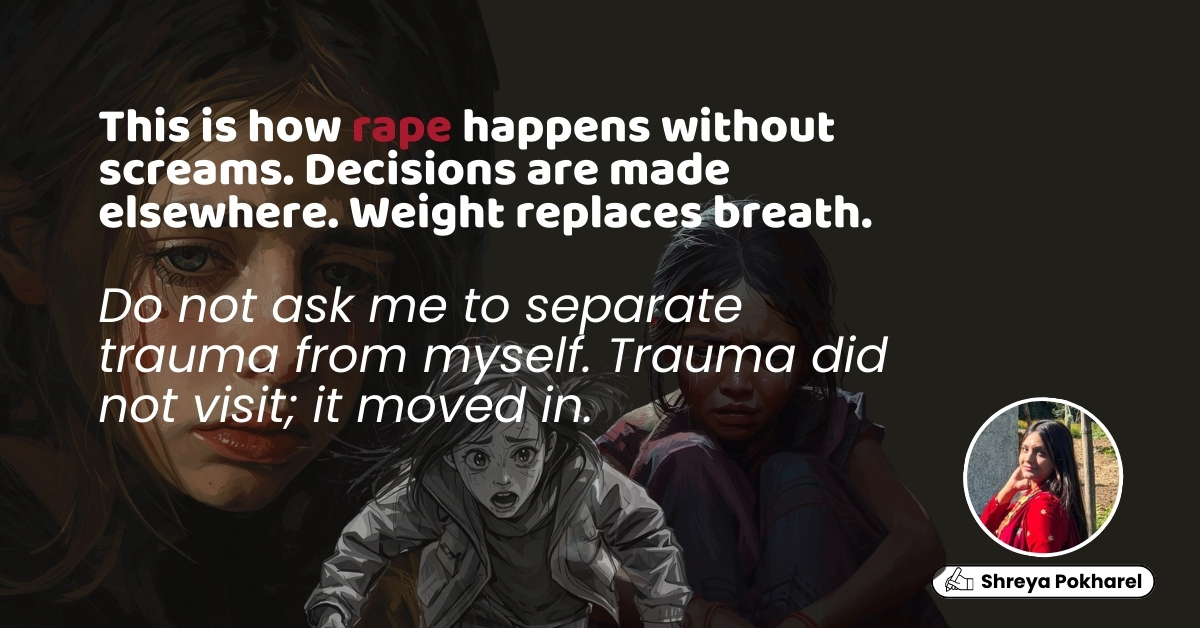
He took me where sound thins. When his hands closed around my waist, anger arrived first-bright, useless, burning. Then my body did what children’s bodies do under force: it froze. This is how rape happens without screams. Decisions are made elsewhere. Weight replaces breath. Time collapses into a small, cruel now. I learned how a person can be present and gone at once. When it ended, he adjusted my clothes with the carefulness reserved for messes, not people, and told me what to say. As if language could launder what had been done.
He instructed what to say. Words were a currency of innocence he could not buy back.
On the way home, his motorcycle failed. Machines fail. Predators assume children will too.
Five minutes.
That’s how long the road gave me.
Those five minutes became calculation. I knew the geography, the blind spots, the memory of accidents long past. I measured distance, timing, and the precise weight of inevitability. Children who survive violence develop a kind of tactical mind-cold, patient, and unsentimental.
The truck appeared-indifferent, unstoppable. I moved. I pushed.
Physics answered. Blood obeyed gravity. The world did not stop.
People gathered. Sirens arrived late. I spoke clearly. Calmly. With the voice I had seen protect wrongs before. Power has a tone; I borrowed it. There were no cameras. A witness said something once and then became a silence. The driver was never questioned. The file was never opened. The name dissolved. Witnesses vanished.
I went home.
No one asked me why.
They didn’t ask how an eleven-year-old knew where to stand, or why my voice didn’t shake, or why the story arrived already ironed flat. They didn’t ask because questions are dangerous when the answers point upward. Our family’s name sat in the room like a uniform; rank does the talking so mouths don’t have to.
The police wrote carefully and read nothing back. Files closed themselves. Pens hesitated. Courage became procedure. When power protects you, curiosity dies first.
I learned the final lesson early: the law doesn’t always fail-it sometimes recognizes who you belong to and decides that asking is unnecessary.
Do not ask me to separate trauma from myself. Trauma did not visit; it moved in. It shaped my reflexes, my ethics, my appetite for quiet.
This is not a plea. It is a record.
Five minutes. An eleven-year-old. A law that blinked.
That is how survival learned to look like violence-and how power taught me it could look away.
That was the verdict.
Silence.
And I walked out of it untouched.