

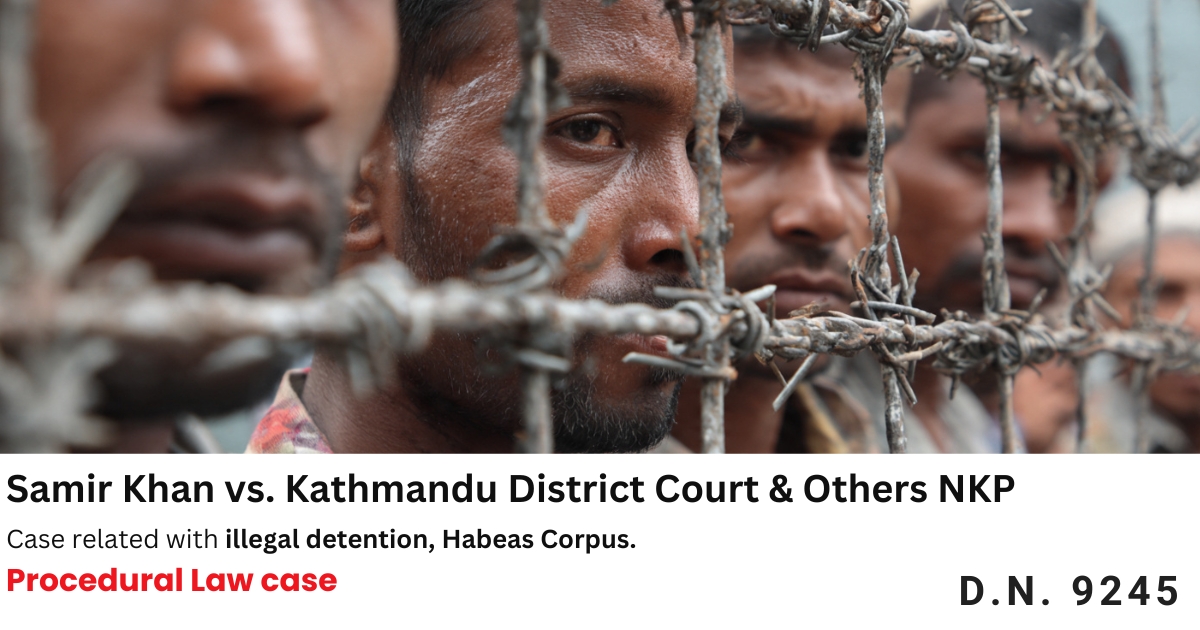
Procedural Law Case: Samir Khan vs. Kathmandu District Court & Others NKP(2071), NO.9, DN: 9245
Case: Writ of Habeas Corpus
Plaintiff: Samir Khan
Respondent: Kathmandu District Court
Decision Number: 9245
This case is related with illegal detention.
Facts Of The Case:
Samir Khan, Abdulla Khan, and Jan Tulla were three men from Bangladesh who were struggling financially. With no proper education or employment, they felt that going abroad for work was their only hope. They wanted to go to Saudi Arabia, but because of a ban at the time, they couldn’t travel legally. While searching for options, they met someone who promised to take them to Saudi Arabia for 15,000–20,000 taka.
On 27 June 2016, this person took them to Delhi, India. It was only at the airport, right before boarding the plane, that they were handed Nepali citizenship papers and Nepali passports. When they reached Saudi Arabia, they were completely abandoned for five days and had to suffer on their own. Eventually, they were sent back to Delhi. Since they were carrying Nepali passports and citizenship documents, the Indian authorities treated them as Nepali nationals and sent them to Nepal.
Claims of the Applicant:
The applicants argue that they were not the ones who forged the documents, nor had they ever crossed into Nepal before those fake documents were handed to them. They insist that they were practically transported to Nepal against their will and that they never intended to come to Nepal in the first place. They further state that they have already spent 13 months in prison and paid all the fines imposed on them, yet they have still not been released. According to them, their continued detention is illegal.
Their advocate, Shree Mohan Bahadur Banjara Chhetri, also submits that any punishment should be strictly under the Citizenship Act, 2063, which the applicants have already undergone by serving those 13 months.
Claim of the Respondent:
The respondents argue that the applicants were already punished in accordance with the law. They were sentenced to a total of 2 years and 7 months of imprisonment and fined Rs. 50 under three different legal provisions:
- Citizenship Act 2063, Section 21(1): 13 months’ imprisonment
- Rahadani Ain 2024, Section 5: 6 months’ imprisonment
- Muluki Ain, Kirtie Kajag Mahal: 1 year imprisonment and Rs. 50 fine
These punishments were imposed by the Kathmandu District Court (Tahasildar Section), and the applicants were imprisoned on the basis of that valid judgment. Therefore, the respondents claim that the applicant’s argument has no merit and should be rejected.
Advocate Shree Sanjeeb Raj Regmi further submits that the applicants were convicted and punished strictly according to the law, and the Kathmandu District Court has already given a lawful decision in this regard.
Decision of the Case:
In this case, the central issue is that the applicants have already served their period of imprisonment, and there is no question raised regarding the fine they were required to pay. According to Muluki Ain, Danda Sajaya ko Mahal, No. 10, when a single act constitutes multiple offences under different laws, a person must not be punished repeatedly unless the law expressly provides otherwise. The law further states that punishment must be determined based on the gravity of the offence and within the legally prescribed time limits. In cases involving monetary fines, separate fines may be imposed under each applicable law, but imprisonment cannot be duplicated beyond what the law permits.
Applying this principle, the applicants have already completed the sentences lawfully imposed on them under the relevant Acts. Since they have already undergone the punishment required by law, any continued detention cannot be justified. Therefore, they must be released, as holding them any longer amounts to illegal detention.
Principles Established:
- The same offence should not be punished separately under different laws.
- When an act falls under multiple legal provisions, the punishment must follow the provision that prescribes the longer time limit or greater severity, rather than imposing repeated sentences.
- However, if the offence involves monetary fines, then fines may be imposed under each applicable law, even if it is the same offence.