
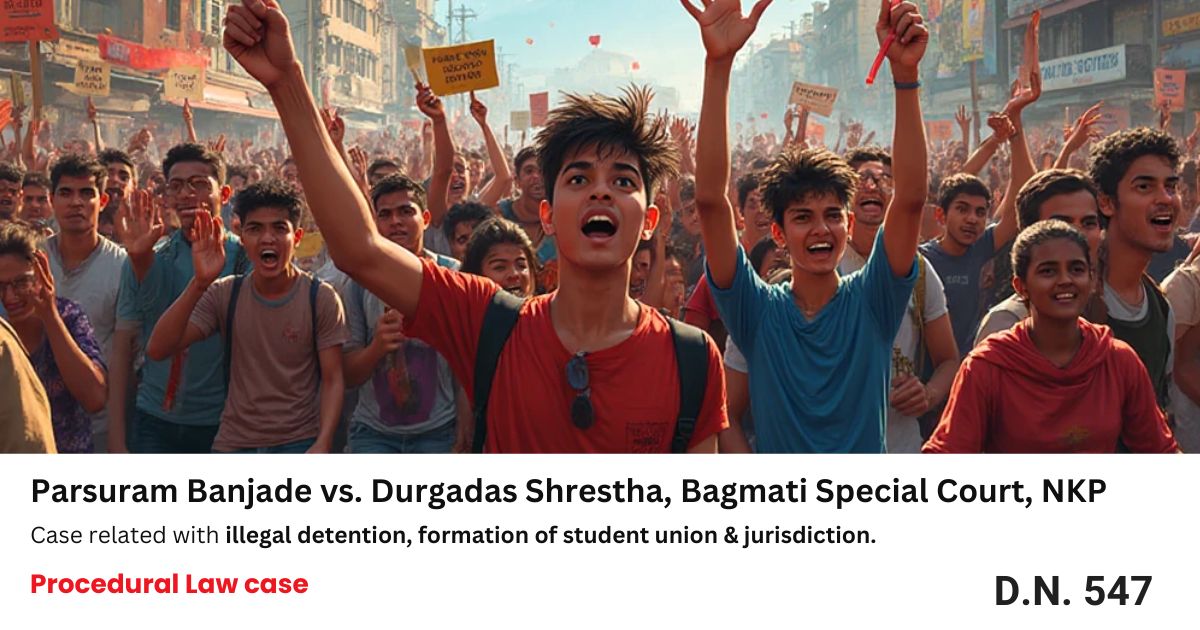
Procedural Law Case: Parsuram Banjade vs. Durgadas Shrestha, Bagmati Special Court, Kathmandu & Others, NKP(2027), NO.7, DN: 547
Case: Writ of Habeas Corpus and Natural Justice
Plaintiff: Parsuram Banjade on behalf of his brother Yagya Murti Banjade
Respondent: Bagmati Special Court, Durgadas Shrestha
Decision No: 547
This case is related with illegal detention, formation of student union & jurisdiction.
Facts Of The Case:
On date 2027/1/18, Yagyamurti Banjade was arrested from Kanthmandu, Naya Sadak and placed into detention at Central Jail. He was arrested by unknown persons wearing civil dress and was unaware of the grounds of accusation. Later, he was taken to the Kathmandu Police and asked to give a statement after presenting a warrant. His Majesty’s Government delegated its power to Durgadas Shrestha, Chairman of the Bagmati Special Court, which was published in the Nepal Gazette on 2027/1/21. Yangyamurti Banjade was unaware about the ground of arrest so his brother Parsuram Banjade filed a writ of habeas corpus in Supreme court claiming arrest was illegal.
Claim of plaintiff:
Parsuram Banjade claims that Yagyamurti Banjade was illegally detained without being informed of the grounds of arrest, violating Article 11 of the Constitution. The arrest warrant did not comply with the Muluki Ain 2020, and court permission was not obtained within 24 hours.
He was first charged under the Organizations Act 2019 without specifying the offence, and later, due to lack of evidence, charged under the National Directives Act 2018. Judicial power was unlawfully delegated to Durgadas Shrestha, who forcefully recorded a statement and acted under government direction.
The detention order and punishment by the Bagmati Special Court were illegal, especially since forming a student union is not a crime and no one can be a judge in their own case. Yagyamurti was also denied legal counsel.
Therefore, the plaintiff seeks a writ of habeas corpus for his release and bail until final judgment.
Claim of defendant:
Defendants argue that Yagyamurti Banjade was lawfully arrested. Although evidence under the Organization Control Act 2019 was insufficient, he was legally detained for running a student union without royal permission, which violated the National Directives Act 2018. His detention complied with Muluki Ain No. 121, and he was informed of the charges. Since 2027/1/19 was a Saturday, the court order was obtained on 2027/1/20.
They deny that the applicant was forced to give a statement. Judicial power was validly delegated to Durgadas Shrestha by His Majesty and published in the Nepal Gazette. No legal or constitutional rights were violated, so the petition should be dismissed.
Questions Raised:
The case of Yagyamurti Banjade is similar to the cases of other applicants: Durga Acharya, Pradip Koirala, Machhindra Nath Pathak, Tika Prasad Pokhrel, and Rajeshwor Acharya. The questions raised in this case are as follows:
-
- Does establishing a student union fall under the National Directives Act, 2018 or not?
- Durgadas Shrestha was given the authority to decide the case, but was this within his jurisdiction or not?
Decision of the Supreme Court:
Although the applications were filed on different dates, the cases were similar and were decided by a single judgment. The Court held that while Durga Das Shrestha was given quasi-judicial authority, he could not act as a judge in his own case, and no decision can be made without proper jurisdiction.
The Court ruled that establishing a student union does not fall under the National Directives Act, 2018. Therefore, Durga Das Shrestha lacked jurisdiction to decide the case. As the detention was illegal, a writ of habeas corpus was appropriate.
Since illegal detention was already established, the issue of conflict between laws was not considered necessary. Supreme Court declared the detention and fine unlawful and ordered the immediate release of Yagyamurti Banjade.
Principle Established:
When the accusations and legal questions are the same, a single judgment may apply to multiple cases, even if they were filed on different dates.
Quasi-judicial authorities must decide cases with a proper judicial approach.
The preamble is an essential part of an Act but does not control the main sections. If the main section is unclear or ambiguous, then the preamble is taken into consideration.