

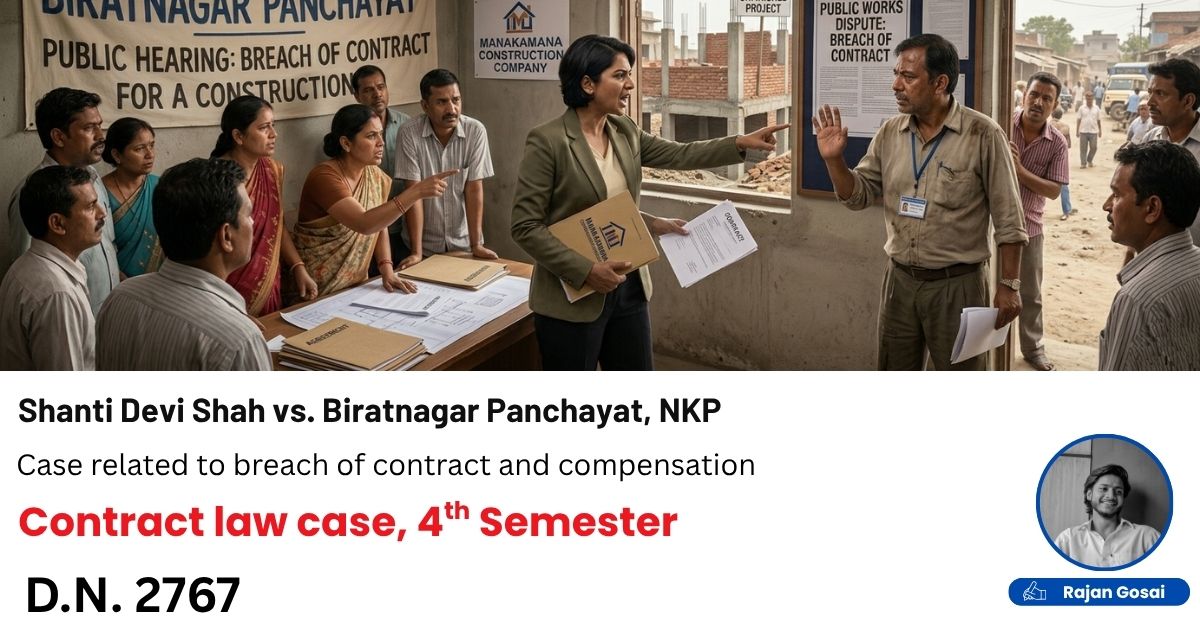
Contract Law Case: Shanti Devi Shah vs. Biratnagar Panchayat, NKP, 2043, No. 6, P. 598, D.N. 2767
Case: Breach of contract and compensation
Plaintiff: Kishan Lal Yadav, Head of Biratnagar Nagar Panchayat
Defendant: Shanti Devi shah, Proprietor of The Manakamana Construction Company, Rajbiraj
Decision No: 2767
This case is related with the concept of Breach of Contract and suit for damages as judicial remedies.
Fact of the case:
On 2035/5/1, a contract was made for the construction of a building as signed between Biratnagar Nagar Panchayat and Shanti Devi Shah, Proprietor of the Manakamana Construction Rs. 8,03,276.43/- was the total tender amount for the construction. As per the condition, Rs.1,28,519.49/- was provided as advance payment to initiate the work. some of the terms and conditions of the contract: The construction work must be completed within the mentioned time period i.e. 1 year the extension to time may be made by Nagar Panchayat and there is no time limitation for making such decision. The constructor shall be made liable to pay Rs.280/- per day as fine with extension of time for the construction.
Plaintiff’s claim:
The contract is not breached. An application for extension of time period was agreed on 2036/05/17 which provided 30 days for the fulfillment of construction work but Nagar panchayat had not made any decision. Plaintiff has not been able to file within 2036/6/30. The lawsuit was filed on 2037/9/26 is not as per the law i.e. 15 months. The act of Plaintiff is contrary to Contract Act, 2023 Sec 13(1) The time and process for completion of the contract shall be within the time specified within the contract.
Defendant’s argument:
The case is filed within the time limit i.e. within 3 months of date of termination of contract on 2037/6/27 pursuant to section 15 and sec 18(2)(c) of Contract Act,2023. Defendant claimed she had performed her duties as per the contract and was not liable to pay any compensation or penalties to plaintiff. Defendant pointed out Clause 30 of the agreement, which stated that if the work was delayed without an extension, she would pay a daily fine of Rs. 280/-. She argued that court could not award massive damages based on revised estimates when a specific daily penalty was already agreed upon. A notice of invalidation of contract ” was provided to applicant on 2037/06/27.
Legal issues:
- Whether plaintiff has filed the case within the time limitation or not?
- Whether defendant shall compensate to plaintiff or not?
- what is the amount to be compensated?
Decision of the Courts:
Morang District Court: According to the contract, defendant shanti Devi could not complete the construction work within the mentioned period. There is breach of contract. So, defendant must compensate plaintiff. With a dissatisfaction over the decision, Defendant appealed to review in Eastern Regional Court.
Eastern Regional Court: As per the sec 15 of Contract Act, 2023, defendant could not perform the contract within the time limit. There is breach of contract. So, Plaintiff has the right to claim for the compensation. Sec 15(2) of Contract Act 2023, If the agreement mentions about the compensation, it will be done accordingly and if not mentioned, the party bearing the loss can claim compensation. So defendant must compensate plaintiff and the decision of Morang District Court is valid on 2041/10/6.
Supreme Court decision of Division Bench: As per the contract formed between the parties, if required; the Nagar Panchayat holds the absolute power to extend the time limit and to declare the contract invalid. So, the contract was declared invalid on 2037/06/27 and the lawsuit was filed within the time limit i.e. Within 3 months as per Sec 18 (2C) on 2037/09/26. Thus, there seem to be the breach of contract by Applicant (shanti Devi Shah). So, the party must compensate to plaintiff (Nagar Panchayat). Calculate the proportional amount of compensation with the total estimated contract amount and the bail amount and the running bill.
Established Principle:
Determination of Cause of Action for Contract Termination: If a contractor asks for more time and negotiations are still ongoing, the deadline to sue does not start automatically when the original contract expires. Instead, the timeline starts on the exact day the authority officially rejects the extension and cancels the contract. Any lawsuit filed within three months of that cancellation date is legally on time.