

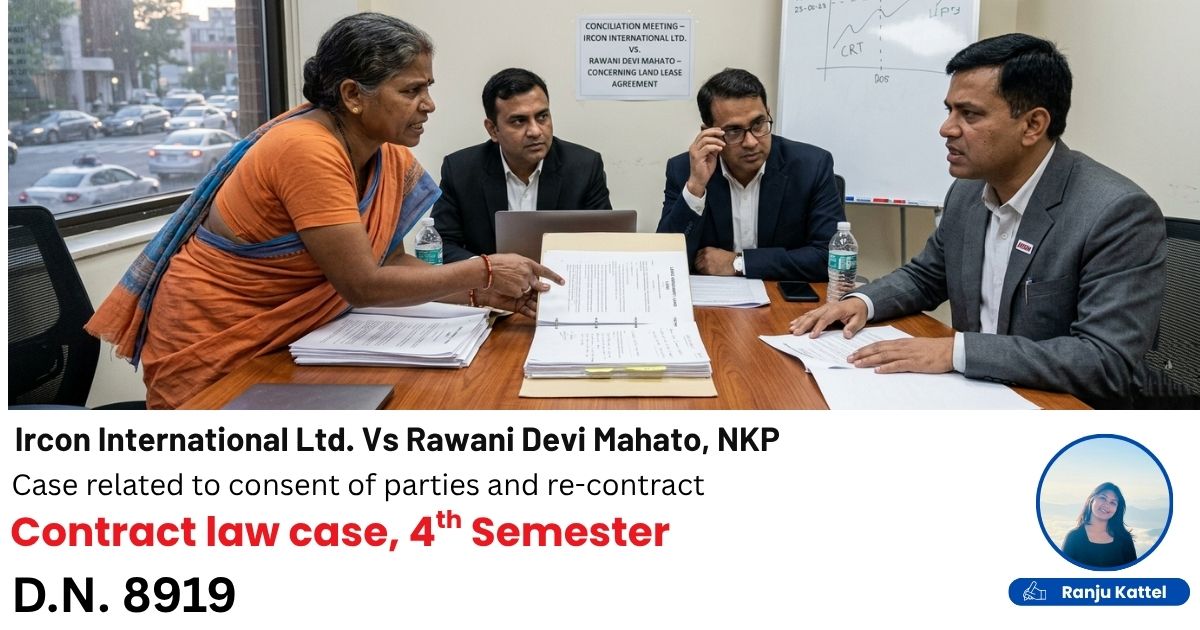
Contract Law Case: Ircon International Ltd. Vs Rawani Devi Mahato, NKP, 2069, No.11, P.1689 D.N. 8919
Case: Consent of parties
Plaintiff: Ircon International Ltd.
Defendant: Rawani Devi Mahato.
Decision No. 8919
This case is related with re-contract of lease agreement without will of other party.
Facts of the Case:
Plaintiff, Ircon International Ltd. an Indian company undertaking a road upgrade project under the East-West Mahendra Highway Project in Nepal, required land to store and manage construction materials for the highway project. They entered into a lease agreement with the defendant on 2062/03/17 for her land Plot No. 448. According to the agreement, any extension or changes required a pre one month notice. The lease was extended via a modified agreement, which remained valid until 2065/05/15.
As the project was incomplete, plaintiff sent multiple letters to defendant before the expiry of the lease to extend the agreement further. However, defendant did not respond or agree to the extension and unilaterally declared the contract terminated, allegedly refusing to let plaintiff remove their construction materials.
Plaintiff’s Claim:
The company could not complete the road construction on time due to flooding in the Koshi River. It argued that because of the flood they sent proposals for an extension before the contract expired, and because defendant did not say “no” immediately, her silence should be legally viewed as an automatic approval to extend the lease. Plaintiff demanded that court should order defendant to officially sign and rewrite the lease extension so our materials stay safe.
Defendant’s argument:
The contract was mutually agreed upon for a specific duration which had already expired. Defendant argued that Section 79 of Contract Act, 2056, was irrelevant to this case. There was no clause or obligation in the initial contract that forced her to extend the lease indefinitely against her will. Therefore, plaintiff’s lawsuit should be dismissed.
Legal Issues:
- Whether one party’s silence or lack of response to a contract extension proposal can be legally interpreted as “acceptance” or “consent” to renew the contract?
- Whether a court can legally compel or force an unwilling party to enter into or renew a contract against their free will?
Decision of the courts:
Biratnagar Appellate Court:Dismissed plaintiff’s petition. Since, the lease period had expired, any renewal could only happen through mutual consent. Court cannot legally force an individual to give consent or enter into a contract against their will.
Joint Bench of Supreme Court: Upheld the decision of Appellate Court Hon. Justices Kalyan Shrestha and Bharat Raj Upreti ruled that respondent’s silence regarding the extension letters did not legally constitute consent under the Contract Act, 2056. Since free consent is mandatory to create or extend a contract, Court cannot issue an order to force the landowner to modify or renew the lease agreement.
Established Principles:
Importance of Free Consent: A contract is a mutual agreement governed by law. Free consent of both parties is most vital element of a contract. No party can be compelled, coerced, or pressured into entering a contractual relationship.
Silence is Not Acceptance: If one party sends a proposal to another party, the silence or failure of the receiving party to respond cannot be interpreted as acceptance of that proposal.
Limits of Judicial Power in Contracts: Courts do not have authority to force an individual to sign, alter, or renew a contract if they do not independently and freely agree to it.