
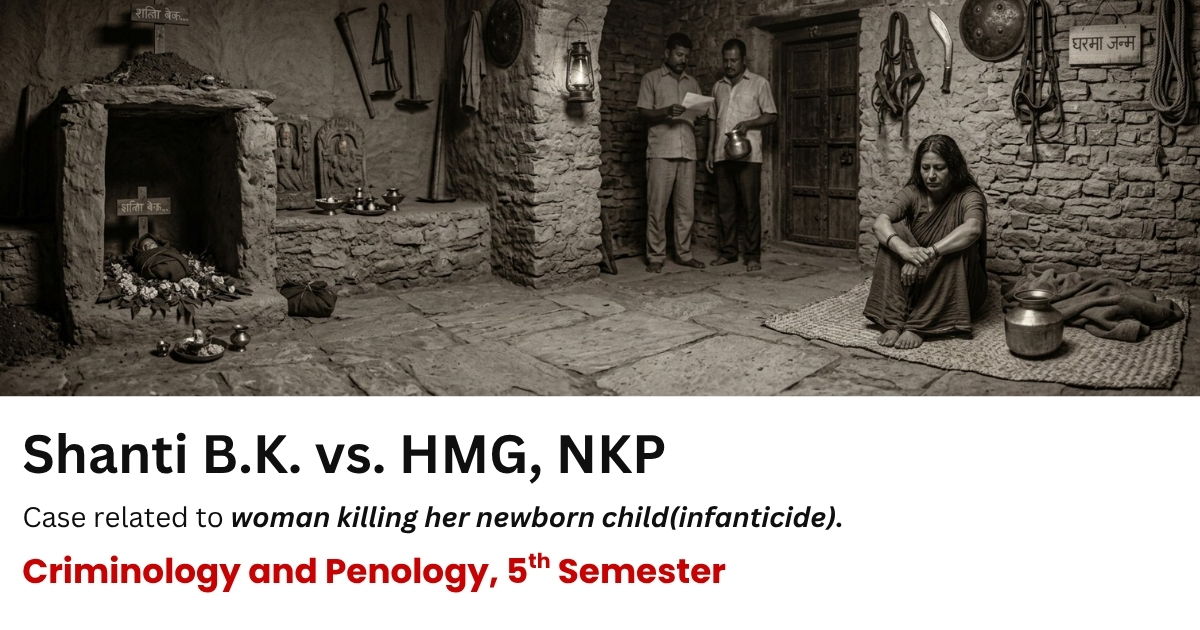
Criminology and Penology Case: Shanti B.K. vs. HMG, NKP 2061 B.S, DN 7399
Case: Infanticide
Plaintiff/Applicant: HMG
Defendant/Respondent: Shanti B.K
Decision Number: 7399
This is a case of a woman killing her newborn child following an out of wedlock pregnancy.
Facts of the Case:
Shanti B.K.’s husband had gone to India for employment. She got intimate with Narayan Bahadur B.K. while he was away, and got pregnant. She told Narayan Bahadur about the pregnancy, and asked him to accept her, but he refused and told her to kill the child after it was born. She was distressed at his refusal and abandoned by both the family of her husband and her family, and was afraid of social shame, so she secretly gave birth to a baby boy at her home.
Her statement to the police and the court was that the child was born alive. She hit the baby several times with her fists on his face and head until she thought he was dead. Then she wrapped the body in cloth, took it to a place named Rahegaira and buried it in a dug pit. Her father-in-law complained and the police found the baby’s body. The post mortem examination showed the child had died from asphyxia causing brain damage and a medical examination revealed that Shanti had recently given birth. She later appealed saying that the child was stillborn and that her confession was given under police pressure, but the medical evidence, her previous confessions and other evidence did not support her defense.
Legal Issues:
- Whether the prosecution was able to establish that the accused intentionally killed her child?
- Whether the accused had the right to a reduced sentence pursuant to No. 188 of the Chapter on Court Procedure?
- What should be the principles that guide the court in exercising its judicial discretion to mitigate punishment?
Different Courts Decisions:
District Court:
Palpa District Court found that the prosecution had established that Shanti B.K. had killed her baby intentionally. It was based on her confession to the police and court, medical evidence that the baby was born alive and died of asphyxia, and the evidence of witnesses. For this reason, it found her guilty of the offences under Sections 1 and 13(3) of the Chapter on Homicide, for which the prescribed punishment was life imprisonment and confiscation of property. Yet, as a young woman, whose husband was away from home, and who was abandoned after falling pregnant from an extra marital affair, the District Court felt the statutory punishment was too harsh as it was not committed with premeditated malice. Accordingly, it recommended, under No. 188 of the Chapter on Court Procedure, that her sentence be reduced to five years’ imprisonment.
High court:
Butwal Appellate Court rejected the appeal filed by the accused and upheld the District Court’s verdict that the accused had intentionally killed her newborn child. The Court concluded that the confession, medical reports, witness statements and circumstances surrounding her case proved she was guilty beyond reasonable doubt. It also agreed that the statutory punishment of life imprisonment with the confiscation of property would be unduly severe in the circumstances in which the offence was committed. It thus accepted the District Court’s recommendation that the sentence be reduced to five years’ imprisonment and sent the matter back to the Supreme Court for (Sadhak).
Supreme Court:
Supreme Court upheld the conviction, finding that the evidence was sufficient to prove that Shanti B.K. had intentionally killed her newborn child and buried the body. The Court did not accept her subsequent contention that the child was stillborn and that her confession was coerced, since her pre-investigation and pre-court statements were consistent and corroborated by the medical evidence of death by asphyxia and the evidence of a recent delivery. Thus, the conviction under Section 13(3) of the Chapter on Homicide was upheld.
The Supreme Court then reviewed the sentence reduction recommended in No. 188. The Court used the occasion to establish important guidelines on sentencing, which include the following: Sentences must be imposed on the basis of clear and consistent standards; and similarly situated offenders must be punished in the same manner. It said that the judge should take into account the circumstances of the offence, the intention of the offender, his age, social background, physical and mental state, family situation, remorse, cooperation with the judicial process, influence or pressure exerted by others, and whether the offence was deliberate or not, when exercising his discretion in No. 188.
The Court, applying these principles, found that the accused had confessed to the offence, had cooperated with the court, had not planned the act, had no personal animosity towards the child’s father, had been emotionally distressed after being abandoned by the child’s father, had no support from her marital family or her own family, and had committed the offence under intense social pressure to avoid the stigma of an illegitimate pregnancy. In such unusual cases, the Court deemed that life imprisonment would be unduly severe. It thus accepted the recommendations of both the lower courts and imposed a term of five years imprisonment instead of life imprisonment with confiscation of property.
Principle Established:
- Sentencing should be based on clear, rational and consistent principles, ensuring that offenders in similar situations receive similar sentences.
- 188 of the Chapter on Court Procedure requires that the judge be cautious in imposing a lesser sentence and that there be identifiable mitigating circumstances. Some of the factors that are taken into account in sentencing are the offender’s intent, motive, age, social background, family circumstances, physical health, mental health, degree of remorse, cooperation with the judicial system, influence or pressure from others, and whether the offense was premeditated.
- Voluntary confession with reliable medical and circumstantial evidence may be used to prove murder.
- Murder normally carries a life sentence, but where mitigation is warranted by the interests of justice, it is possible for a substantial sentence reduction to be ordered.