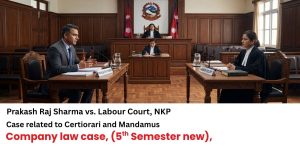


Labour Law Case: Rup Jyoti vs. Labour Court, NKP 2063 B.S, No. 4, P. 407, DN: 7675
Case: Certiorari and Mandamus
Plaintiff/Applicant: Jyoti Farms Pvt. Ltd. and others represented by Dr. Rup Jyoti
Defendant/Respondent: Labour Court and others including Harun Ansari
Decision Number: 7675
This case is related to writ jurisdiction certiorari and mandamus against decisions of the Labour Court.
Facts of the Case:
Jyoti Farms Pvt. Ltd. dismissed its employee Harum Ansari from the service. Ansari then appealed the dismissal to the Labour Court under Section 60 of the Labour Act, 2048. On 2059/03/04, the Labour Court ruled in the favour of Ansari and reinstated him to his former post and awarded him back wages and other benefits from the date of removal to the date of reinstatement.
Jyoti Farms then filed a writ petition before the Supreme Court seeking to quash the decision of the Labour Court through a writ of certiorari.
The respondent Haren Ansari further claimed that there is no right to appeal directly for the management against the decision of the Labour Court under the Labour Act, 2048.
Legal Issues:
- Whether a company acting as the management has the right to file a writ petition against a Labour Court decision.
- Whether the absence of a statutory appellate remedy under the Labour Act, 2048 against Labour Court decisions attracts the Supreme Court’s extraordinary writ jurisdiction under Article 88(2) of the Constitution of the Kingdom of Nepal, 2047.
- Which of the two conflicting Division Bench precedents (Balaju Kapada and Casino) be followed for consistency.
Different Courts Decision:
Labour Court:
Labour Court ruled in favor of the employee Harun Ansari and held the dismissal be declared void and also ordered its reinstatement to his former position and awarded back wages and other benefits.
Supreme Court (Division Bench):
Two prior Joint Bench (Division Bench) rulings had reached opposite conclusions on whether writ jurisdiction could be invoked against Labour Court decisions. In Balaju Kapada Udhyog Ltd vs. Asharman Rai (Writ No. 3991 of 2058) it was held that management could not seek writ remedy against a Labour Court decision. In Casino vs. Uttam Prasad Silwal (Writ No. 3211 of 2056) it was held that a Labour Court decision could be quashed through writ jurisdiction.
So the case reached a Full Bench because two earlier rulings on the same legal question had conflicted.
Supreme Court (Full Bench):
Full Bench of the Supreme Court held that where the legislature is silent on a right of appeal, a party aggrieved by a lower court/authority’s decision is deprived of the ability to have that decision tested is a deprivation of a legal right. In the absence of any alternative remedy i.e appeal under the Labour Act, 2048, Article 88(2) of the Constitution attracts the Court’s extraordinary writ jurisdiction.
The Court affirmed the ruling in Casino vs. Uttam Prasad Silwal (NKP 2060, DN: 7237) as the correct and lawful precedent. The Full Bench’s role was limited to resolving the conflict of precedent and referred the petition back to the Division Bench under Rule 7A (1) of the Supreme Court Regulations, 2049 to decide the case on its merits.
Principle Established:
- Being deprived of a legal remedy due to an erroneous judgement amounts to being deprived of a legal right.
- Where the legislature is silent on the right to appeal a decision of a lower court/authority, the aggrieved party is deprived of the right to have that decision reviewed for correctness.
- Where deprivation of a statutory remedy occurs and no alternative remedy exists, the extraordinary jurisdiction of the Supreme Court under Article 88(2) of the Constitution of the Kingdom of Nepal, 2047 is attracted.
- In the absence of any other alternative remedy such as appeal against the decision of the Labour Court under the Labour Act, 2048, a writ petition may be filed under the Supreme Court’s extraordinary jurisdiction.
Relevancy of the Case:
The decision of this case is a leading precedent on the scope of writ jurisdiction certiorari as a substitute remedy where a special statute does not provide a right of appeal.