

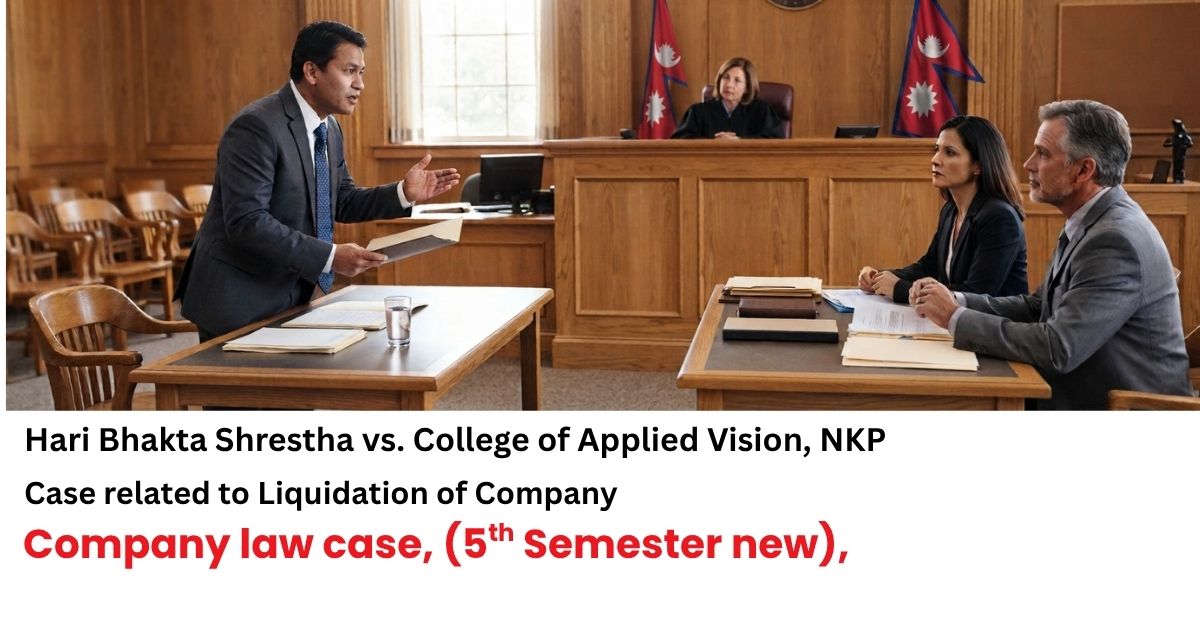
Company Law Case: Hari Bhakta Shrestha vs. College of Applied Vision, NKP 2080 B.S, Vol. 5, Pages 865
Case: Liquidation of Company
Plaintiff: Haribhakta Shrestha and others
Defendant: College of Applied Business (CAB),
Decision No: 11091
This case is related to company registration, conversion of a trust-run college into a non-profit company, validity of Board of Trustees’ decisions, corporate governance, jurisdiction of the Commercial Bench, and company name.
Facts of the Case:
College of Applied Business (CAB) had been operating as a non-profit trust under its own statute after receiving affiliation from Tribhuvan University and permission from the Higher Secondary Education Council. A dispute arose among its Board of Trustees. On 2066/11/03 BS, a Board meeting was held, and petitioners alleged that some persons took away the original minute book and subsequently reorganized the Board. On 2066/11/25 BS, the reorganized Board decided to establish CAB as a non-profit company under the Company Act, 2063. On the basis of that decision, the Company Registrar’s Office registered College of Applied Business as a non-profit company on 2066/11/27 BS. Petitioners challenged the Board decisions and company registration, claiming that the existing college could not be converted into a company without the required consent of the founding trustees and that the new company could not use the same name or take over the college’s assets, liabilities and institutional identity.
Plaintiff’s Claim:
Plaintiffs claimed that the decisions of 2066/11/03 and 2066/11/25 were contrary to the college’s statute because persons who were not valid founding trustees were involved in the reorganization and subsequent decision. They argued that the existing CAB could not be converted into a non-profit company without the consent of the founding trustees. They further claimed that the company’s Memorandum and Articles unlawfully provided for the transfer of the college’s assets, liabilities and establishment expenses to the new company. They also argued that registering the company under the same name, College of Applied Business, could create confusion among students, parents, stakeholders and the general public. Therefore, they sought cancellation of the unlawful decisions and company registration-related actions under Section 180 of the Company Act, 2063, along with punishment of defendants under Section 160.
Defendant’s Arguments:
Defendants argued that the Board meetings and decisions were conducted according to the existing college statute and that the company was properly established and registered as a non-profit company under the Company Act, 2063 after fulfilling the required legal procedures. They contended that plaintiffs had no legal standing because they were not shareholders, creditors or members of the newly registered company and that the Company Registrar’s Office had lawfully registered the company. They further argued that the court had improperly interfered with the company’s Memorandum and Articles and that there was no legal basis for cancelling the company’s registration or punishing defendants.
Legal Issues:
- Whether petitioners had locus standi to file the complaint under Section 159(1) of the Company Act, 2063?
- Whether the Commercial Bench had jurisdiction to hear the dispute concerning the decisions made before the company’s registration?
- Whether the decisions of 2066/11/03 and 2066/11/25, the related actions, and the company’s registration could be cancelled under Section 180 of the Company Act, 2063?
- Whether defendants were liable to be punished under Section 160 of the Company Act, 2063?
- Whether the decision of the High Court Patan was legally correct?
Decision of Courts:
High Court Patan: The High Court held that the decision to reorganize the Board and establish CAB as a non-profit company was contrary to the college’s statute. It therefore invalidated the relevant decisions and certain provisions of the company’s Memorandum and Articles, particularly those relating to the existing college’s obligations and institutional arrangements. However, the Court held that the company registration itself could not be cancelled under Section 180 of the Company Act, 2063.
Supreme Court: The Supreme Court partly upheld and partly reversed the decision of the High Court. It held that petitioners were stakeholders whose rights and interests were affected by the disputed decisions and therefore had locus standi under Section 159(1). It further held that the Commercial Bench had jurisdiction to examine the disputed decisions and related actions. The Court found that the decisions of 2066/11/03 and 2066/11/25 were invalid because the required consent of the founding trustees was absent. The provisions relating to the transfer of the college’s liabilities and establishment expenses to the new company were also held invalid under Section 180. However, the Supreme Court held that the company’s registration itself could not be cancelled, because the statutory conditions for deregistration under Section 136 were not present. Since the company had been registered using the same name, College of Applied Business, while the original college continued to exist, the Court found that this could create confusion among students, parents, stakeholders and the public. Therefore, the company was ordered to change its name according to law. Defendants were not punished under Section 160.
Established Principles:
- Company registration cannot be cancelled except according to the conditions prescribed by the Company Act, 2063.
- Deregistration of a company is a legal status affecting its institutional existence, not merely a procedural matter.
- Stakeholders whose rights or interests are affected by company-related actions have locus standi under Section 159(1).
- The Commercial Bench has jurisdiction over company-related decisions and actions, including certain matters arising before formal company registration.
- Company formation and management must comply with institutional governance and applicable governing documents.
- Where two institutions have the same name and similar objectives, and their simultaneous existence may create confusion, the later company may be required to change its name.
- Invalidity of the decision leading to company formation does not automatically require cancellation of the company’s registration when the statutory grounds for deregistration are absent.