

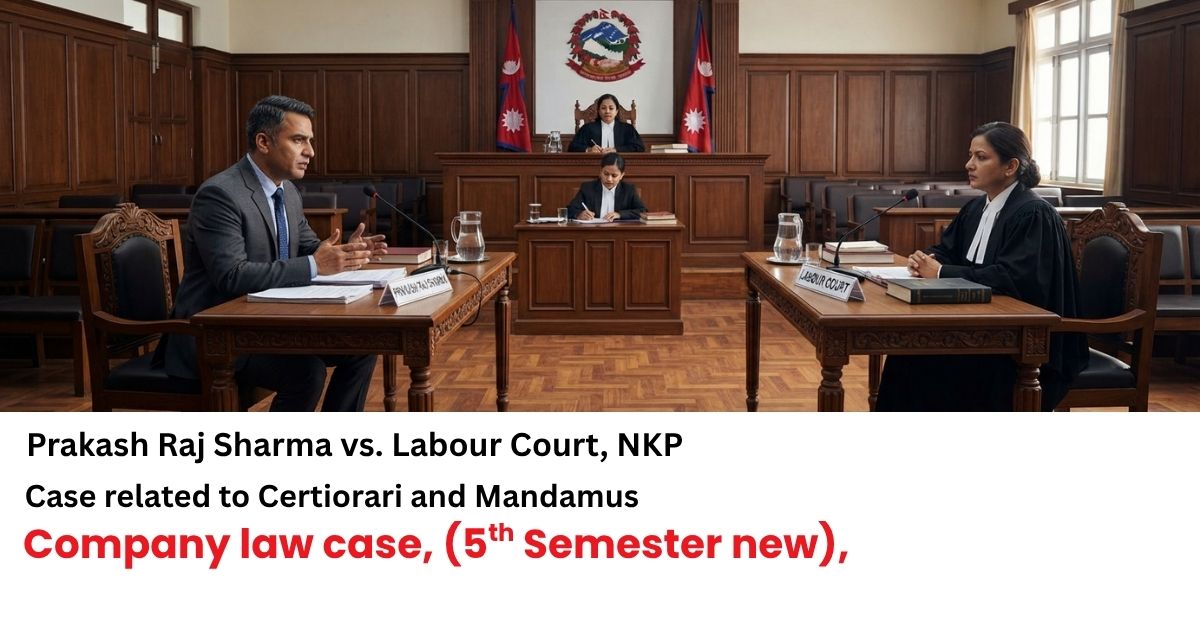
Company Law Case: Prakash Raj Sharma vs. Labour Court, NKP 2070 B.S, Vol.8, Page 963
Case: Certiorari and Mandamus
Petitioner: Prakash Raj Sharma.
Respondent: Labour Court, Kathmandu & others
Decision No: 9039
This case is related to Jurisdiction of Labour Court over employees of banks and financial institutions; applicability of the Labour Act, 2048
Facts of the Case:
Nirdhan Utthan Bank was established under the Development Bank Act, 2052 and later operated under the Bank and Financial Institutions Act, 2063 and the Companies Act. Under Section 91 of the Bank and Financial Institutions Act, the Bank had framed its Employee Regulation, 2061, which was approved by Nepal Rastra Bank. Prem Prasad Ghimire, an assistant-level employee of the Bank, was accused of misconduct, financial irregularities and misappropriation causing loss to the Bank. Under Regulation 88(1)(b), the Bank dismissed him from service on 2064/05/26 BS. Instead of appealing under Regulation 97 of the Employee Regulation, Ghimire appealed directly to the Labour Court under Section 60(c) of the Labour Act, 2048. The Labour Court, on 2065/03/27 BS, cancelled the dismissal and ordered his reinstatement with service benefits, mainly on the ground that the procedure under Section 53 of the Labour Act had not been followed. The Bank then filed a writ petition before the Supreme Court challenging the Labour Court’s jurisdiction.
Petitioner’s Claim:
The Bank argued that it was governed by the Bank and Financial Institutions Act, 2063, a special law, and that its Employee Regulation, 2061 had been framed under Section 91 of that Act and approved by Nepal Rastra Bank. The Regulation specifically provided for disciplinary action and an appeal under Regulation 97. Therefore, an employee dissatisfied with disciplinary action had to seek the remedy provided by the Regulation rather than appeal to the Labour Court under the Labour Act. The Bank contended that the Labour Court had therefore acted without jurisdiction by entertaining Ghimire’s appeal and ordering his reinstatement.
Respondent’s Arguments:
Prem Prasad Ghimire argued that the Bank was a company and therefore fell within the definition of an “establishment” under the Labour Act, 2048. He maintained that the Labour Court had jurisdiction over disciplinary action against its employees. He also argued that his dismissal was procedurally defective because different officials were involved in asking for his explanation, recommending dismissal and making the dismissal decision. He further argued that the Employee Regulation could not be applied against him because it was introduced under the later legal framework, whereas he had been appointed earlier. The Labour Court also defended its decision, arguing that the Labour Act provides basic protection to workers.
Legal Issues:
- Does the Labour Act, 2048 apply to employees of every establishment, or only to establishments of a particular nature?
- When a bank or financial institution takes disciplinary action against an employee under regulations framed pursuant to the Bank and Financial Institutions Act, 2063, must the employee seek the remedy provided under those regulations, or may the employee appeal directly to the Labour Court under the Labour Act, 2048?
- Did the Labour Court have jurisdiction to entertain Prem Prasad Ghimire’s appeal when the Bank’s Employee Regulation itself provided an appellate remedy?
Decision of Courts:
Labour Court, Kathmandu: The Labour Court cancelled the Bank’s dismissal decision dated 2064/05/26 BS and ordered Prem Prasad Ghimire to be reinstated with service benefits. It relied principally upon the procedural requirements of Section 53 of the Labour Act, 2048.
Supreme Court (Full Bench): The Supreme Court allowed the Bank’s writ petition and quashed the Labour Court’s decision. It held that the Labour Act does not automatically apply to employees of every type of establishment. Where an institution is established and regulated under a special statute, and that statute provides a separate legal framework concerning employees, that special law and its regulations apply. Regulation 88(1)(b) provided for dismissal, while Regulation 97(1)(b) provided an appeal to the Chairman. Therefore, Ghimire was required to use the remedy under the Employee Regulation rather than directly approaching the Labour Court. Since the Labour Court had no jurisdiction to hear the appeal, its decision ordering reinstatement was without jurisdiction and was therefore quashed. The Court also emphasized that a valid law remains binding unless it is declared invalid
Established Principles:
- The Labour Act does not apply automatically to employees of every establishment.
- Where a special statute regulates an institution and its employees, the special statute and regulations made under it prevail in matters covered by them.
- Employees of banks and financial institutions governed by the Bank and Financial Institutions Act must follow the employee regulations validly framed under that Act.
- Where the applicable employee regulation provides an appellate remedy, the employee must pursue that remedy rather than directly approaching the Labour Court.
- A Labour Court cannot acquire jurisdiction merely because an employee files an appeal before it; its jurisdiction must come from law.
- A valid employee regulation cannot be accepted while beneficial and rejected only when it produces an adverse disciplinary decision.
- A judicial body must follow the principles previously established by the Supreme Court regarding its jurisdiction.