
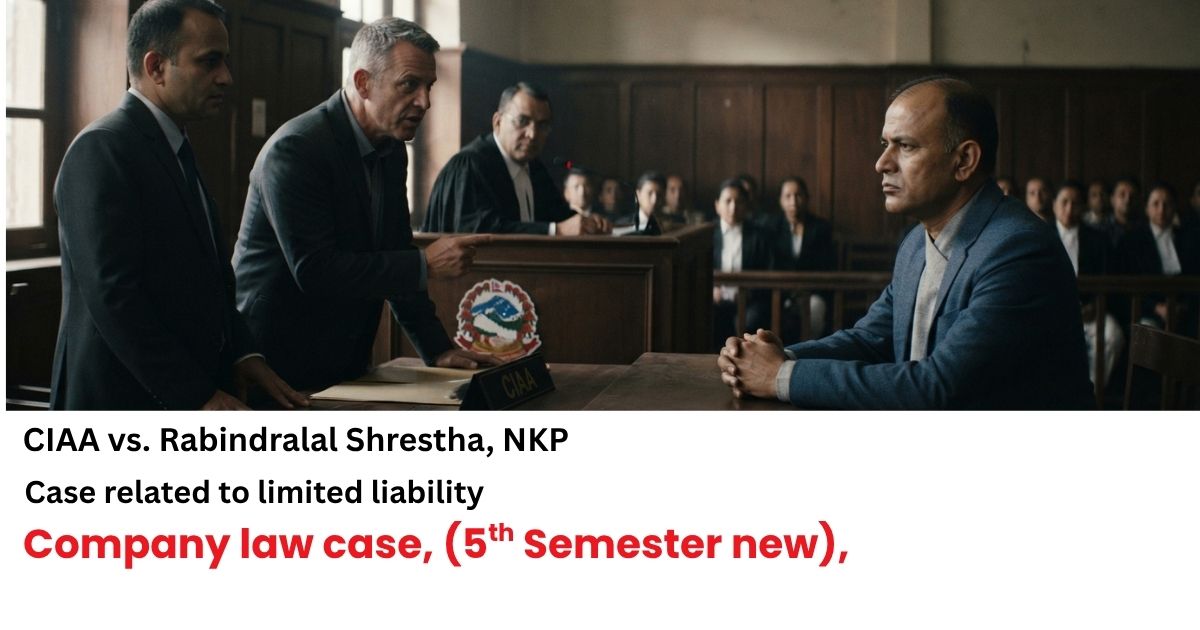
Company Law Case: CIAA vs. Rabindralal Shrestha, NKP 2074 B.S, Vol.1, Pages 162.
Case: limited liability
Plaintiff: Government of Nepal, Commission for Investigation of Abuse of Authority (CIAA).
Defendant: Rabindralal Shrestha, Rameshman Shrestha, Devendralal Shrestha
Decision No: 9752
This case is related to separate legal personality, limited liability, shareholders’ rights, corporate governance, minority shareholder protection, and directors’ fiduciary duties.
Facts of the Case:
Vishal Bazar Company Ltd. was established in 2026 B.S. under the Companies Act, 2021. Its paid-up capital was Rs. 4,91,40,000/- divided into 4,91,400 shares. Three fully government-owned institutions; Nepal Food Corporation, National Trading Ltd., and Agriculture Inputs Company Ltd. collectively held about 34% of the company’s shares. The company had 346 shop spaces in its Vishal Bazar building. The Office of the Company Registrar had repeatedly directed the company to manage and lease the shops through open competitive bidding, but such directions were not followed. Rameshman Shrestha had purchased 1,500 shares from Rameshman Pradhan and 100 shares from Ratnashree Pradhan through the Nepal Stock Exchange. On 2060/10/20 BS, he entered into an agreement with Vishal Bazar Company to lease shop spaces Nos. 99 and 51 at a monthly rent of Rs. 1,00,793/- and Rs. 6,545/- respectively. The following day, on 2060/10/21 BS, Rameshman entered into an agreement with Nepal Investment Bank to sub-lease the relevant premises for Rs. 3,76,200/- per month, along with another shop of 97.5 square feet for Rs. 9,750/- per month. The investigation found that the difference between the rent paid to Vishal Bazar Company and the higher rent received from Nepal Investment Bank was deposited into the bank accounts of Devendralal Shrestha and Rabindralal Shrestha. An amount of Rs. 36,72,875.42/- was deposited into Devendralal’s account, while Rs. 1,02,84,449.70/- was deposited into Rabindralal’s account. Rabindralal Shrestha was the Chairman of the company’s Board of Directors. Rameshman Shrestha had previously worked as Rabindralal’s personal secretary when Rabindralal was a National Assembly member. Rabindralal and Devendralal were brothers. The CIAA alleged that defendants had caused unlawful loss to Vishal Bazar Company and obtained unlawful benefits by leasing the shops at a lower rate and subsequently sub-leasing them at a higher rate.
Plaintiff’s Claim:
The Government argued that, Vishal Bazar Company was a public institution because fully government-owned institutions held approximately 34% of its shares. The company was required to manage its shops transparently and through competitive bidding. Rabindralal, as Chairman of the Board, had acted in violation of his duties by facilitating the lease of the shops to Rameshman. Rameshman subsequently sub-leased the shops to Nepal Investment Bank at a substantially higher rent. The excess rent was deposited into the accounts of Rabindralal and his brother Devendralal. Defendants had therefore caused unlawful loss to the company and obtained unlawful benefits. The prosecution claimed Rs. 1,39,57,325.12/- as the total loss and sought punishment under Section 8 of the Prevention of Corruption Act, 2059.
Defendant’s Arguments:
Rabindralal Shrestha; Rabindralal argued that, decisions of the company were made by the Board of Directors by majority, so he could not individually decide to provide a shop to Rameshman. Rameshman had acquired the shares through the stock exchange and the shop was associated with those shares under the company’s rules. The sub-lease was permitted under the company’s rules. The higher rent paid by Nepal Investment Bank was deposited into his account because Rameshman owed him money. He had not caused any unlawful loss to the company or obtained any unlawful benefit.
Rameshman Shrestha; Rameshman argued that he was a legitimate shareholder of Vishal Bazar Company. The shop was associated with the shares he had purchased and his agreement with the company permitted him to sub-lease the shop. He had paid the rent required by the company. The additional amount received from Nepal Investment Bank was deposited into the accounts of Rabindralal and Devendralal because he owed them money from previous transactions and loans and he had committed no corruption.
Devendralal Shrestha; Devendralal argued that he had no shares in Vishal Bazar Company. He had not leased any shop from the company. He had no connection with the company. Rameshman had deposited money into his account merely to repay loans previously taken from him.
Legal Issue:
- Whether CIAA had jurisdiction to investigate and prosecute corruption allegedly committed within Vishal Bazar Company Ltd?
- What is the legal relationship between a company, its shareholders and its directors, and what duties do directors owe to the company?
- Whether defendants’ conduct constituted corruption and whether the Special Court was correct in acquitting them?
Decision of Courts:
Special Court, Kathmandu: The Special Court acquitted all defendants on 2067/01/24 BS. It reasoned, Rameshman had legitimately purchased the shares through the Nepal Stock Exchange and the company’s rules permitted a shareholder to sub-lease the shop. There was no sufficient evidence that Rabindralal alone had caused Rameshman to obtain the shares or shop. The company had not specifically disputed the rent paid by Rameshman. The prosecution had not established the alleged corruption to the required extent.
Supreme Court: The Supreme Court reversed the Special Court’s decision and held defendants responsible. It held that Vishal Bazar Company was a public institution because about 34% of its shares were owned by fully government-owned institutions. Therefore, the CIAA had jurisdiction to investigate corruption in the company. Court found that the practice of giving shops to shareholders at low rent and allowing them to sub-lease the shops at much higher rent was against proper corporate governance and could harm the interests of the company and other shareholders. The Court also held that Rabindralal Shrestha, as a director and chairman, had a fiduciary duty to act in the company’s interest. His involvement in giving the shop to his personal secretary and the deposit of the additional rent into his and his brother’s accounts violated that duty. Therefore, Supreme Court imposed the following:
Rabindralal Shrestha: Fine and recovery of Rs. 1,02,84,449.70/-
Rameshman Shrestha: 1 month imprisonment.
Devendralal Shrestha: Recovery of Rs. 36,72,875.42/-
Established Principles:
- Company has a separate legal personality: A company is legally distinct from its shareholders. Its business is conducted in the company’s own name, and shareholders are generally not directly involved in the company’s transactions.
- Shareholders have limited liability: The liability of shareholders is generally limited to the amount they have agreed to contribute for their shares.
- Majority shareholders cannot oppress minority shareholders: Majority shareholders cannot use their majority position to commit fraud on the minority, oppress minority shareholders, reduce the value of their investment, or act contrary to the company’s proper purpose.
- Directors owe fiduciary duties to the company: Directors must act in good faith and in the interests of the company. They must avoid conflicts of interest and must not use company property, opportunities or information for their personal benefit.
- Articles/Memorandum of Association are fundamental: The Memorandum of Association is the basic contract among shareholders. Where all shares have equal value and shareholders are not classified differently, internal regulations cannot validly create arrangements contrary to the memorandum and its basic purpose.
- Public companies may come under anti-corruption law: Where a company falls within the statutory definition of a public institution, corruption occurring within that institution may attract the jurisdiction of CIAA and the Prevention of Corruption Act.