

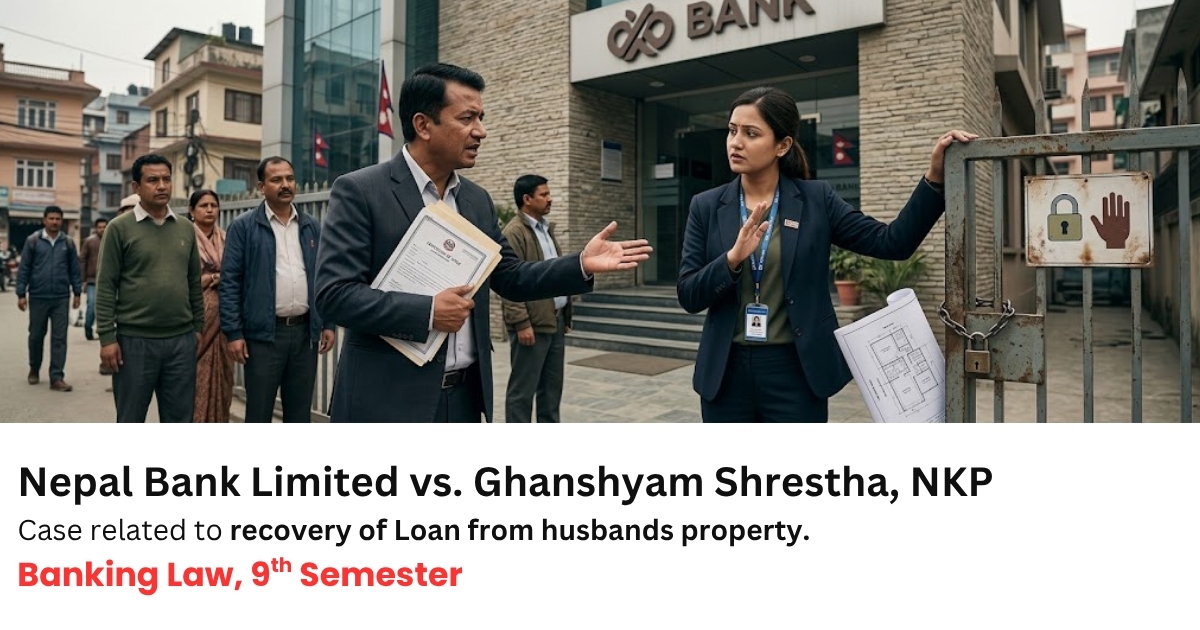
Banking Law Case: Nepal Bank Limited vs. Ghanshyam Shrestha, NKP (2063) No.5, P.582.
Case: Appeal against Mandamus Order
Plaintiff/Applicant: Nepal Bank Limited, City Office, Dharan
Defendant/Respondent: Ghanshyam Shrestha
Decision Number: 7697
This case concerns whether a bank could freeze a husband’s individually-owned property to secure recovery of a loan taken by his wife’s separate business, without his consent or a prior hearing.
Facts of the Case:
Ghanshyam Shrestha owned Kitta No. 84 in his own name. When he went to sell the property, he found that the bank had placed a hold on it to recover a loan taken by Purwanchal Beet Board, a business registered in his wife Chandrika Shrestha’s name.
Chandrika had mortgaged her own properties as security for the business loan. However, the bank also placed a hold on
Ghanshyam’s Kitta No. 84, even though he was not a borrower, partner, or guarantor and had never pledged his property as security.
Ghanshyam asked the bank to release the hold, but the bank refused. He therefore filed a petition seeking mandamus to direct the bank to release the hold on his property.
Legal Issues:
- Whether the bank could hold property belonging to a non-borrower who had not pledged it as security.
- Whether the bank must first recover the loan from the mortgaged property.
- Whether Shrestha had a right to be heard before his property was held.
- Whether the Appellate Court was right to release the hold on Kitta No. 84.
Different Courts’ Decision:
Biratnagar Appellate Court:
The Appellate Court, Biratnagar, held that the bank had not first asked the borrower to provide additional security as required by Section 47(a)(2) of the Commercial Bank Act, 2031. Instead, it placed a hold on her husband’s separately registered property. The Court therefore found the action unlawful and ordered the release of the hold on Kitta No. 84.
Supreme Court:
The Court found that the bank had not asked Chandrika Shrestha to provide additional security before placing a hold on her husband Ghanshyam Shrestha’s property. Ghanshyam had also never consented to pledge his property as security for the loan.
The Court further held that the bank had not given Ghanshyam an opportunity to be heard before placing the hold on his property. It also had not first taken steps to recover the loan from the property actually mortgaged by Chandrika.
Therefore, the Court held that the bank’s action was unlawful and upheld the order to release the hold on Kitta No. 84.
Principle Established:
- A bank must first recover the loan from the property actually mortgaged by the borrower.
- A person’s property cannot be held for someone else’s loan without their consent.
- A property owner must be given an opportunity to be heard before their property is held for another person’s debt.
- Living with the borrower or signing as a witness does not mean that a person has consented to pledge their own property as security.