
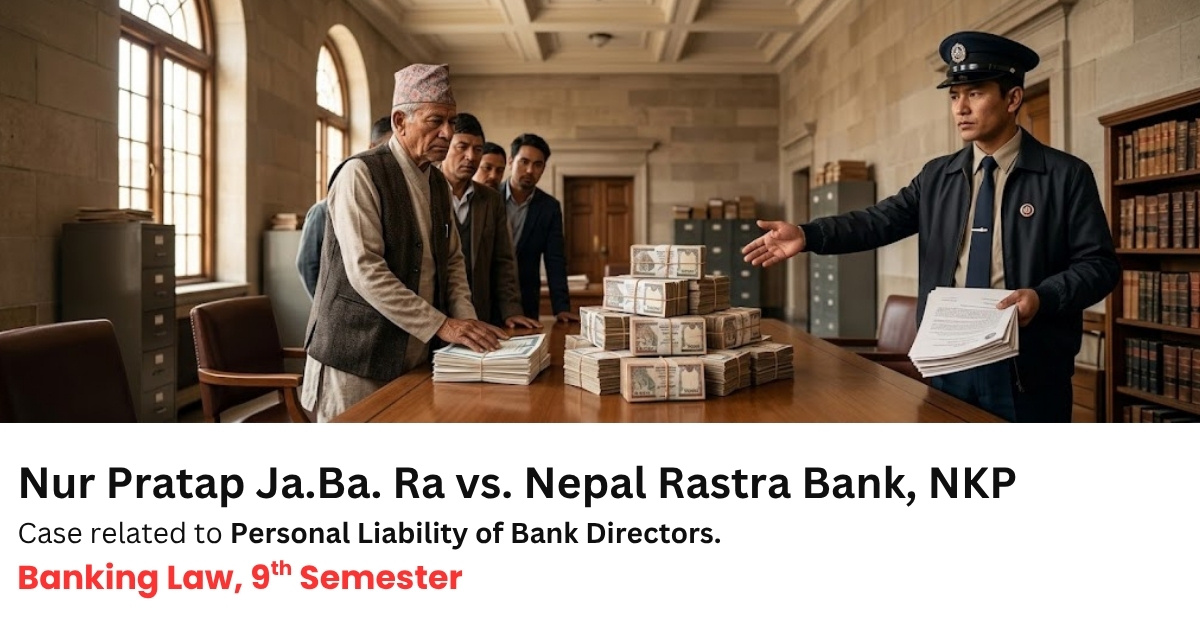
Banking Law Case: Nur Pratap Ja.Ba.Ra vs. Nepal Rastra Bank, NKP (2064), No. 11, P. 1451.
Case: Certiorari and Prohibition
Plaintiff/Applicant: Nur Pratap J.B. Rana
Defendant/Respondent: Nepal Rastra Bank and others
Decision Number: 7899
This case is about whether Nepal Rastra Bank could order a bank’s directors to personally pay back a large “pre-operating expense” that had earlier been turned into shares, because the expense had no supporting bills.
Facts of the Case:
Nur Pratap J.B. Rana was a founder shareholder and Chairman of Kumari Bank. Before the bank started operations, the founder shareholders spent about NPR 1.5 crore on setting up the bank.
The bank later treated this amount as a pre-operating expense and issued shares to the shareholders who had paid it. The decision was approved by the bank’s AGM and was repeatedly reflected in its reports and audited accounts, which were also reviewed by Nepal Rastra Bank.
Later, Nepal Rastra Bank directed the bank to return the NPR 1.5 crore in cash, stating that the amount could not be converted into shares as a pre-operating expense.
Rana argued that Nepal Rastra Bank had already accepted the expense several times and could not later reverse its position. He also argued that share allocation was a company-law matter, not something Nepal Rastra Bank could interfere with.
Nepal Rastra Bank argued that it had the legal authority to regulate and supervise banks and that the expense could not be recognized without proper supporting documents.
Legal Issues:
- Could Nepal Rastra Bank regulate a pre-operating expense approved before the Nepal Rastra Bank Act, 2058?
- Could Nepal Rastra Bank question and recover an expense already approved by the bank’s Board and AGM?
- Does internal approval make an expense without supporting documents legally valid?
- Should the Nepal Rastra Bank’s directive be cancelled?
Supreme Court’s Decision:
The Supreme Court dismissed the writ petition and upheld Nepal Rastra Bank’s directive. It held that Nepal Rastra Bank had the authority to examine the pre-operating expense even though it arose before the Nepal Rastra Bank Act, 2058, as its regulatory and supervisory powers continued under the new law.
The Court found that the NPR 1,50,31,705 expense had no supporting bills or receipts. Approval by Kumari Bank’s Board and AGM alone could not make an unsupported expense legally valid. As the central bank, Nepal Rastra Bank could inspect the bank’s financial records and issue directions regarding its income and expenditure.
Since Rana could not show how the amount was actually spent, the Court held that Nepal Rastra Bank was justified in directing the directors to return the amount in cash. The directive was therefore lawful, and the writ petition was dismissed.
Principle Established:
- Nepal Rastra Bank’s regulatory powers continue under the new Act, including for matters arising under the earlier law.
- Nepal Rastra Bank has authority to regulate, inspect, supervise, and direct banks regarding their financial activities.
- A bank’s Board or General Assembly cannot override Nepal Rastra Bank’s legal authority through internal approval.
- An expense without proper bills or receipts is not legally valid merely because it was approved by the Board or shareholders.