
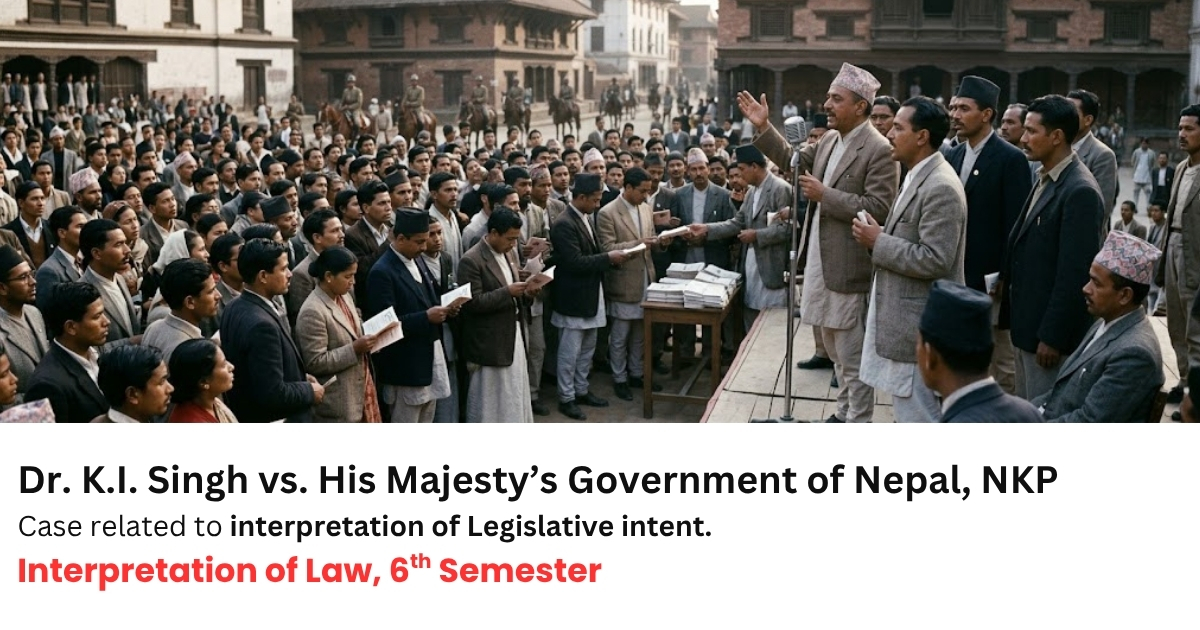
Interpretation of Law Case: Dr. K.I. Singh vs. His Majesty’s Government of Nepal, NKP 2022 B.S, Vol: 3, DN: 279.
Case: Offenses Against the State (Causing Hatred, Malice and Contempt)
Plaintiff: His Majesty’s Government
Respondent: Ex PM Dr. K.I. Singh and Keshav Chandra Gautam
Decision Number: 279
This case is related to offences against the State and the interpretation of legislative intent in determining whether public criticism of the Government falls within the offence of creating hatred, malice and contempt against the State.
Facts of the Case:
The government authorities searched the residence of former Prime Minister Dr. K.I. Singh on Falgun 26, 2020 B.S., during which they found and seized press statements as well as printed pamphlets that called for a “nationwide non-violent satyagraha” (civil disobedience movement). The pamphlets had criticized the Government for violating democratic principles, raised several political demands, and called upon the public to join a peaceful collective movement. Likewise, On Falgun 30, 2020 B.S., coinciding with Ghode Jatra, Dr. Singh publicly distributed the pamphlets and delivered a speech at Bhugol Park, Kathmandu. He later confirmed these actions in a written statement. Co-defendant Keshav Chandra Gautam also distributed the pamphlets and delivered a supporting speech, endorsing Dr. Singh’s statements and political demands.
Following these activities, the Government initiated legal proceedings against both individuals, alleging that their speeches and distribution of pamphlets were intended to create hatred, malice, and contempt against the Government under Section 6 of the Rajkaj (Offences and Punishments) Act, 2019. In his defense, Dr. Singh stated that his actions were an exercise of peaceful political expression intended to pressure the Government for policy reform, and that a call for non-violent movement was not equivalent to inciting hatred or sedition against the State.
Legal Issues:
- Whether the Special Court was legally constituted and had jurisdiction to hear the case.
- To what extent could freedom of speech and publication under the Constitution be restricted?
- Whether Dr. K.I. Singh’s pamphlets and press statement amounted to creating hatred, malice or disaffection against the Government under Section 6 (2) of the Rajkaj (Offences and Punishment) Act.
- Whether merely supporting or agreeing with Dr. K.I. Singh’s views was sufficient to establish criminal liability against Keshav Chandra Gautam.
Different Courts Decisions:
Special Court:
The Special Court held that the actions of the defendants amounted to an offense against the state. It found Dr. K.I. Singh guilty and sentenced him to 2 years in prison and imposed a fine of Rs. 2,000. It also found co-defendant Keshav Chandra Gautam guilty and sentenced him to 1 year in prison along with a fine of Rs. 500.
Supreme Court:
The Supreme Court upheld the jurisdiction and constitutional validity of the Special Court, ruling that minor procedural errors in its formation did not invalidate its authority. Furthermore, the Court interpreted that the Constitution allows the state to enact laws restricting freedom of speech and expression if done for the public interest.
Consequently, the Supreme Court affirmed that Dr. K.I. Singh’s pamphlets and statements constituted offenses of hatred and contempt against the government under the Rajkaj Act, and it upheld his conviction and sentence. Regarding Keshav Chandra Gautam, the Court held that his actions in distributing the pamphlets and giving speeches in support of Dr. Singh also established his criminal liability, thus upholding his conviction and sentence as well.
Principles Established:
- A court’s decision will not be declared void due to minor procedural defects or clerical errors if there is no fundamental defect in its formation or the court’s jurisdiction.
- When interpreting phrases like “complaints made or to be made” under Section 3(1) of the Special Court Act, the law must be construed to cover prospective or future complaints, rather than being strictly restricted to existing ones.
- Fundamental rights, such as Article 11 (2) rights (freedom of speech and expression), are subject to restrictions imposed by law under Article 17, allowing the legislature to regulate these rights in the interest of the general public.
- The failure to strictly follow a procedural provision does not invalidate a case unless it causes actual harm or hindrance to the administration of justice