
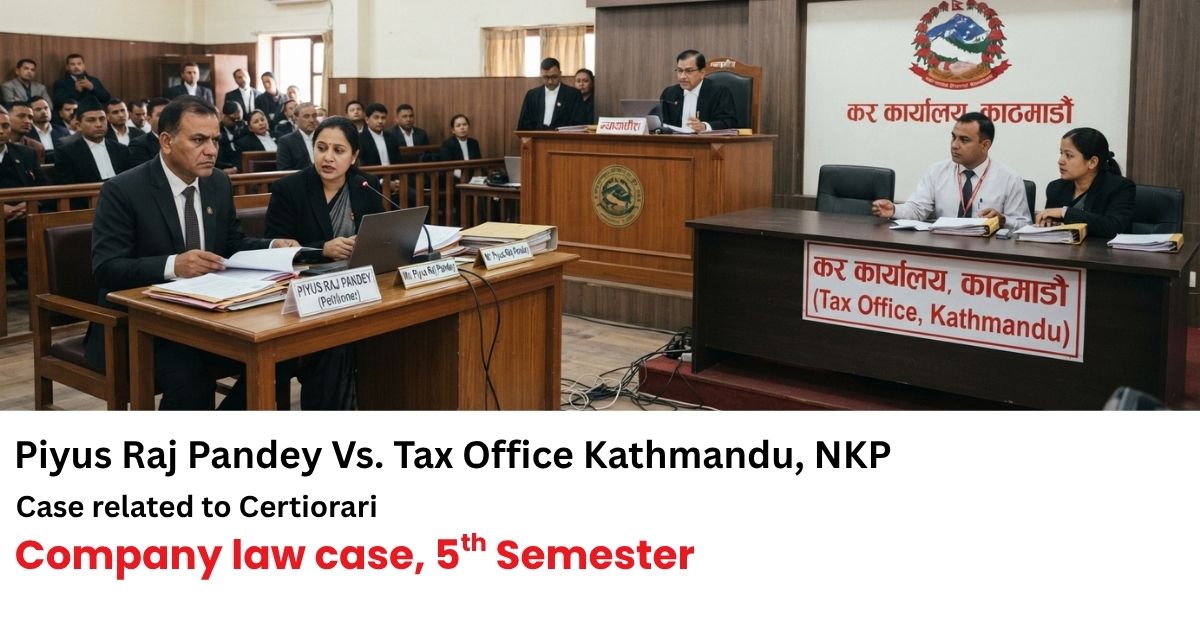
Company Law Case: Piyus Raj Pandey Vs. Tax Office Kathmandu, NKP, 2040, No. 12, P. 901.
Case: Certiorari
Petitioner: Piyus Raj Pandey, resident of Raktakali, Kathmandu
Respondents: Tax Office, Kathmandu and others
Decision No: 1857
This case is related to registration of immovable property for recovery of tax owed by a separate private limited company
Facts of the Case:
Nepal Petroleum Company Pvt. Ltd. was a company registered under Section 7 of the Companies Act, 2021. It was a separate legal entity with its own property and liabilities. The company had failed to pay income tax within the prescribed period. The Income Tax Settlement Commission had determined that tax amounting to Rs. 5,40,000/- was payable for the relevant financial years, from 1965 A.D. to 1976 A.D. On 2038/05/08 BS, the company’s Managing Director, Piyus Raj Pandey, had agreed before the commission to pay the determined tax within 35 days. The agreed amount was not paid within the stipulated period. Consequently, the Tax Office, Kathmandu, issued a letter dated 2038/11/29 BS to the concerned Land Revenue Offices of Kathmandu, Lalitpur and Bhaktapur. The letter directed those offices to stop registration of immovable properties standing in the names of Piyus Raj Pandey, his wife Prem Kumari Pandey, and his sons, until further notice.The Tax Office justified this action on the ground that the company had failed to pay its outstanding income tax. Piyus Raj Pandey challenged this action before Supreme Court. He argued that the tax liability belonged to Nepal Petroleum Company Pvt. Ltd, not to him personally or to his family members. He further argued that the company was a separate legal person and that the law did not permit the Tax Office to use the company’s tax liability as a basis for stopping registration of the personal immovable properties of its Managing Director and family. He therefore requested Supreme Court to issue an appropriate writ, including certiorari, and cancel the unlawful order of the Tax Office.
Petitioner’s Claim:
Petitioner claimed that, Nepal Petroleum Company Pvt. Ltd. was a company registered under the Companies Act and therefore had its own separate legal personality. The company’s tax liability could not automatically become the personal liability of its Managing Director Also claimed that his personal property, and properties of his wife and sons, could not be stopped or restricted merely because the company had failed to pay tax. Being the Managing Director of the company did not mean that all company liabilities became his personal liabilities. According to petitioner, Section 37(3) of the Income Tax Act, 2031 did not give the Tax Office unlimited authority to stop registration of personal immovable property. He claimed that the unlawful restriction affected his constitutional rights relating to equality, property and freedom. Therefore, he requested Supreme Court to quash the Tax Office’s order through certiorari.
Respondent’s Arguments:
The Tax Office argued that, Nepal Petroleum Company Pvt. Ltd. had failed to pay Rs. 5,40,000/- in income tax. The Managing Director, Piyus Raj Pandey, had himself agreed before the Income Tax Settlement Commission to pay the tax within 35 days. Since the amount was not paid, the Tax Office was entitled to take steps for recovery under Section 37 of the Income Tax Act, 2031. Piyus Raj Pandey was the main person behind the company and the company was operated with him and his family as shareholders. The Tax Office therefore argued that stopping the property from registration was a lawful step to secure recovery of the outstanding tax. The Land Revenue Office, Lalitpur also argued that where government revenue remained unpaid, property could be restricted during the recovery process. Thus, respondents requested that the writ petition be dismissed.
Legal Issues:
- Whether a company and its Managing Director are legally separate persons for the purpose of the company’s tax liability?
- Whether the Income Tax Act, 2031 authorized the Tax Office to stop registration of the immovable property of the company’s Managing Director and his family for recovery of the company’s tax?
Decision of the Court:
Supreme Court: Supreme Court held that the Tax Office had acted beyond its legal authority and quashed its order restricting registration of the petitioner’s and his family’s immovable property it held that Nepal Petroleum Company Pvt. Ltd. was a separate legal entity from its Managing Director, Piyus Raj Pandey. Therefore, the company’s tax liability could not automatically be enforced against the Managing Director’s or his family’s personal property and the provision of the Income Tax Act, 2031 did not authorize the Tax Office to stop registration of the personal immovable property of the Managing Director and his family for the company’s tax liability.
Established Principles:
- A registered company is a separate legal person from its shareholders, directors and Managing Director. Therefore, the company’s debts and liabilities are ordinarily the liabilities of the company itself.
- A company has its own property, separate from the personal property of its directors. Therefore, the personal property of the Managing Director cannot ordinarily be treated as company property merely because he manages the company.
- A private limited company has the characteristic of limited liability. The fact that a person is a Managing Director does not by itself make him personally liable for all debts and taxes of the company.
- Immovable property cannot be restricted without legal authority.
- The Managing Director’s personal property cannot be attached or restricted merely because the company has outstanding tax. There must be specific legal authority making the director personally liable.
Legal Doctrines:
- Doctrine of Corporate Personality: Once incorporated, a company obtains its own legal identity. It can own property, incur debts, enter contracts, sue and be sued, independently of its members and directors.
- Doctrine of Ultra Vires / Acting Beyond Legal Authority: An authority must remain within the powers granted by statute. If a tax officer exercises a power that the statute does not provide, the action is ultra vires.