

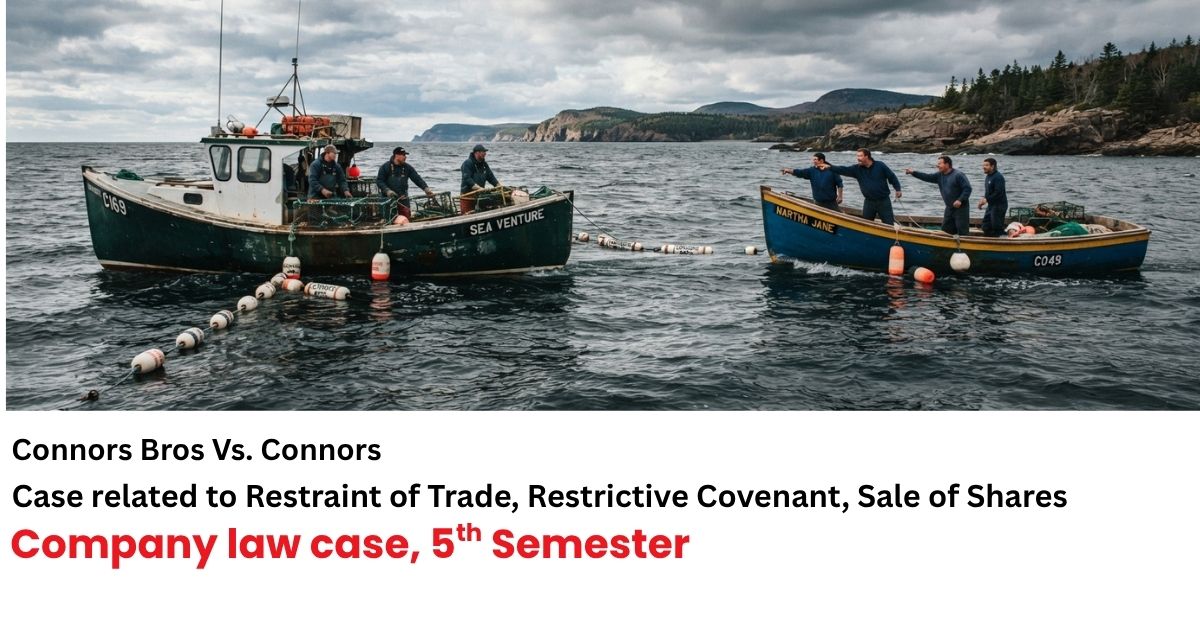
Company Law Case: Connors Bros Vs. Connors (1940) 4 AII E R 179 UK
Case: Contract, Restraint of Trade, Restrictive Covenant, Sale of Shares, Goodwill.
Plaintiff: Bernard Connors
Defendant: Connors Bros., Ltd. and Lewis Connors & Sons, Ltd.
In the Privy Council appeal, Connors Bros., Ltd. and others were appellants and Bernard Connors was respondent.
Decision Number: [1939] S.C.R. 162 ; Supreme Court of Canada, [1940] 4 All E.R. 179 / [1940] UKPC 57; Privy Council
The case primarily concerns the enforceability of a restrictive covenant given by a shareholder in connection with the sale and acquisition of an interest in a sardine business.
Facts of the Case:
Bernard Connors had been involved in the sardine business from an early age with his father and uncle. The original Connors family business was transferred to Connors Bros., Ltd., and Bernard later became involved in a competing business carried on by his father, himself and another family member, which was incorporated in 1924 as Lewis Connors and Sons, Ltd. Connors Bros., Ltd. subsequently faced serious competition from this business. In 1925, negotiations took place between the competing interests and an option agreement was entered into on 30 April 1925. Under the subsequent agreement of 9 June 1925, Connors Bros., Ltd. acquired an interest in Lewis Connors and Sons, Ltd., and agreed to purchase the remaining outstanding shares from the shareholders upon demand within the specified period. Bernard Connors also agreed to a restrictive covenant under which he would not directly or indirectly engage in any other sardine business in the Dominion of Canada and would not use the brands of Connors Bros., Ltd. or Lewis Connors and Sons, Ltd., and would not use the name “Connors” in connection with the sardine business for ten years from 30 April 1925. Bernard was also employed as manager of Lewis Connors and Sons, Ltd. Subsequently, disputes arose between Bernard and the companies. On 2 October 1926, Bernard sold his 172 shares in Lewis Connors and Sons, Ltd. to Connors Bros., Ltd. for $11,416, and his employment was terminated by mutual consent. The 1926 agreement contained substantially the same restrictive covenant. Bernard thereafter carried on other fish businesses but did not engage in the sardine business. In 1937, Bernard informed respondents that he considered the restrictive covenants unenforceable and wished to engage in the sardine business in Canada or elsewhere. Respondents refused to release him and maintained that the covenants were legally binding. Bernard therefore commenced proceedings by originating summons seeking determination of his rights under the covenants. The New Brunswick courts upheld the restriction, but the Supreme Court of Canada, by a majority, declared the principal restraint unenforceable. Connors Bros., Ltd. and the others then appealed to the Privy Council.
Plaintiff’s Claim:
Bernard Connors claimed that the restrictive covenant preventing him from engaging directly or indirectly in any sardine business in Canada was an unreasonable restraint of trade and therefore unenforceable. He sought a determination of whether he was prohibited from engaging in the sardine business as an owner, prohibited from engaging in it as a partner, prohibited from engaging in it as a shareholder of an incorporated company, prohibited from working in the business as an employee or entitled to use the name “Connors” in connection with the sardine business.
Defendant’s Arguments:
The respondents argued that the covenant was connected with the sale and acquisition of shares and the goodwill of the business and was therefore not merely a covenant in gross. They argued that the restriction was reasonably necessary to protect the interest acquired by Connors Bros., Ltd. in Lewis Connors and Sons, Ltd. They also contended that the circumstances of the transaction justified the restriction and that it did not constitute an unreasonable or injurious restraint of trade. Before the Privy Council, the appellants maintained that the covenant was a reasonable protection of the shares purchased by Connors Bros., Ltd.
Legal Issues:
- Whether the restrictive covenant preventing Bernard Connors from directly or indirectly engaging in any sardine business in Canada was enforceable as a reasonable restraint of trade connected with the acquisition of shares and goodwill of the business?
- Whether the covenant prevented Bernard from engaging in the business as an owner, partner, shareholder, or employee, and whether he could use the name “Connors.”?
Decision of Courts:
Supreme Court of New Brunswick: The Chief Justice held that Bernard Connors was barred from engaging in the sardine business in Canada as contemplated by Question (a), declined to answer Question (b), and held that he could not use the name “Connors” in connection with the sardine business.
The Appeal Division affirmed the decision.
Supreme Court of Canada: The Supreme Court of Canada, by a 3–2 majority, allowed Bernard Connors’ appeal. The majority held that the covenant preventing him from engaging directly or indirectly in any sardine business in Canada was unenforceable because respondents had failed to establish that such a broad restriction was reasonably necessary for the protection of the business acquired. The Court therefore set aside the judgments below and declared the covenant unenforceable to that extent. Crocket J. and Kerwin J. dissented.
Privy Council [1940] UKPC 57: The Privy Council allowed the appeal from the Supreme Court of Canada to the extent specified by it. It held that the covenant contained in the 9 June 1925 agreement was binding as a reasonable protection of the shares purchased by Connors Bros., Ltd. in Lewis Connors and Sons, Ltd. The Privy Council declared that Bernard Connors was: barred from engaging in the sardine business in Canada as owner by himself or in partnership with others. The Privy Council ordered Bernard Connors to pay the appellants’ costs both in the Privy Council and below.
Established Principles:
- A restraint-of-trade covenant is prima facie invalid: A covenant restricting a person’s freedom to carry on trade is generally prima facie invalid, unless special circumstances justify it.
- A restrictive covenant may be valid when connected with the sale of a business or shares: A covenant given in connection with the sale or acquisition of a business interest or shares may be enforceable where it is reasonably necessary to protect the interest acquired.
- Severable parts of a covenant may be treated differently: The Privy Council regarded the three parts of the covenant as severable because they dealt with different matters: restriction on engaging in the sardine business, restriction on using the companies’ brands, and the time-limited restriction on using the name “Connors.”
- Final principle established by the Privy Council: A restrictive covenant given in connection with the acquisition of shares may be enforceable where it constitutes reasonable protection for the interest acquired, even though it restricts the covenant from competing with the business.