
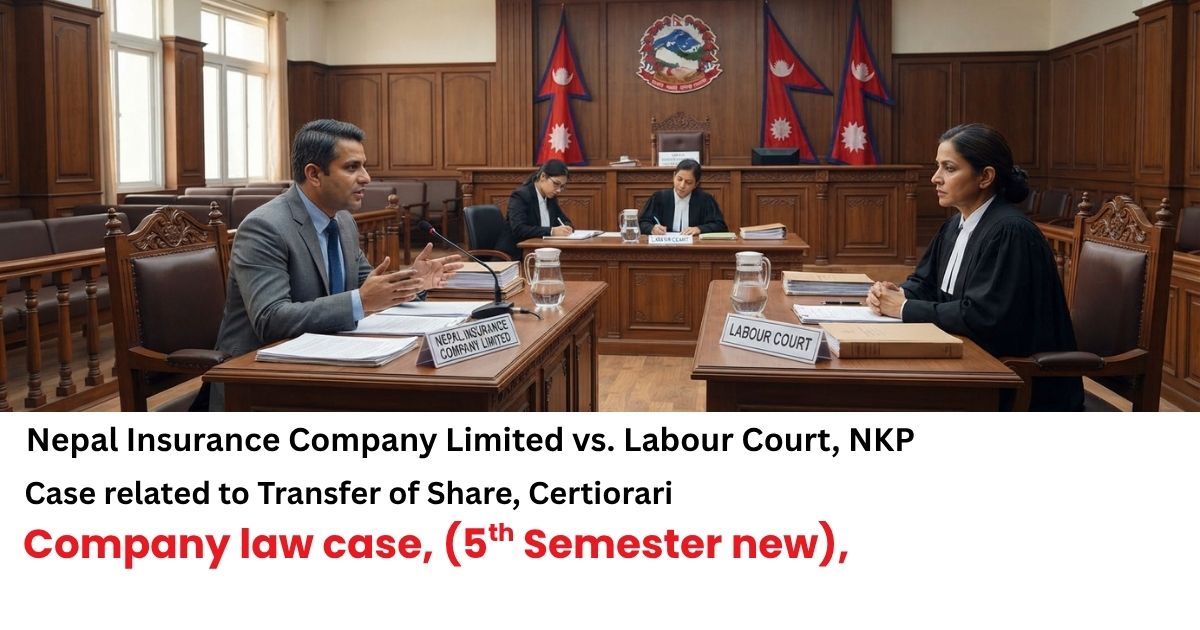
Company Law Case: Nepal Insurance Company Limited vs. Labour Court, NKP 2072 B.S, Vol.5, Pages 856
Case: Transfer of Share, Certiorari
Petitioner: Nepal Insurance Company Ltd.,
Respondent: Labour Court, Kathmandu & Others,
Decision No: 9402
This case is related to retired productivity award of labours.
Facts of the Case:
Nepal Insurance Company’s Employee Regulation, 2063, Rule 4(11) provided for a productivity award equal to 25% of the marginal increase in profit. During FY 2065/066, the Company earned Rs. 7,61,03,840.72/- from the sale of NCC Bank shares. On 5 Magh 2065, the Company amended Rule 4(11) and excluded income from the sale of shares and other investments from the calculation of productivity awards. Nineteen employees who later took voluntary retirement claimed that they were entitled to the productivity award because they had worked during FY 2065/066 when the income was earned. The Labour Office, Bagmati Zone, ordered the Company to distribute 25% of the disputed profit among them, and the Labour Court upheld that decision. The Company then filed a writ petition before the Supreme Court.
Petitioner’s Claim:
The Company argued that income from the sale of shares was investment/capital-related income, not income from insurance business. It also argued that its employees were governed by its own Employee Regulation and that Rule 4(11) had been lawfully amended by the Board of Directors. Since the amendment had not been challenged or invalidated, the Labour Office and Labour Court could not disregard it. The Company further argued that Section 73(5) of the Labour Act, 2048 did not provide jurisdiction to decide this dispute.
Respondents’ Arguments:
The retired employees argued that the productivity award was a benefit provided by Rule 4(11) and that they had worked throughout FY 2065/066. They claimed that the Company had earned the disputed profit during their service period and had previously provided similar awards from profits earned through share sales. They argued that the amendment made during the financial year was intended to deprive them of their existing benefit and therefore should not prevent their claim.
Legal Issues:
- Whether income from the sale of shares could be treated as marginal increase in profit for calculating the productivity award?
- Whether the 19 retired employees were entitled to claim the productivity award from such income?
- Whether Section 73(5) of the Labour Act, 2048 was applicable to the dispute?
- Whether the Labour Office and Labour Court committed a jurisdictional error in ordering payment of the productivity award?
- Whether their decisions should be quashed by a writ of certiorari?
Decision of the Courts
Supreme Court: The Supreme Court allowed the writ petition and quashed the decision of the Labour Office, Bagmati Zone, dated 2067/9/13 BS and the Labour Court’s decision dated 2068/8/14 BS. The Court held that income from the sale of shares was related to the Company’s capital investment and could not be treated as income from its insurance business. Under the amended Rule 4(11), such income was excluded from the calculation of the productivity award. The amendment remained valid because it had not been challenged or invalidated. The Court also held that the retired employees could not obtain the disputed benefit through the Labour Act when the relevant provision was not applicable. Most importantly, the Labour Office had exercised jurisdiction under Section 73(5) of the Labour Act even though the provision did not apply to the dispute. Therefore, there was a jurisdictional error, and the decisions of both the Labour Office and Labour Court were quashed by certiorari.
Established Principles:
- Income from the sale of shares is capital related income and cannot automatically be treated as income from insurance business.
- Share sale proceeds cannot be included in marginal increase in profit for calculating a productivity award where the applicable employee regulation excludes such investment income.
- A valid amendment to an employee regulation remains applicable unless it is successfully challenged and invalidated.
- Retired employees cannot invoke the Labour Act merely to claim a benefit that does not fall within its applicable provisions.
- A Labour Office or Labour Court cannot exercise jurisdiction under Section 73(5) of the Labour Act when the dispute itself does not fall within that provision.