
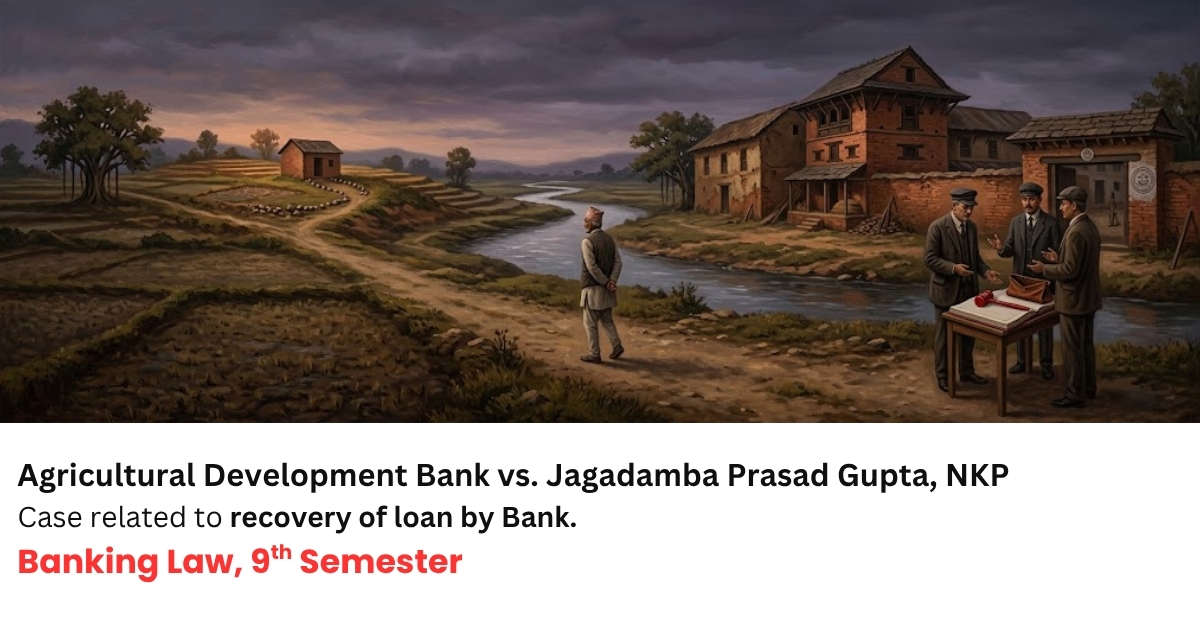
Banking Law Case: Agricultural Development Bank, Nepaljung vs. Jagadamba Prasad Gupta, NKP (2063), No. 4, P.531.
Case: Appeal against Injunction-cum-Mandamus Order
Plaintiff/Applicant: Agricultural Development Bank and others
Defendant/Respondent: Jagadamba Prasad Gupta
Decision Number: 7691
This case is about whether a bank could go after a man’s second house to recover the balance still owed on a loan.
Facts of the Case:
Jagadamba Prasad Gupta obtained several loans totaling NPR 7,93,000 from the Agricultural Development Bank, to operate a rice mill. He mortgaged the mill house and godown as security for the loans. The loan agreement also allowed the bank to recover any remaining amount from his other property if the mortgaged property was insufficient.
Gupta failed to repay the loans. The bank later auctioned the mortgaged property and took it over when no other bidder came forward. However, NPR 3,21,832.31 remained outstanding.
The bank then moved to auction Gupta’s other property, known as No. 22, to recover the remaining amount. Gupta challenged the proposed auction, claiming that the bank had not properly informed him of the outstanding amount and had not followed the required legal procedure.
He therefore sought an injunction to stop the auction and an order to release the hold on the property.
Legal Issues:
- Whether the bank could recover the remaining loan from the borrower’s other property.
- Whether the bank could auction the No. 22 property under Section 20(a) of the Agricultural Development Bank Act, 2024.
- Whether the Appellate Court was right to stop the auction and release the hold on the property.
Different Courts’ Decisions:
Nepalgunj Appellate Court:
The Appellate Court, Nepalgunj, held that the bank had unlawfully auctioned and placed a hold on the No. 22 property without proper notice and procedure. It therefore stopped the auction and ordered the release of the hold.
Supreme Court:
The Supreme Court found that Gupta had agreed in the loan documents that if the mortgaged property was insufficient to recover the loan, the bank could recover the remaining amount from his other property.
The Court also noted that Gupta had himself requested the bank to take the No. 22 property as additional security if the original mortgaged property was insufficient.
Under Section 20(a)(3) of the Agricultural Development Bank Act, 2024, the bank can recover the remaining loan from the borrower’s other property when the mortgaged property is not enough to cover the outstanding amount.
Since the original mortgaged property was insufficient to recover the full loan, the Court held that the bank’s attempt to auction the No. 22 property was lawful.
Therefore, the Supreme Court set aside the Appellate Court’s decision and dismissed Gupta’s petition.
Principle Established:
1. If the mortgaged property is not enough to recover the loan, the bank can auction the borrower’s other property to recover the remaining amount.
2. If the borrower has agreed in writing to this arrangement, the bank can recover the remaining loan from the agreed property.
3. A borrower’s written consent can allow the bank to recover the loan from property beyond the original mortgage.
.