
Banking Law Case: Arun Chand vs. Nepal Rastra Bank, NKP (2063), No. 11, P. 1434.
Case: Certiorari and Mandamus
Plaintiff/Applicant: Arun Chand on behalf of Wasuling Sugar & General Industries Ltd
Defendant/Respondent: Nepal Rastra Bank and others
Decision Number: 7785
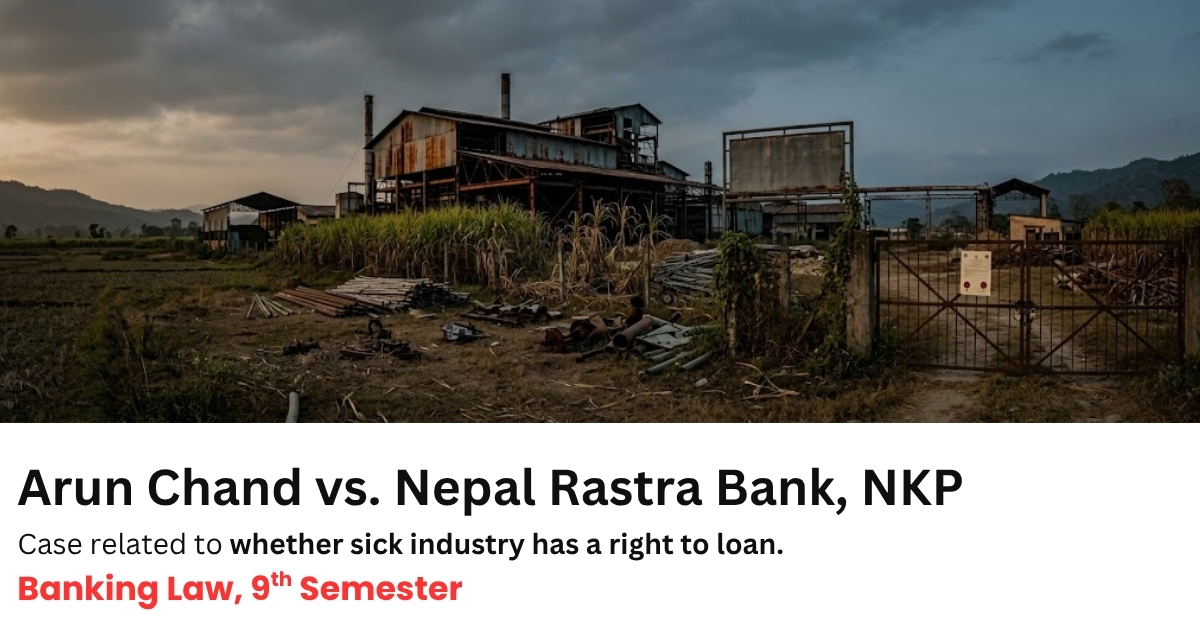
This case concerns whether a company declared a “sick industry” has a right to loan restructuring and whether the bank can still blacklist it for failing to repay the loan.
Facts of the Case:
Wasuling Sugar & General Industries Ltd. was established in Kailali to produce sugar. To operate the industry, it took about NPR 57.43 crore in loans from several banks under a co-financing arrangement.
The company faced financial difficulties due to shortage of raw materials, delayed loan disbursement, insecurity, and other problems. As a result, it suffered losses and could not repay the loans on time. It repeatedly asked the banks to defer interest payments and restructure the loans.
The company was later officially recognized as a “sick industry” under the government’s sick-industry program. It therefore expected to receive the loan restructuring and other relief available to sick industries.
However, the banks later required the company to pay 25% of the outstanding interest before restructuring the loan. The company considered this inconsistent with its sick-industry status. Around the same time, the company, its directors, and shareholders were blacklisted for loan default.
The company challenged the blacklisting, the refusal to provide sick-industry benefits, and the legal authority of the Credit Information Centre to blacklist borrowers.
Legal Issues:
- Whether a “sick industry” has a legal right to loan restructuring and concessions.
- Whether Regulations 3(1) and 4 of the Credit Information Regulations, 2059 were legally valid.
- Whether the company, its directors, and shareholders could be blacklisted despite its “sick industry” status.
- Whether the petitioner was entitled to the orders sought.
Supreme Court’s Decision:
The Supreme Court held that being recognized as a “sick industry” does not create an automatic legal right to loan restructuring or concessions. The banks had offered restructuring subject to certain conditions, including payment of 25% of the outstanding interest, but the company had not fulfilled those conditions. Therefore, the company could not claim restructuring as a legal right.
On the Credit Information Regulations, the Court found that Nepal Rastra Bank had the legal authority to establish and regulate a Credit Information Centre. The challenged regulations were therefore not beyond the authority given by the Nepal Rastra Bank Act, 2058.
The Court also held that blacklisting was lawful because the company had failed to repay its loan according to the agreed terms. Nepal Rastra Bank and the Credit Information Centre had the authority to blacklist defaulting borrowers.
Finally, the Court noted that repaying the loan is the borrower’s legal duty. Since a separate loan-recovery case was already pending before the Debt Recovery Tribunal, the company could not use the writ petition to obtain the restructuring and other relief it sought.
The writ petition was dismissed.
Principle Established:
- Loan restructuring or concessions are not legal rights unless provided by law; they remain subject to the lender’s discretion.
- A claim that a law or regulation is ultra vires must clearly show how it exceeds the legal authority granted.
- Company directors are responsible for the company’s obligations and cannot avoid responsibility for its loan default merely because the company has a separate legal identity.
- Under Section 88(1) of the Nepal Rastra Bank Act, 2058, a Credit Information Centre may lawfully blacklist borrowers who fail to repay their loans, even if the borrower is recognized as a “sick industry.”
- Where a loan-recovery case is already pending before the Debt Recovery Tribunal, the Court should not issue an order that interferes with that proceeding.