

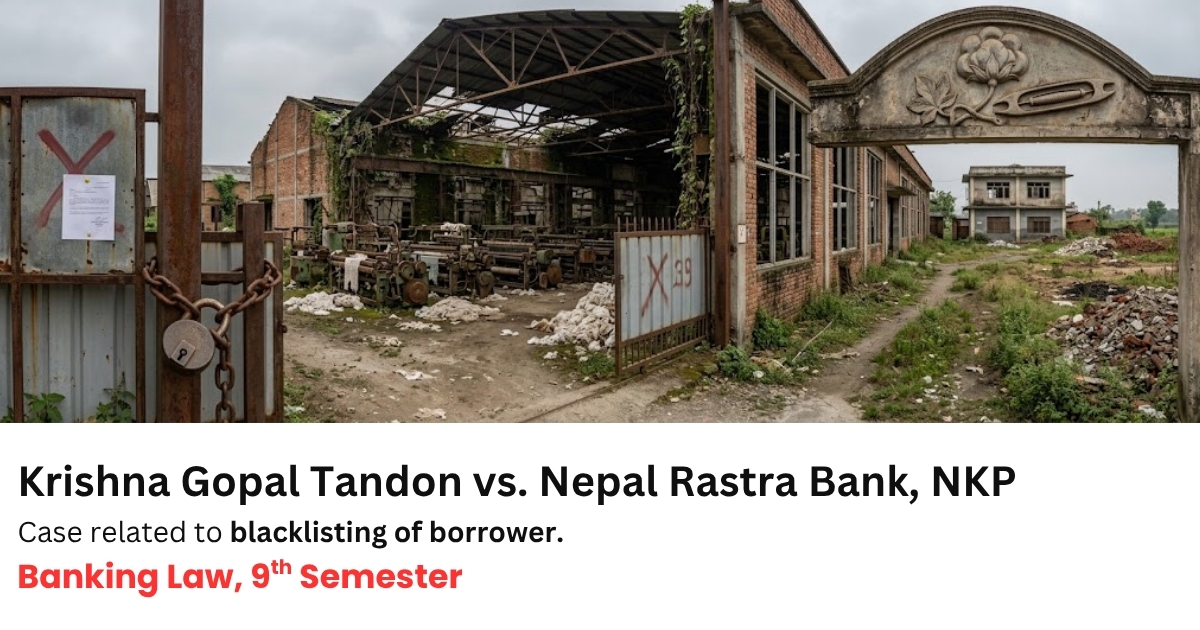
Banking Law Case: Krishna Gopal Tandon vs. Nepal Rastra Bank, NKP (2060), No. 11/12, P. 918.
Case: Certiorari and Related Writs
Plaintiff/Applicant: Krishna Gopal Tandon on behalf of Tandon Textile Pvt.
Defendant/Respondent: Nepal Rastra Bank, Kathmandu, and others
Decision Number: 7295
This case examines whether a bank can blacklist a borrower and its directors after taking over all mortgaged property and taking no further recovery action for years.
Facts of the Case:
Tandon Textile Pvt. Ltd. took a NPR 36,00,000 loan from Nepal Industrial Development Corporation to manufacture and sell terry towel cloth. The company mortgaged its machinery, equipment, land, and building as security for the loan.
The company later faced financial difficulties and failed to repay the loan as required. The Corporation eventually took possession of the company’s machinery, equipment, and other assets.
Several years later, Tandon Textile and its directors were blacklisted for defaulting on the loan. The Corporation stated that the blacklisting was based on a directive issued by Nepal Rastra Bank.
The petitioners argued that the law allowed the Corporation to auction or take over mortgaged property for loan recovery, but did not give it the power to blacklist borrowers or directors. They therefore challenged the blacklisting and the directive authorizing it.
Legal Issues:
- Whether Nepal Rastra Bank had legal authority to blacklist loan defaulters.
- Whether blacklisting is a punishment or an administrative banking measure.
- Whether blacklisting was lawful after the Corporation had already taken over the mortgaged property.
- Whether the blacklisting violated the petitioners’ constitutional rights.
Supreme Court’s Decision:
The Supreme Court partly allowed the petition.
The Court held that Nepal Rastra Bank had the legal authority to issue a directive on blacklisting loan defaulters under the Nepal Rastra Bank Act, 2012. Blacklisting was considered a legitimate banking practice for dealing with borrowers who failed to repay loans.
However, the Court ruled in Tandon Textile’s favor on the facts of the case. The Corporation had already taken possession of all the company’s mortgaged property after the loan default but then took no further recovery action for a long period.
The Court held that blacklisting the company and its directors years later, without sufficient justification, was unreasonable. The Court therefore cancelled the Corporation’s blacklisting decision and related actions.
Principle Established:
- Nepal Rastra Bank has authority to establish a blacklisting system under Section 22 of the Nepal Rastra Bank Act, 2012.
- Blacklisting a loan defaulter is a recognized banking practice, not an unlawful punishment by itself.
- Blacklisting must have a reasonable basis. After taking over the mortgaged property, a bank cannot remain inactive for years and later blacklist the borrower without sufficient reason.
- Financial institutions must properly manage mortgage security and take timely action when recovery problems arise.