

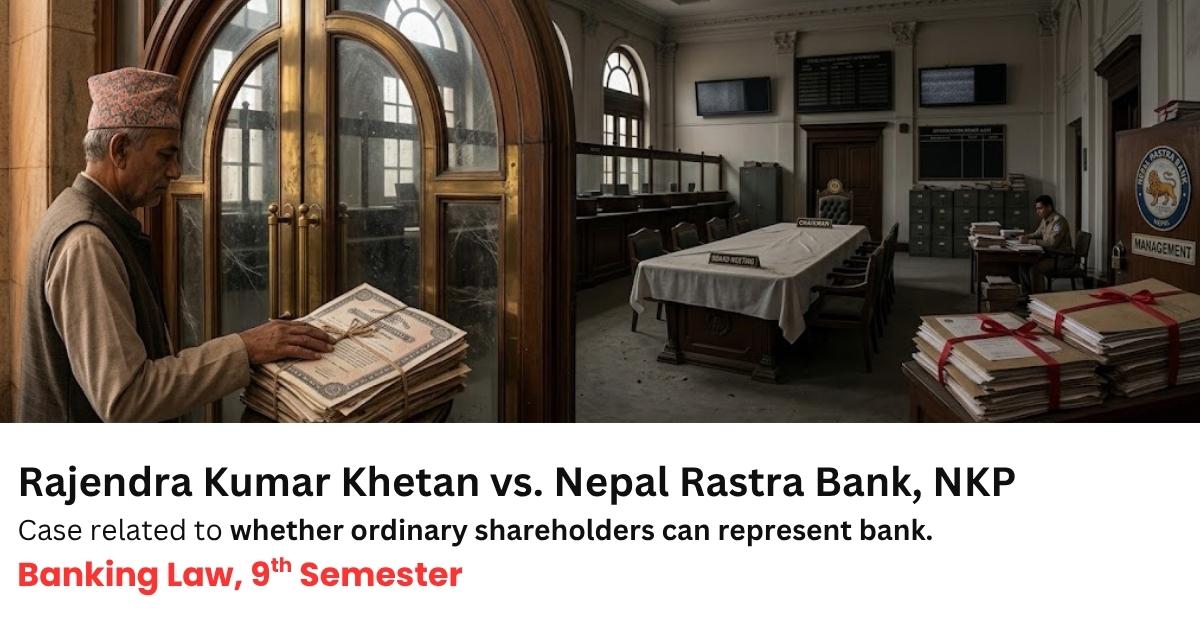
Banking Law Case: Rajendra Kumar Khetan vs. Nepal Rastra Bank, NKP (2065), No. 3, P.375.
Case: Certiorari-cum-Mandamus
Plaintiff/Applicant: Rajendra Kumar Khetan
Defendant/Respondent: Nepal Rastra Bank and others
Decision Number: 7949
This case asks whether an ordinary shareholder of a bank can go to court when the central bank takes over that bank’s management, and whether Nepal Rastra Bank’s takeover of Nepal Bank Limited was lawful.
Facts of the Case:
Rajendra Kumar Khetan purchased 172,725 ordinary shares of Nepal Bank Limited, each with a face value of NPR 100. Later, Nepal Rastra Bank suspended the bank’s Board of Directors and placed its management under other officials.
No Board meeting or required Annual General Meeting was held afterward, and the bank’s shares were delisted from the securities market. As a result, Khetan and other shareholders could not trade their shares or obtain proper information about the bank’s financial condition.
Khetan challenged these actions, claiming that they violated his legal and constitutional rights as a shareholder. He sought the restoration of the shareholders’ rights, including holding the AGM, electing a new Board of Directors, and relisting the bank’s shares for trading.
Legal Issues:
- Can an ordinary shareholder file the writ petition on behalf of the bank?
- Was Nepal Rastra Bank’s suspension of the bank’s Board and transfer of management lawful?
- Did the action violate the shareholder’s rights to equality, freedom, or property?
- Should the relief sought by the petitioner be granted?
Supreme Court’s Decision:
The Supreme Court held that a shareholder cannot represent the company or claim its property as their own. However, a shareholder can protect their own rights and interests. Since Khetan was a shareholder, he had the right to bring the petition.
The Court held that Nepal Rastra Bank lawfully suspended Nepal Bank’s Board and took control of its management. The bank was in serious financial trouble. The law allowed Nepal Rastra Bank to intervene to protect depositors and shareholders.
During the takeover, the appointed management could exercise the powers of the Board and General Meeting. Therefore, Khetan could not demand a new Board or General Meeting during that period.
However, Nepal Rastra Bank could not keep the bank under its control indefinitely without accountability. It had to regularly report the bank’s financial progress and the need for continued intervention. It also had to keep shareholders and depositors informed.
The Court therefore dismissed most of the petition but directed Nepal Rastra Bank to regularly publish progress reports and inform shareholders and depositors about the bank’s condition.
Principle Established:
- A shareholder cannot sue on behalf of the company, but can sue to protect their own rights and interests.
- In public-interest matters, courts may take a broader approach to locus standi.
- Under Section 86 of the Nepal Rastra Bank Act, 2058, Nepal Rastra Bank can suspend a troubled bank’s Board and take over its management to protect shareholders and depositors.
- The takeover cannot continue indefinitely without accountability. Nepal Rastra Bank must regularly report the bank’s progress and inform shareholders and depositors.