

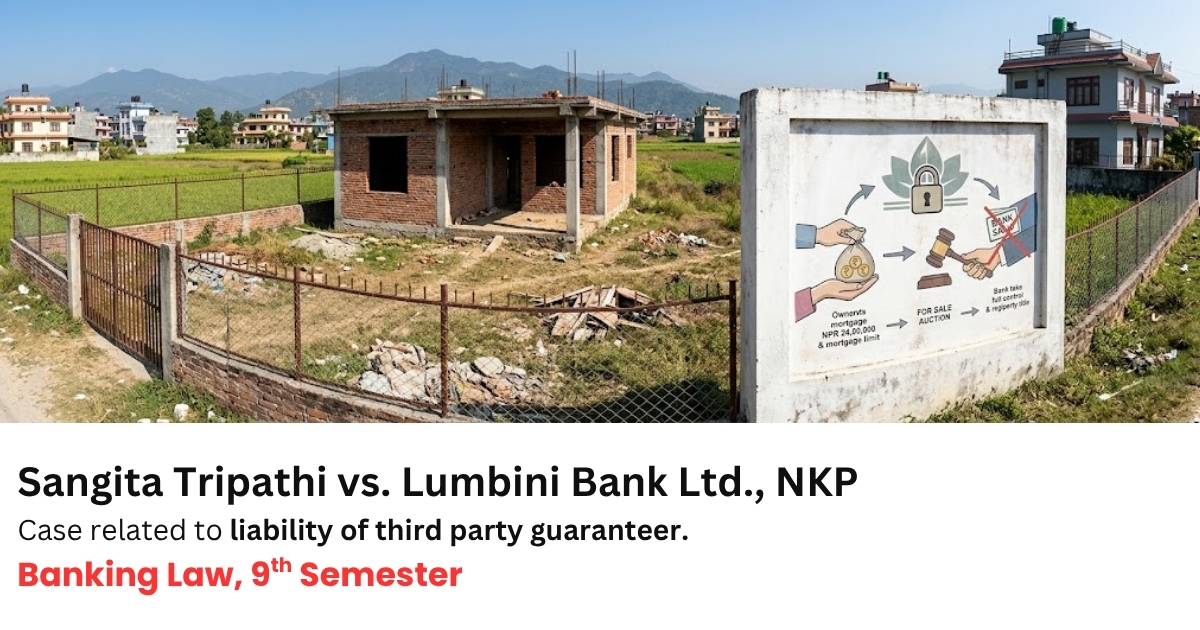
Banking Law Case: Sangita Tripathi vs. Lumbini Bank Ltd., NKP (2066), No. 3, P.499.
Case: Certiorari and Mandamus
Plaintiff/Applicant: Sangita Tripathi
Defendant/Respondent: Lumbini Bank Limited, Head Office, Chitwan, and others
Decision Number: 8107
This case concerns whether a third-party guarantor could be held liable beyond the mortgage value pledged, and whether a bank’s self-acquisition of the pledged property without proper notice or a genuine failed bidding process was lawful.
Facts of the Case:
Sangeeta Tripathi owned a piece of land in Kathmandu. She mortgaged the land for up to NPR 24,00,000 to help Harati Wire Industries Pvt. Ltd. obtain a loan from Lumbini Bank Limited. The company also mortgaged its factory land and machinery for the same loan.
The company later defaulted on the loan. The bank issued notices and put the mortgaged properties up for auction. When no one submitted a bid, the bank took over the property and registered it in its own name.
Tripathi claimed that the bank had not given her proper notice or an opportunity to repay the amount covered by her mortgage. She also argued that the loan period had not yet expired and that the bank had not followed the required legal procedure before taking over the property.
She therefore challenged the auction and transfer of her land and sought its release on payment of NPR 24,00,000, the amount secured by her mortgage.
Legal Issues:
- Whether Tripathi’s liability was limited to NPR 24,00,000 or extended to the borrower’s full debt.
- Whether the bank could take over the mortgaged property after a single failed auction.
- Whether the bank could reduce the property’s value without notifying Tripathi.
- Whether Tripathi should have used the District Court instead of filing a writ petition.
Decisions of court:
Supreme Court’s Decision:
The Court held that a third-party mortgagor’s liability is limited to the security they have provided. Since Tripathi had mortgaged her property for only NPR 24,00,000, she could not be held liable for the borrower’s entire outstanding debt.
The Court also held that under Section 57 of the Banks and Financial Institutions Ordinance, 2062, a bank cannot take over mortgaged property after only one failed auction. A second auction attempt was required before the bank could take over the property itself.
The Court further found that the bank had reduced the property’s value without proper notice to Tripathi. This violated the principles of natural justice and her property rights.
The Court therefore cancelled the bank’s decision to take over the property and its registration in the bank’s name. It ordered that Tripathi’s land be released once she paid NPR 24,00,000, the amount secured by her mortgage.
Principle Established:
- A third-party guarantor is liable only up to the amount or security agreed in the mortgage deed.
- A bank cannot later take a different position against a guarantor after admitting elsewhere that only the main borrower is liable for the remaining debt.
- A bank can take over mortgaged property only after the required second auction also fails.
- Taking over mortgaged property for more than the secured amount, without proper notice, violates the guarantor’s property rights.
- A bank cannot undervalue mortgaged property and take it over without notifying the person who pledged it.