

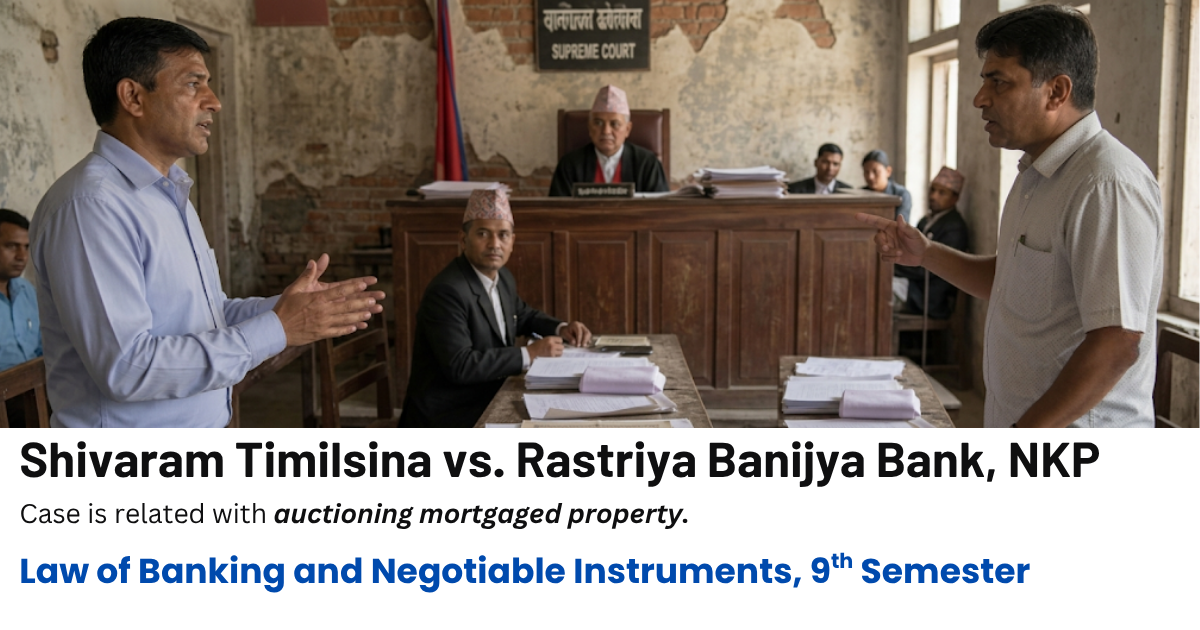
Banking Law Case: Shivaram Timilsina vs. Rastriya Banijya Bank, NKP 2058 B.S. No. 9/10, P.611, DN: 7043
Case: Writ of Mandamus (Property/Banking Dispute)
Plaintiff/Applicant: Shivaram Timilsina
Defendant/Respondent: Rastriya Banijya Bank, Central Office, Ramshah path, Kathmandu (and Thapathali Branch Office)
Decision Number: 7043
This case concerns whether a bank could proceed with auctioning mortgaged property while a separate court case about ownership of that same property was still pending.
Facts of the Case:
Shivaram Timilsina, proprietor of Jaya Shree Mahalaxmi Enterprises, took a business loan of NPR 700,000 (7 lakhs) from Rastriya Banijya Bank’s Thapathali Branch in 2053 B.S. The loan was for a term of one year. As security for the loan, he pledged house and land registered in the name of his wife, Savitri Timilsina, situated in Ward No. 22, Kathmandu.
After the loan was taken, a dispute arose over ownership and possession of the pledged property. This dispute developed into litigation, first before the Patan Appellate Court and later before the Supreme Court. Timilsina informed the bank about this pending dispute.
Despite this, Timilsina failed to repay the loan within the agreed one year term. Citing the unpaid loan, the bank published an auction notice for the pledged property in Kantipur Daily on 2056/8/26.
Timilsina then filed a writ petition before the Supreme Court, seeking a writ of mandamus to restrain the bank from auctioning the property until the ownership dispute was finally resolved. He argued that proceeding with the auction while the property’s title remained sub judice violated his property rights under Article 17 of the Constitution of Nepal, 2047, and Section 9 of the Civil Rights Act, 2012 (2012 B.S.). Along with the writ, he sought an interim order to halt the auction, which the Court granted, directing the bank to submit its response.
In its response, bank argued that the auction was lawful because the loan remained unpaid beyond the agreed one year term, and that the pending ownership dispute over the property was a private matter between Timilsina and the opposing claimant, for which the bank bore no responsibility. The bank maintained that it had complied with all applicable auction rules and requested the Court to dismiss the writ petition.
Legal Issues:
- Was it wrong for the bank to auction off the mortgaged property while a court case about that same property was still ongoing?
- Whether the petitioner’s constitutional right to property was violated by the bank’s auction notice.
- Whether a writ of mandamus should be issued to stop the auction until the pending case is resolved.
Supreme Court’s Decision:
Supreme Court (Joint Bench of Justice Bhairab Prasad Lamsal and Justice Gopal Prasad Khatri) held that the petitioner had voluntarily mortgaged the property to secure the loan and had not repaid within the agreed period. The petition did not clearly explain the pending case or how it related to the bank’s rights, and there was no indication the bank had knowledge of that litigation. Since the auction notice, issued after non payment and based on a validly executed mortgage deed, was not shown to be contrary to law, the Court held no order as sought could be issued. The petition was dismissed.
Principle Established:
- A pending, unrelated or vaguely described court case concerning mortgaged property does not automatically bar a bank from exercising its lawful right to auction that property for loan recovery.
- A petitioner seeking mandamus must clearly establish the connection between pending litigation and the respondent’s impugned action; vague references to a pending case are insufficient.
- Where a mortgage was voluntarily executed and the loan was not repaid within the agreed period, the bank’s action of publishing an auction notice does not violate the mortgagor’s constitutional right to property.
Relevancy of the Case:
This case is relevant to banking and secured transactions law, illustrating that a mortgagor cannot use an unrelated or unclearly connected pending litigation as a shield against a bank’s lawful recovery action.